

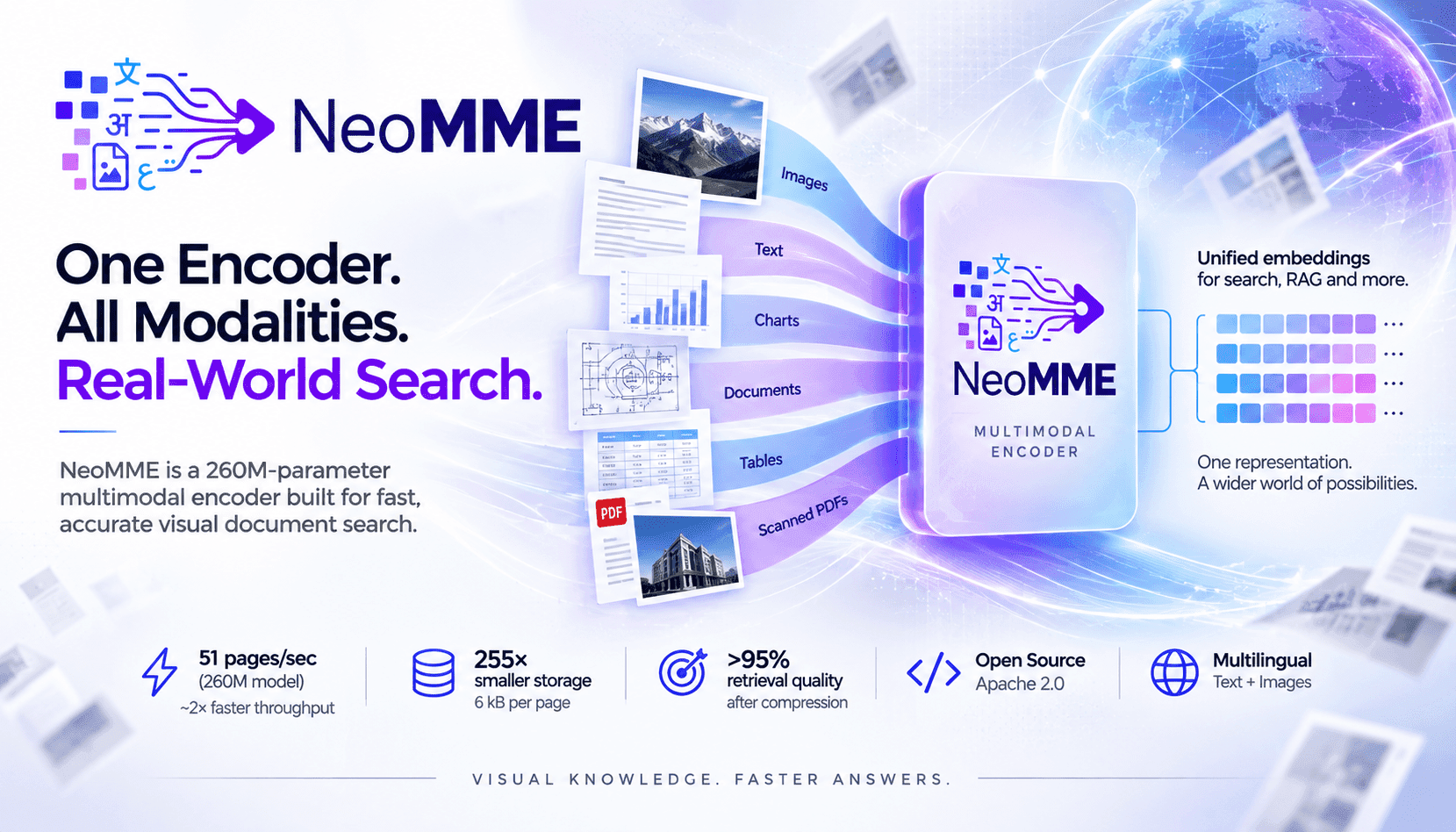
NeoMME’s core idea is architectural restraint in service of retrieval. A single bidirectional Transformer ingests multilingual text tokens alongside raw 32×32 image patches, dropping the separate vision tower and causal decoder common in VLM-style stacks. Trained from scratch with a masked denoising objective, the 260M variant returns dense and late‑interaction embeddings in one pass. In practice, that means fewer moving parts at inference, tighter latency budgets, and simpler scaling. On matched 2048×2048 inputs, the model encodes about 51 pages per second on an L40S—around twice the throughput of widely used visual document retrievers—while keeping retrieval quality competitive for real‑world search and RAG pipelines.
Why does this matter for enterprise search? Most document pipelines still depend on OCR to extract text chunks, then try to reconstruct a page’s layout semantics downstream. NeoMME flips that: it retrieves on page images directly, preserving tables, plots, and typography cues that OCR tends to flatten. The dual‑head design offers workflow flexibility: use dense vectors for fast recall via ANN, then apply late‑interaction to capture token‑to‑region matches without loading a second model. With a 16k context window, dynamic image resolution, and modern encoder features, NeoMME concentrates parameter budget where retrieval benefits most: long context, high‑resolution documents, and multilingual queries.
Late‑interaction accuracy historically came with a steep storage bill. High‑res pages can yield thousands of vectors per document and megabytes of per‑page index footprint. NeoMME mitigates this by combining hierarchical token pooling (to reduce the number of vectors) and asymmetric quantization (to compress document vectors more aggressively than queries). With measured configurations, footprint falls from roughly megabytes per page to tens of kilobytes—down to about 6 kB per page in a more aggressive setting—while retaining the vast majority of baseline retrieval quality. The takeaway: you can afford late‑interaction where it matters, even at scale, without breaking storage budgets.
For builders, the deployment calculus changes. Indexing speeds near 51 pages per second per GPU radically shorten time‑to‑search for large archives and reduce ongoing corpus refresh costs. One forward pass yields both dense and late‑interaction embeddings, so you can standardize your pipeline and defer trade‑offs to the index layer. Fine‑tune with Sentence Transformers for domain‑specific dense or late‑interaction heads, or keep the generalist checkpoint and rely on compression to balance cost and relevance. In visual RAG, retrieve page images first, then pass top‑k pages to a VLM only for answer generation—shifting most of the heavy lifting to a lean, retrieval‑native encoder.