

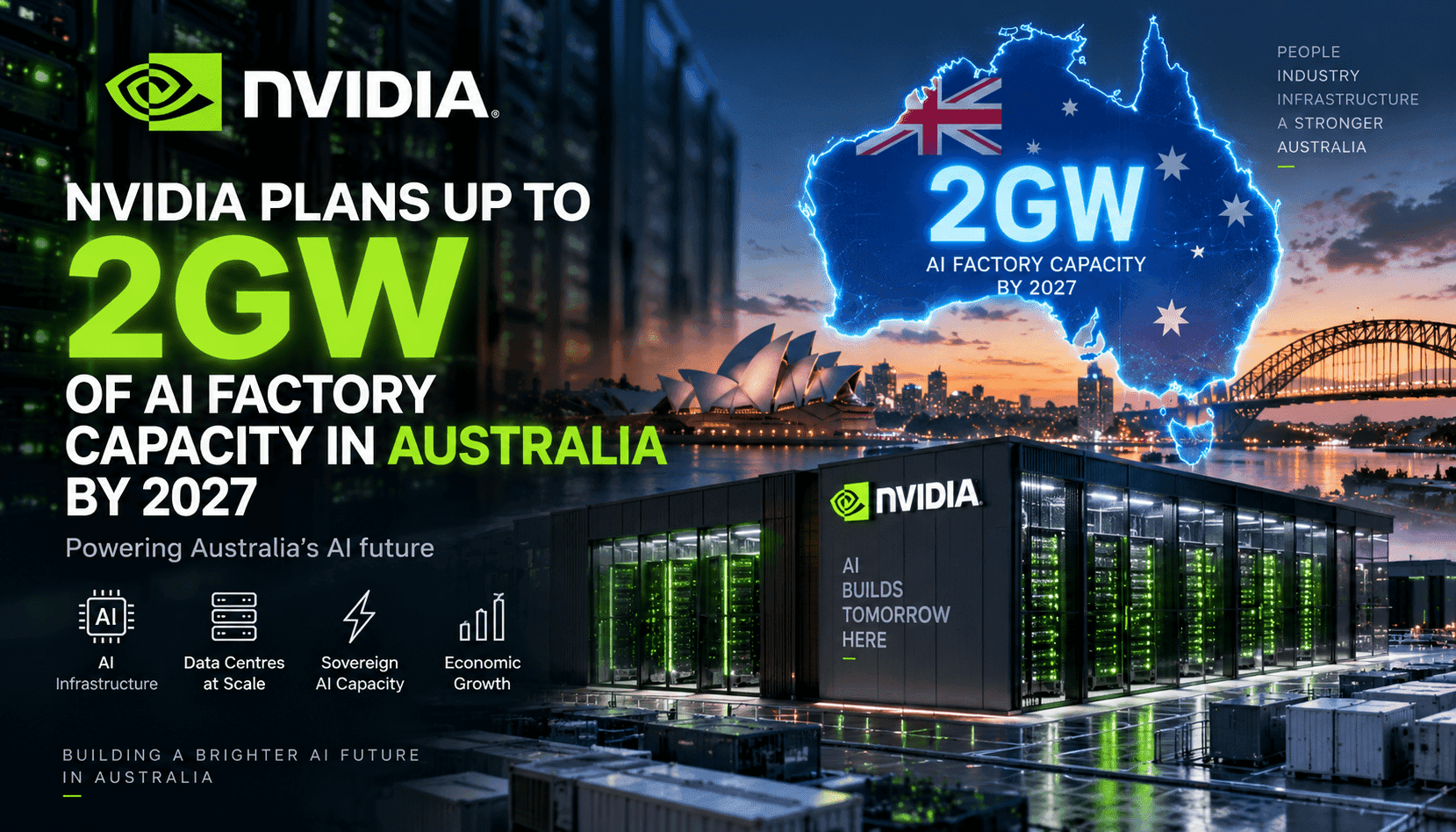
Australia is set to become a sovereign AI heavyweight. NVIDIA’s plan—delivered through an ecosystem of local operators—to enable up to 2GW of capacity by 2027 moves the country past scattered GPU islands into full DSX “AI factories” designed to house multiple silicon generations. This is not just more compute; it is standardized, software-defined infrastructure spanning facilities, networking, orchestration, and model tooling. The result is a durable asset base that can be upgraded in place, improving utilization, capex amortization, and customer on-ramps for AI-native companies and established enterprises.
What changes for Australian builders is proximity and predictability. Training and fine-tuning with region-specific data—health, finance, public sector—becomes easier under domestic residency requirements. With DSX leveraging liquid-to-chip cooling and high-density racks, operators can bring large clusters online without blowing past thermal or floor space limits. Pair that with InfiniBand and AI-optimized Ethernet, plus software-defined interconnects from carriers, and you get lower-latency, higher-throughput paths for multi-cluster jobs and hybrid cloud spillover.
The macro lens matters too. A 2GW roadmap forces coordination across energy, siting, and fiber. Australia’s renewables pipeline and experience with high-availability, low-water-use cooling are well matched to DSX-class loads, but sequencing is everything: power purchase agreements (PPAs), transformer lead times, and liquid-cooling retrofits must align with GPU deliveries to avoid stranded capital. Buyers should expect tiered capacity releases and reservation windows, with early movers rewarded by firmer SLAs and better network adjacency to backbone exchanges.
On the software side, widespread access to open models like Nemotron lowers time-to-value for sector-specific applications while keeping sensitive corpuses onshore. For enterprises pushing retrieval-augmented generation, speech, or multimodal analytics, the practical playbook is clear: pre-commit to interconnect bandwidth, verify liquid-cooling readiness, benchmark with DSX reference designs, and stage MLOps for multi-tenant clusters. Australia’s AI factories will be most valuable to teams prepared to scale workloads quickly—without refactoring every time the hardware revs.