

NexusAi logo

NexusAi

  • Products
  • Categories
  • Prompts
  • Search
  • AI Insights
  • Pricing
  • Promote
  • Contact
Sign In
NexusAi LogoNexusAi

NexusAI helps you discover, compare, and learn AI tools with ease. From expert insights to training resources, we empower individuals and businesses to harness AI technology for smarter decisions, innovation, and growth.

Useful Links

  • About Us
  • AI Products
  • AI Category
  • AI Prompts
  • AI Search
  • AI Insights

Services & Legal

  • Showcase & Promotion
  • Membership Plans
  • Terms & Conditions
  • Refund Policy
  • Privacy Policy
  • Disclaimer

Contact Us

88 Tribune Street
South Brisbane, QLD, Australia, 4101
Website: www.nexusai-tech.com
Email: info@nexusai-tech.com

© Copyright 2026 NexusAi All Rights Reserved

Developed by DStudio Technology
Home/AI Insight/General AI Industry News/Anthropic Pledges 5% Equity to Public Benefit Fund to Tackle AI Labor Disruption
General AI Industry NewsAI Public Benefit

Anthropic Pledges 5% Equity to Public Benefit Fund to Tackle AI Labor Disruption

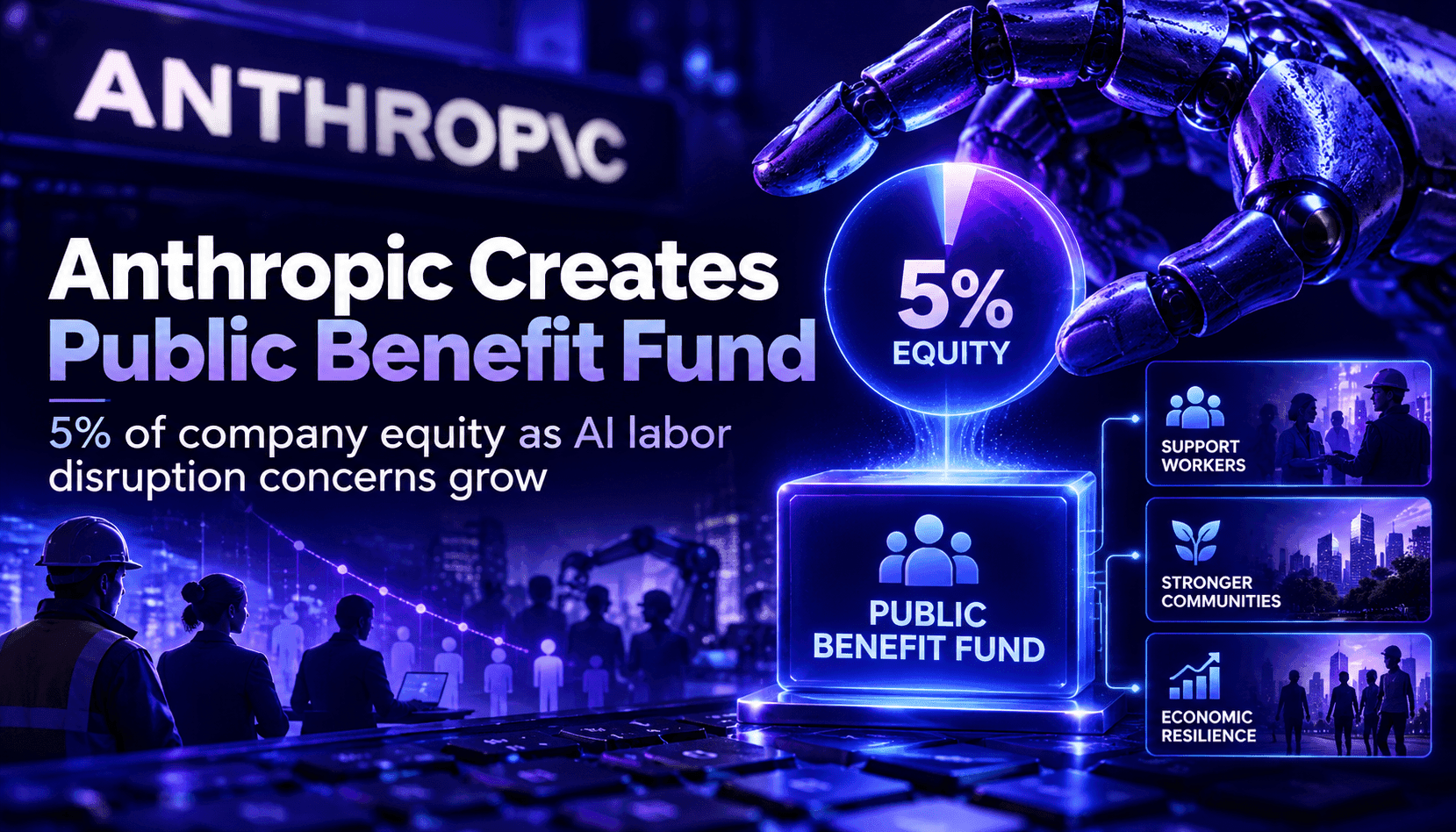
Anthropic has committed 5% of its equity to a Public Benefit Fund ahead of a possible IPO. This piece analyzes how the fund could scale with valuation, which labor-market programs it can support, and what this signals about frontier AI firms preparing for broader social and economic disruption.

NexusAI Editorial DeskOct 19, 20262.0K views7 min read
Anthropic Pledges 5% Equity to Public Benefit Fund to Tackle AI Labor Disruption
AI Brief

Anthropic's plan to allocate an initial 5% equity stake into a Public Benefit Fund — with the potential for that stake to rise as the company's valuation grows — is a strategic move blending corporate finance, reputational risk management and social policy signaling. For founders, investors and policy teams, the core question is how such a fund can be governed, scaled, and targeted to mitigate labor-market disruption from advanced AI agents while avoiding greenwashing. This article explains the mechanics of the pledge, the practical avenues for program funding, governance trade-offs, measurable outcomes to demand, and what similar frontier AI firms might do next.

Anthropic’s commitment to direct 5% of its equity to a Public Benefit Fund — and to let that stake grow as the company’s valuation rises — reframes a financing move as a social-policy instrument. Rather than a one-off donation, the approach creates an equity-backed endowment that can appreciate with the company, potentially producing a long-term revenue stream for nonprofits, retraining programs, community transition projects and public-interest AI research. For stakeholders tracking frontier AI accountability, the pledge is notable because it ties company success to sustained social spending rather than a fixed cash grant.

Practically, an equity-funded public benefit vehicle raises immediate governance questions: who sets funding priorities, what constraints exist on using proceeds, and how will performance be measured? The fund's structure matters — whether it's an independent trust with third-party trustees, a foundation with donor-advised mechanisms, or an internal corporate entity with ring-fenced capital will determine both agility and credibility. Investors will watch how the pledge interacts with IPO mechanics, dilutive effects, and shareholder expectations, while labor-policy actors will evaluate whether the fund targets high-impact transition interventions or disperses money to symbolic programs.

For programs, an equity-backed fund changes time horizons. Unlike grants tied to annual budgets, appreciation can create multi-year funding certainty useful for workforce development initiatives that require multi-cohort training, portable benefits pilots, or small-business adaptation grants. But conversion from equity to deployable cash depends on liquidity events or dividend policies; therefore, immediate cash needs for displaced workers may not be met unless the fund adopts intermediate monetization strategies. That tension — between long-term capacity building and near-term hardship relief — should guide any operational design.

Finally, Anthropic’s move is a signaling device for the frontier AI market. If other leading labs adopt similar instruments, the industry could create an ecosystem of mission-aligned capital that rotates private returns into public goods. Yet the risk of reputational engineering is real: funds can be used as PR shields without meaningful impact unless governance, transparency and metrics are built into the commitment. For decision-makers — from corporate trustees to municipal workforce directors — evaluating such funds will require clear reporting, independent audits, and alignment with measurable labor-market outcomes.

Key Takeaways

Equity funding ties social spending to company success

An equity-backed Public Benefit Fund can grow with valuation, creating sustained resources for workforce programs — but only if governance and monetization rules enable conversion into deployable cash when needed.

Design determines credibility and impact

Independent trustees, clear spending priorities, and published KPIs (re-employment rates, wage recovery, program retention) are essential to prevent the fund becoming a PR vehicle instead of delivering measurable labor-market outcomes.

Operational trade-offs must be explicit

Decide upfront whether the fund prioritizes immediate relief or long-term capacity building and document the monetization ladder so stakeholders can evaluate timing, liquidity risk and expected cash flows.

What Anthropic announced and how the equity vehicle works

Anthropic has pledged an initial 5% equity stake to a new Public Benefit Fund that will grow in absolute value if company valuation rises. Structurally, an equity-backed fund differs from a fixed grant: its capacity depends on the underlying asset performance and on policies for liquidity conversion. This section explains the options fund designers typically choose — independent trust, private foundation, or corporate-sponsored endowment — and how each impacts control, tax treatment and the timeline for making funds available to programs addressing AI-driven labor transitions.

Who benefits: nonprofit programs, workers, communities and research

Funding priorities determine beneficiaries. High-impact uses include industry-aligned retraining with guaranteed employer interviews, wage top-ups for displaced workers, local small-business resilience grants, and public-interest research on agent safety and labor economics. This section maps how different program types address discrete harms — short-term income loss versus structural reskilling — and recommends targeting funds where public finance gaps exist rather than duplicating existing welfare programs.

Governance, transparency and measuring impact

Credibility hinges on governance. Independent trustees, multi-stakeholder advisory boards, and legally enforceable charters reduce capture risk. Transparency requires regular public reporting on grants, valuation assumptions, monetization events and outcome metrics such as re-employment rates, earnings differentials and program retention. This section outlines governance templates that balance donor intent with independent oversight and lays out practical KPIs fund stewards should publish annually to demonstrate real labor-market impact.

Operational trade-offs: liquidity, valuation and program timing

An equity stake is only valuable if there is a path to conversion into cash or recurring payouts. Options include scheduled token sales at IPO, dividend policies, or synthetic monetization via derivatives or secondary markets. Each option has trade-offs: early monetization can supply immediate cash but may cap upside; waiting for liquidity preserves value but delays assistance. This section discusses practical monetization ladders, reserve strategies for emergency grants, and legal mechanisms to protect funds from executive interference during corporate transitions.

What Anthropic’s pledge signals for the AI industry and policy

Beyond the mechanics, the pledge is a market signal: frontier AI firms are internalizing social externalities and experimenting with new corporate-public funding hybrids. If this becomes an industry norm, regulators and investors will demand standardized reporting, and labor-market actors may condition collaboration on demonstrable support. This section evaluates likely next steps — standard-setting by coalitions, integration of fund commitments into IPO decks, and potential regulatory responses — and recommends actions for policymakers and foundations to align incentives with worker outcomes.

Frequently Asked Questions

How can an equity-backed fund deliver immediate cash for displaced workers?

To meet near-term needs, funds typically set aside a liquidity reserve funded by early monetization (e.g., pre-IPO secondary sales, scheduled dividend policies, or a cash tranche established at the fund’s inception). Another option is establishing partnerships with philanthropic organizations that front emergency grants against future equity conversion.

What governance model best prevents capture or greenwashing?

A hybrid model with a legally independent board, majority independent trustees, binding charters for spending priorities, and an external audit requirement tends to be most robust. Including worker representatives and public-interest experts on advisory bodies also enhances legitimacy and relevancy of funding decisions.

How should policymakers respond to similar corporate pledges?

Policymakers can set reporting standards for equity-backed public benefit vehicles, require disclosure of monetization plans, and incentivize measurable outcomes through matching funds or tax treatments that reward long-term community benefit commitments tied to clearly defined labor-market metrics.

#anthropic ipo#IPO Valuation#Labor Market Transition#AI IPO Playbook#Frontier Model Economics#Frontier Model Governance#Public Benefit Fund#AI Labor Transition#Frontier AI Governance#Equity-Endowed Philanthropy#AI-Driven Workforce Policy

AI Insight Newsletter

Get the latest AI updates, tool news, and insights delivered to your inbox.

No spam. Unsubscribe anytime.
On This Page
1.What Anthropic announced and how the equity vehicle works2.Who benefits: nonprofit programs, workers, communities and research3.Governance, transparency and measuring impact4.Operational trade-offs: liquidity, valuation and program timing5.What Anthropic’s pledge signals for the AI industry and policy
Share this article

Related Articles

ServiceNow’s AI Passport: A Runtime Authority Layer for Enterprise Agents
AI Product News

ServiceNow’s AI Passport: A Runtime Authority Layer for Enterprise Agents

Oct 17, 2026

Elastic’s nightshift AI SRE: An autonomous reliability agent that investigates incidents while teams sleep
AI Product News

Elastic’s nightshift AI SRE: An autonomous reliability agent that investigates incidents while teams sleep

Oct 9, 2026

Google’s Verifiably Private FL for Gboard: How TEEs, Transparency Logs and DP Fit Together
AI Model & Platform Updates

Google’s Verifiably Private FL for Gboard: How TEEs, Transparency Logs and DP Fit Together

Oct 5, 2026

Alibaba’s AgentCore Unifies Multi-Model Agents with MCP Tools and Enterprise Governance
AI Product News

Alibaba’s AgentCore Unifies Multi-Model Agents with MCP Tools and Enterprise Governance

Sep 27, 2026

Genesis AI’s Eno Picks Wheels Over Legs for a General‑Purpose Physical Agent
AI Product News

Genesis AI’s Eno Picks Wheels Over Legs for a General‑Purpose Physical Agent

Sep 25, 2026

Related AI Tools

View All
Claude by Anthropic: Frontier Grade AI Models, Agents and Safety Platform

Claude by Anthropic: Frontier Grade AI Models, Agents and Safety Platform

AI Assistants & Agents