Best AI Automation Tools for Business in 2026: From Simple Workflows to Autonomous Agents
Not all automation is created equal. This 2026 buyer’s guide maps four levels—triggers, multi-step workflows, enterprise RPA, and autonomous agents—and compares Zapier, Make, n8n, Power Automate, UiPath, Relevance AI, CrewAI, Lindy, and Pipedream. Learn which tier fits your complexity, governance, integrations, self-hosting, MCP, and oversight needs.
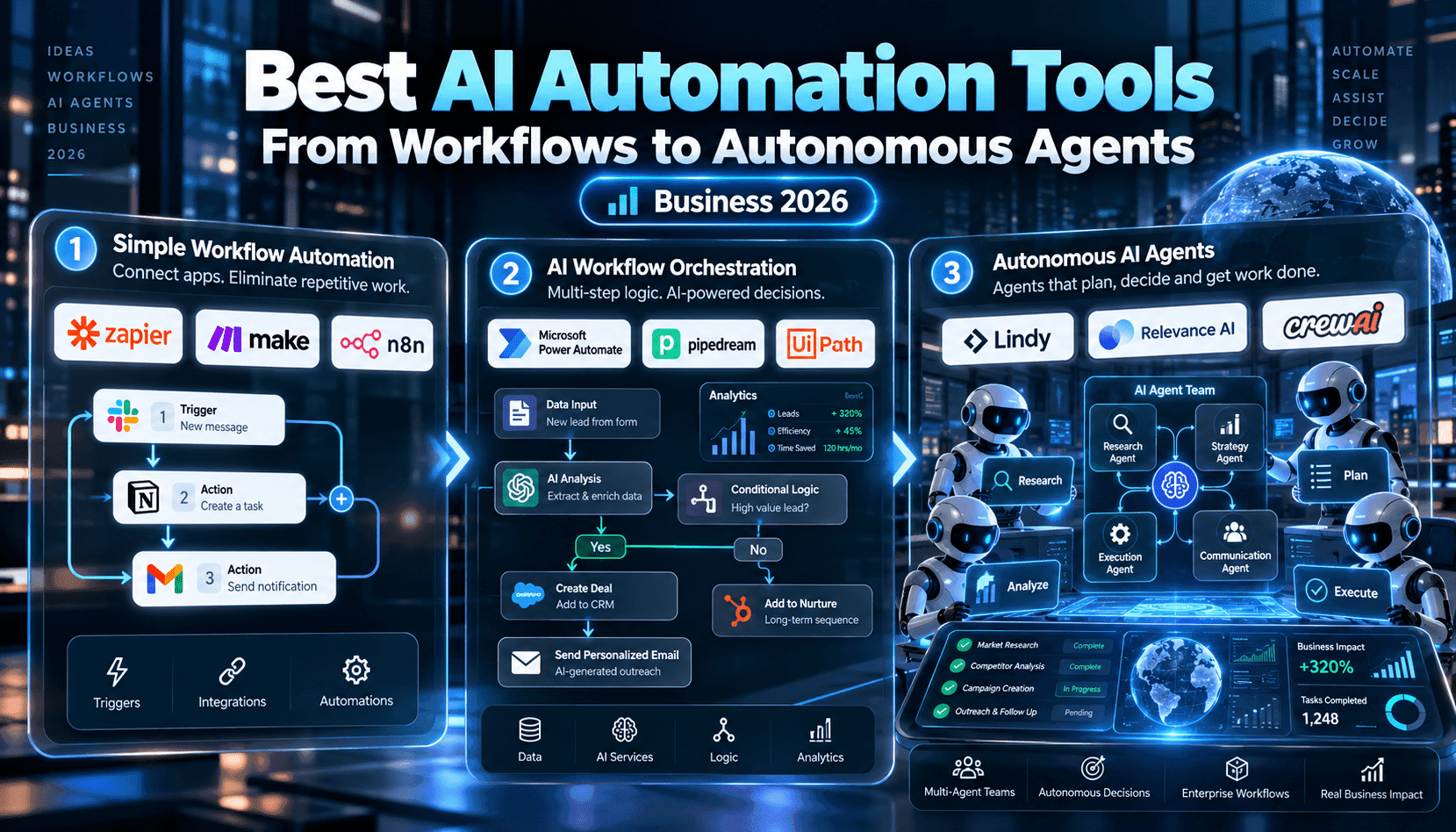
AI BriefAutomation in 2026 spans four distinct tiers: trigger-based wiring, multi-step workflow builders, enterprise RPA, and autonomous AI agents. The right choice depends on process ambiguity, data sensitivity, required integrations, governance posture, and who will operate the system. This guide compares leading options—Zapier, Make, n8n, Microsoft Power Automate, UiPath, Relevance AI, CrewAI, Lindy, and Pipedream—through a maturity lens. We explain where each shines, where it struggles, and how to phase upgrades without burning budget or trust. The takeaway: start with the simplest tool that meets your reliability and compliance bar, and add agentic orchestration only when your workloads demand reasoning, adaptation, and safe autonomy.
Most teams overbuy automation. The practical way to choose in 2026 is to align tool class with the ambiguity of the work. Linear, API-friendly tasks still belong with classic workflow builders. Branching, stateful processes with retries and transformations call for mid-tier orchestrators. Legacy UIs, green screens, and document-heavy back offices remain the home field of RPA. Only workloads that require interpreting unstructured inputs, reasoning across systems, and adapting plans mid-flight need autonomous agents. This piece maps those tiers to specific platforms and helps you avoid paying agent premiums where a router node or desktop bot would do.
At the entry level, Zapier and Make win on breadth and speed, while n8n, Activepieces, and Pipedream trade polish for control, cost-efficiency, and self-hosting. Microsoft Power Automate is the default inside M365 shops thanks to native policy, identity, and data loss controls. Enterprise RPA—UiPath and peers—still dominates where selectors, OCR, and desktop automation bridge brittle system gaps. Agent platforms like Relevance AI and open frameworks such as CrewAI push further: multi-agent collaboration, dynamic tool selection, and human-in-the-loop approvals for safety and auditability. The trick is knowing when each leap in capability justifies the operational overhead.
Governance is the real dividing line. If you need SSO, RBAC, audit trails, and approval gates, your shortlist shrinks fast—especially for self-hosted setups. Another 2026 fault line is MCP (Model Context Protocol) support, which turns automations into callable tools for agents and makes your stack future-proof as agent ecosystems expand. Cost modeling also changes: per-task pricing compounds at scale, while self-hosting shifts spend to infrastructure and ops. We provide a migration playbook that stages capability upgrades, preserves observability, and keeps humans in the loop until exception rates fall below agreed thresholds.
Key Takeaways
Match Tool Class to Ambiguity
Use workflow builders for linear API tasks, RPA for legacy UIs, and agents only when processes need reasoning over unstructured inputs and mid-flight adaptation.
Governance Decides the Shortlist
SSO, RBAC, audit trails, approvals, and data residency instantly narrow options—especially if you self-host or handle regulated data.
Design for Interop and Cost Control
Favor MCP-capable stacks and instrument every run. Model total cost including per-task fees, model usage, retries, and human-review time.
The Four Levels of Automation—and When to Use Each
Level 1, Triggers: Simple if-this-then-that links like “form → CRM → Slack.” Best for non-technical teams, low risk, and well-structured APIs. Tools: Zapier, Make. Level 2, Multi-step Orchestration: Branching, retries, transformation, and error handling with optional code steps. Fits ticket triage, enrichment, and multi-app updates. Tools: n8n, Power Automate, Activepieces, Pipedream. Level 3, Enterprise RPA: Desktop and legacy system automation with selectors, OCR, and attended/unattended bots. Fits finance ops, claims, and ERP/SAP UI. Tools: UiPath and peers. Level 4, Agents: Goal-driven workflows that plan, call tools, and adjust strategies. Fits unstructured inputs, cross-system reasoning, and exception-rich processes. Tools: Relevance AI, CrewAI, Lindy (lighter/individual use).
Workflow Builders: Zapier, Make, n8n, Activepieces, Pipedream—Quick Picks by Need
Choose Zapier for unrivaled app breadth and fastest time-to-first-automation—especially for business users. Make is best when visual branching and scenario design matter more than sheer catalog size. For technical teams that want control and data residency, n8n offers self-hosting, community nodes, and code-in-the-loop. Activepieces is a pragmatic pick for unlimited self-hosted operations with a clean UI and emerging MCP support. Pipedream suits developers who want full Node.js/Python execution, low-latency webhooks, and a code-first experience without managing runtimes. If you expect agent interoperability later, prioritize platforms that expose steps as callable endpoints and log every decision for review.
RPA Still Matters: Where UiPath and Friends Win—and Their Limits
RPA remains the right hammer when the nail is a desktop UI, mainframe terminal, or stubborn ERP screen. UiPath’s ecosystem, governance, and document processing make it ideal for finance and operations where compliance and audit are non-negotiable. Strengths: attended bots for front office, unattended bots for back office, robust monitoring. Limits: brittle selectors when UIs change, higher TCO, and slower change cycles versus API-first automations. Vendors now tout agentic add-ons, but treat them as accelerators, not replacements: use LLMs for classification, extraction, and routing; keep deterministic steps for money-movement and policy-heavy flows. Start with a process inventory and retire bots when APIs become available.
Agentic Automation: Relevance AI, CrewAI, Lindy—When Reasoning Beats Routing
Agents shine when inputs are messy, paths are non-linear, and success requires judgment. Relevance AI provides multi-agent “workforces” for sales and support with role assignment, SLAs, and handoffs. CrewAI gives developers fine-grained control over roles, tools, and collaboration patterns in Python—useful for research and operations where custom logic matters. Lindy targets personal and small-team assistants via natural-language setup. Non-negotiables at this tier: human-in-the-loop approvals, runbooks for escalation, MCP or equivalent tool interoperability, and deep observability (traces, tool calls, prompts, decisions). Expect to invest in evaluation harnesses, offline testing, and policy checks before expanding scope.
Governance, MCP, and a Safe Migration Playbook
Adopt in stages: 1) Stabilize with a workflow builder and centralize logging. 2) Add self-hosted or enterprise controls for PII (SSO, RBAC, DLP). 3) Introduce agents on low-risk segments with mandatory approvals. 4) Expand autonomy only when exception rates drop and evaluation metrics (precision/recall on tasks, cost/run, mean time to recover) meet targets. MCP support turns workflows and internal tools into reusable capabilities for agents; prioritize platforms that expose secure, least-privilege interfaces. Costing tip: compare $/1,000 runs including AI model charges, storage, and egress. Governance tip: require change reviews for prompts and tool permissions just like code.
Frequently Asked Questions
How do I decide between Zapier, Make, n8n, Activepieces, and Pipedream?
Prioritize by operator and control. For business users and maximum integrations, pick Zapier. For visual branching, Make. For self-hosting and code-in-the-loop, n8n. For unlimited self-hosted runs, Activepieces. For developer-first, full code execution and webhooks, Pipedream. If you’ll add agents later, ensure APIs and logs are easily consumable.
When should I move from workflows to agentic automation?
Move when three signals align: 1) >20% exception rate from unstructured inputs, 2) human reviewers spend more time deciding than clicking, and 3) paths vary widely by context across systems. Start with human-in-the-loop agents on low-risk slices, measure error types, then gradually relax approvals as metrics stabilize.
How should I budget and staff an automation program in 2026?
Plan for platform fees, model usage, observability, and change management. A lean team: one automation engineer, one process owner, one analyst for evaluation/QA, and a security partner. Expect low hundreds per month for simple workflows; mid-five figures annually for governed, multi-app orchestrations; and higher for enterprise RPA or agent programs.