

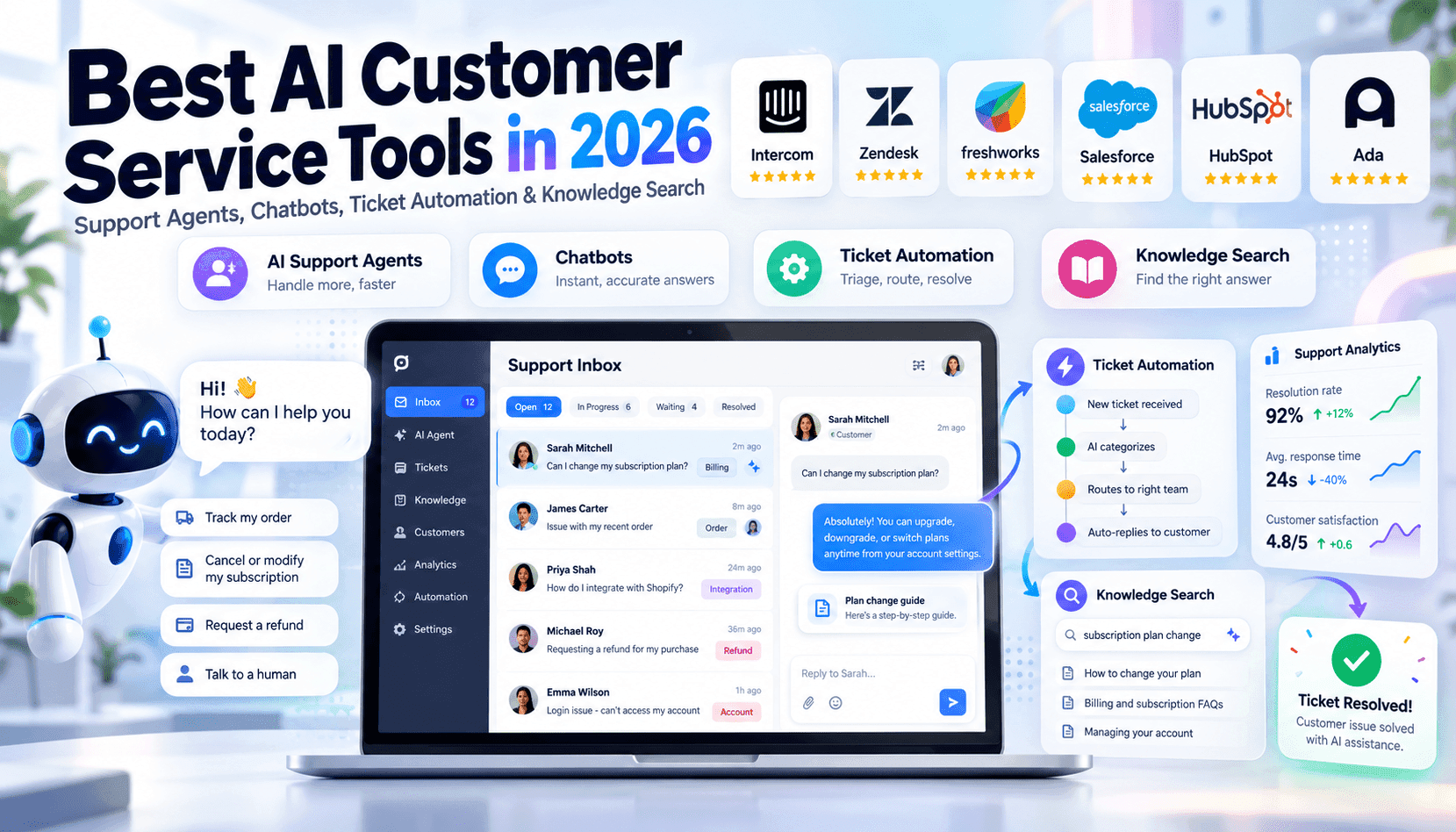
Customer service AI in 2026 is no longer a curiosity: it’s a business-critical stack component for retention and cost control. But the market has bifurcated—some platforms prioritize high-accuracy knowledge grounding and conservative hand-offs to humans, while others optimize for rapid autonomous resolution and aggressive deflection that reduces headcount. Buyers who treat all offerings as interchangeable still experience regressions in CSAT, compliance gaps, and hidden integration costs. This article moves beyond feature lists to evaluate the real trade-offs that determine whether an AI deployment reduces cost while protecting customer experience.
Our analysis focuses on how effectively each platform answers customer questions without a human, when and why it escalates, how reliably it pulls from your company knowledge, and how fast teams can deploy and iterate. We compare solutions that combine AI support agents, chatbots, ticket triage automation, and vector-search-grounded knowledge search, and we weigh integration maturity, reporting for ops, and pricing transparency. The goal: give procurement and ops teams a clear decision lens for SMBs, ecommerce stores, SaaS vendors, high-volume contact centers, and regulated enterprises.
Practical buying decisions depend on two linked measurements: autonomous resolution rate (ARR) in typical use cases, and the reliability of knowledge grounding measured by hallucination incidents and citation provenance. A platform with high ARR but weak grounding can reduce tickets short-term then spike escalations and refunds. Conversely, overly conservative routing erodes the cost case. Below we unpack evaluation criteria, profile leading platforms, and provide scenario-specific recommendations with deployment and monitoring checklists.