

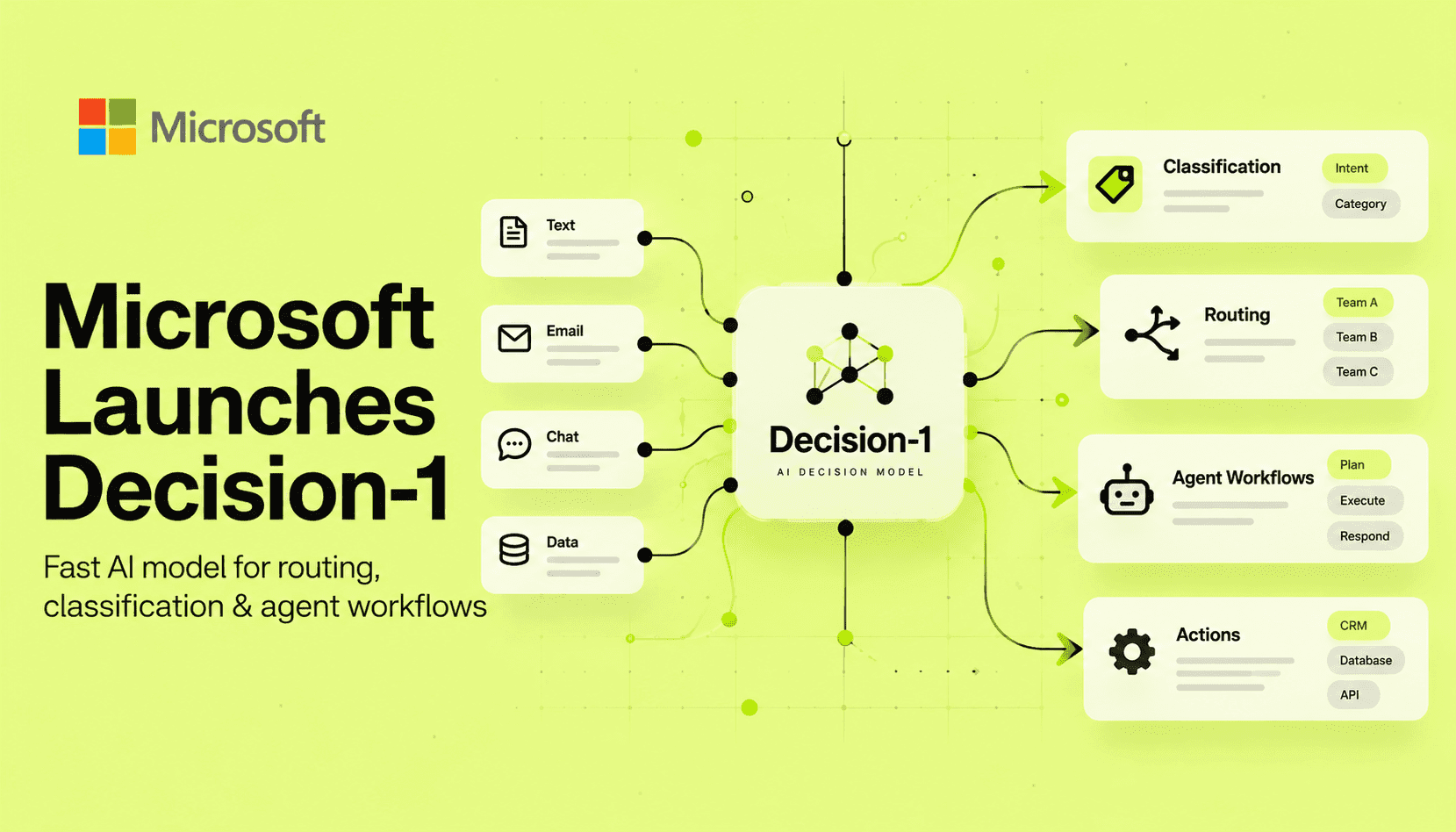
Microsoft-Decision-1 is a specialized scoring model designed for software that needs decisions — choose, rank, classify, verify or score — rather than generation. Unlike general-purpose LLMs tuned to produce fluent text, this model produces structured outputs and calibrated probabilities in a single forward pass. For product teams, that distinction matters: it transforms decision-heavy workloads from expensive, high-latency LLM calls into compact, deterministic scoring steps suitable for real-time agents, webhooks, and high-throughput moderation pipelines.
Technically, Microsoft describes the model as Qwen3.5‑9B–based and optimized for calibration and low-latency inference. The model outputs probabilities for labeled choices so software can use the probability vector directly for routing or thresholded decisions. That avoids round-trips to a text-generating LLM and removes the need for extra parsing or heuristic extraction. The single-pass calibrated scores also simplify downstream telemetry: you can measure confidence, tune thresholds, and roll out guardrails without expensive prompt engineering or multi-step verification chains.
Microsoft’s benchmark claims are notable: Decision‑1 topped a 36‑benchmark comparison for accuracy and—critically—was much faster than generative baselines, with a reported 35x speed advantage over a GPT-6 Sol comparator in their tests. That magnitude of improvement matters when latency, cost-per-inference, and throughput drive product constraints. Still, benchmark context, hardware, batching, and dataset alignment matter; teams should reproduce key microbenchmarks on their production stack before committing to architecture changes.
Practically, Decision‑1 fits between lightweight classifiers and heavyweight LLMs: it’s more purpose-built than a small classifier because it’s trained and calibrated for many decision tasks, but far cheaper and faster than using a full generative LLM to parse and decide. For engineering teams, that creates a clear operational playbook: replace full-text LLM calls when your intent is selection, routing, scoring, or verification and keep generative LLMs for creative, summarization, or long-form synthesis tasks.
Adopting a decision model in production requires attention to calibration, distribution shift, and integration with existing agent toolchains. Teams should instrument confidence thresholds, fallbacks to generative LLMs when calibration or data drift appears, and training/evaluation cycles to align the decision model with business-specific classes and cost objectives. When implemented correctly, Decision‑1 can reduce latency, lower inference cost, and increase system determinism for decision-heavy flows.