

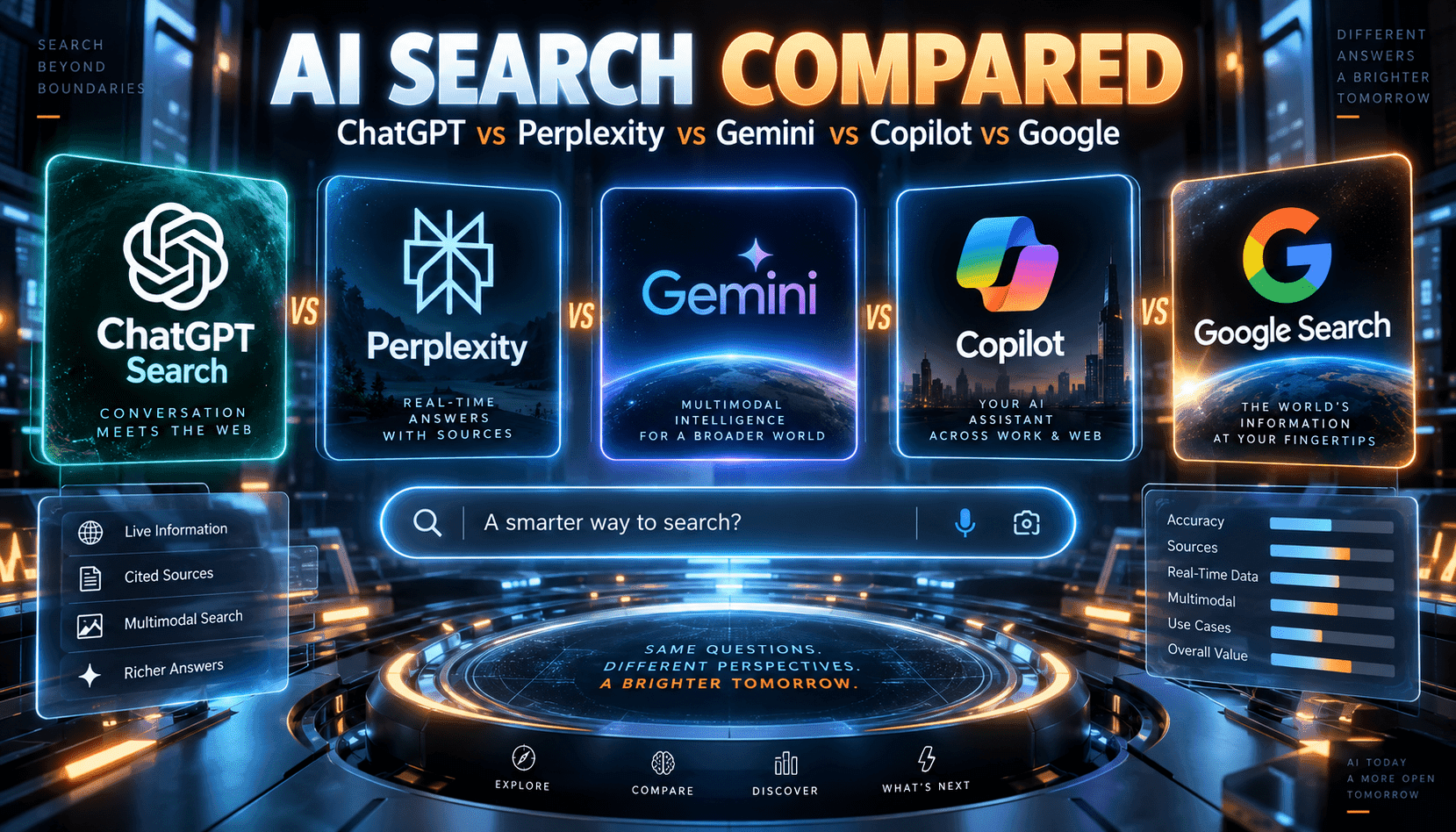
AI search tools are converging on a common promise—faster answers with less clicking—yet they differ sharply in what they optimize for. Treat them as complementary instruments, not substitutes. Reasoning-oriented copilots shine on multi-step synthesis, while answer engines focus on speedy retrieval with citations. Meanwhile, traditional search remains unmatched for navigation and for exploring the long tail of the open web. The practical implication for operators and buyers: build a portfolio that routes each query type to the tool that’s best at it rather than forcing one system to cover every intent.
ChatGPT, when paired with web browsing, is a superb reasoning assistant that can retrieve, verify, and transform content into plans, code, or briefs. Perplexity is built around source-first retrieval and crisp, cited summaries that help you audit claims quickly. Gemini’s AI Overviews sit inside Google’s mature ranking stack, benefitting from strong indexing, freshness signals, and integrated links for deeper exploration. Microsoft Copilot brings together Bing results and your organization’s Microsoft 365 knowledge, offering policy-aware responses under enterprise identity. Classic Google Search still dominates navigational and open-ended discovery, where you want breadth before synthesis.
Evidence and governance vary meaningfully. Perplexity foregrounds citations and is fast for quick fact-finding. Gemini’s overviews increasingly restrict triggers where answers are risky and emphasize link-outs for context, reflecting search-grade safeguards. ChatGPT’s web mode is excellent at chain-of-thought synthesis but should be paired with explicit source review. Copilot’s value grows with tenant data and permissions, enabling compliant, role-aware answers that reflect organizational context. Across all, buyers should insist on evaluation harnesses that test reliability on their own query distributions and content domains, not just generic benchmarks.
From an operating perspective, plan for routing, costs, and latency. Some tools are ideal for fast lookups at scale; others justify slower responses with higher reasoning quality. Enterprises should design an intent router that classifies queries (navigational, factual lookup, synthesis, enterprise-context) and sends them to the right engine. Track per-query cost, token use, cache hits, and user actions after answer (click-through, save, escalate) to quantify value. The organizations that win won’t pick a single engine; they’ll blend engines, enforce governance, and continuously measure outcomes on live traffic.