

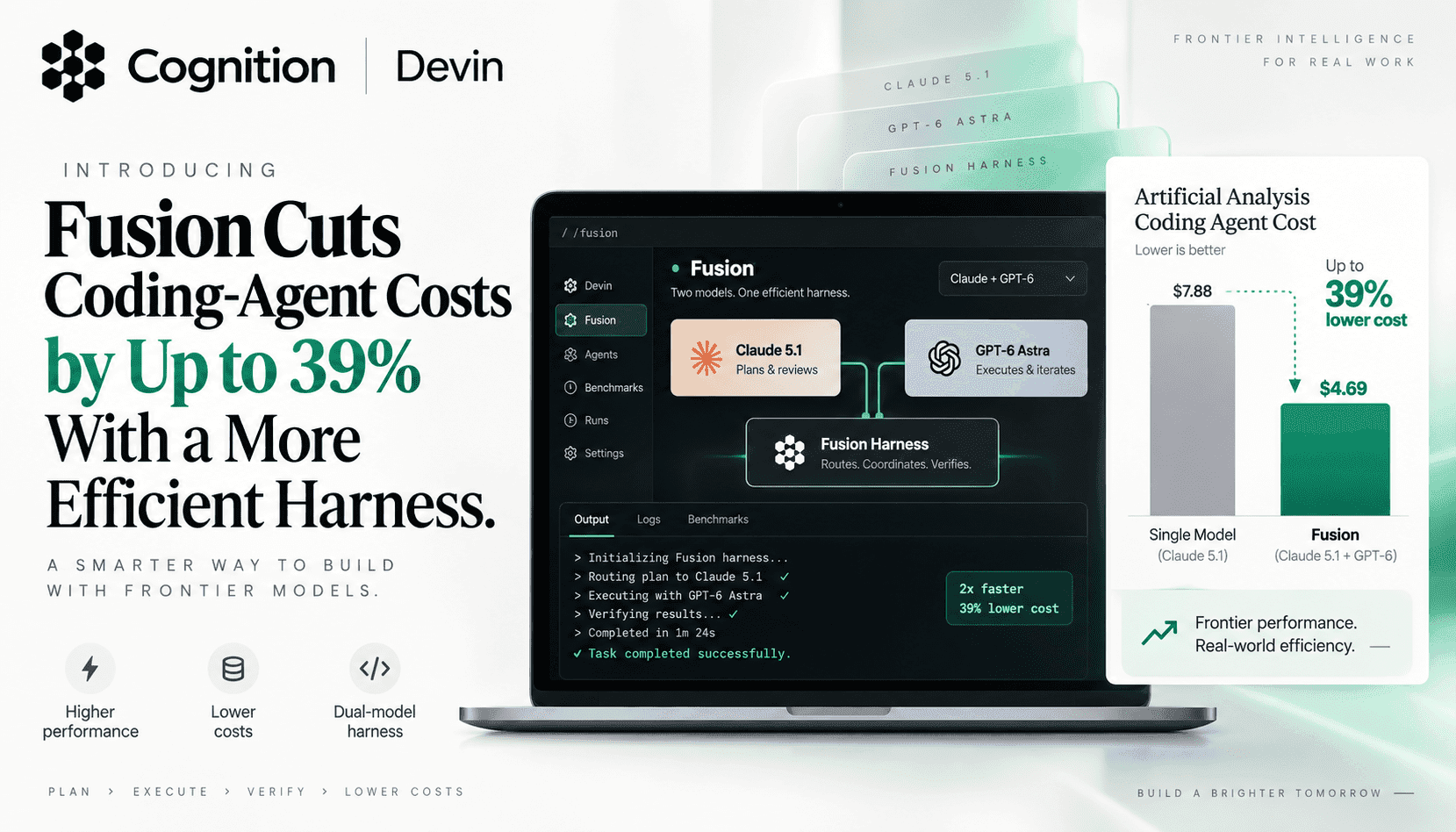
Fusion is a two-agent harness designed for coding work: a frontier lead model plans and reviews; a cheaper sidekick executes. Instead of routing entire conversations across models, the pair trade structured briefs and results while each builds its own persistent context. That separation matters. Swapping models mid-thread often trashes caches and invites rework. In Fusion, brief-based delegation keeps context stable, lets the sidekick move fast on implementation, and reserves expensive reasoning for the lead’s checkpoints. The result, according to reported benchmarks, is frontier-level quality at meaningfully lower cost—especially on tasks where steady execution dominates the token budget.
The strategic shift is from model selection to orchestration quality. Price per token underestimates the reality that better planners write tighter briefs, need fewer retries, and minimize lead-sidekick back-and-forth. In practice, a stronger (sometimes pricier) lead can make the system cheaper by delegating earlier and reviewing less. Similarly, a more capable sidekick may cost more per token but cut overall turns by getting implementations right the first time. This is why Fusion’s claims resonate: they operationalize a price-per-task mindset, harmonizing planning, execution, and review into a workflow that protects caches and curbs churn.
For buyers, this resets evaluation checklists. Benchmarks still matter, but the meaningful questions are now about harness policy: how plans are formed, what gets delegated, how often the lead reviews, and how errors escalate. Teams piloting Astra or Claude-like leads should measure cost, time, and quality at the task level and instrument where tokens and turns actually land across phases—plan, setup, implementation, debug, validate, closeout. If most cost accrues in implementation and debugging, a dual-agent harness with persistent context and prompt caching will likely outperform naive routing or single-model loops.
Adoption isn’t zero-lift. Delegation briefs must be tuned to the chosen pair; sidekick autonomy should scale with capability; and exploration that shapes the plan should generally stay with the lead unless the sidekick is strong enough to avoid misreads. Organizations will also need governance: traceable review checkpoints, reproducible runs across caches, and guardrails so the sidekick doesn’t overreach tools or permissions. But the upside is compelling: a stable planning channel that concentrates frontier intelligence where it pays off, and an execution channel that turns code changes quickly without repeatedly waking an expensive brain.