

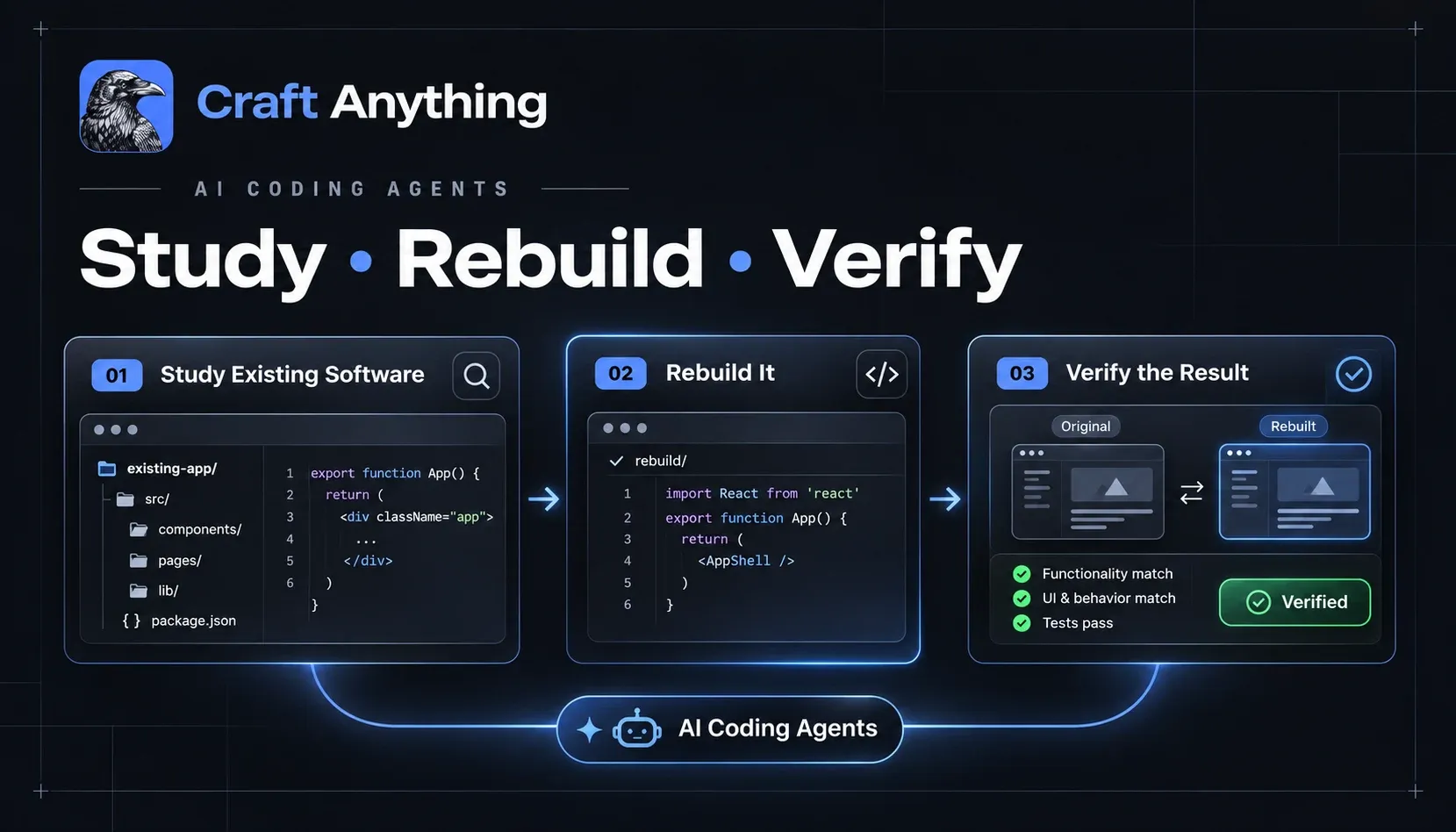
Coding agents are evolving beyond one-shot code generation. Craft Anything puts that evolution into a practical workflow: first, the tool inspects a target — a website, application, game binary or data file — with instrumented tools that record the evidence behind every observation; second, a coding agent uses those observations to produce a new implementation that matches the intended behavior; third, the system compares outputs and behavior, surfaces differences and iterates until the build meets the defined fidelity. That sequence changes how teams learn from existing software: it’s no longer guesswork or blind prompt engineering, it’s an evidence-driven reconstruction loop.
Craft Anything is free and open source, and its engine is accessible via a desktop app, a headless CLI and an MCP server for automated agent pipelines. Those entry points matter: designers and researchers can use the desktop workbench to capture interactive sessions and annotate findings; engineers can script large-scale inspections and reproducible builds in CI with the CLI; operations teams can run inspection and verification at scale via MCP, feeding agents into enterprise workflows. The same underlying evidence model and permission system govern all modes, so results are consistent across interactive and automated use.
A key practical point is control. Craft Anything supports a permission model where actions that fall outside rules set by the user — network requests, file writes, or live execution steps — are flagged for human review. That means agents can run safely inside a preapproved sandbox, escalate only when required, and keep changes auditable. For teams that need pure analysis without side-effects, the clean-room option captures visible behavior (UIs, network traces, file contents) without executing or probing internals, reducing legal risk when examining third-party products.
The verification stage is what separates Craft Anything from a typical code generator. After an agent crafts an implementation, the platform runs behavioral comparisons against the recorded evidence: UI states, API responses, file outputs and deterministic traces. Differences are reported with their evidentiary sources so teams can decide whether divergences are acceptable, require redesign, or point to licensing or security issues. This evidence-backed verification supports both short-cycle prototyping and rigorous modernization projects where fidelity to legacy behavior matters.