

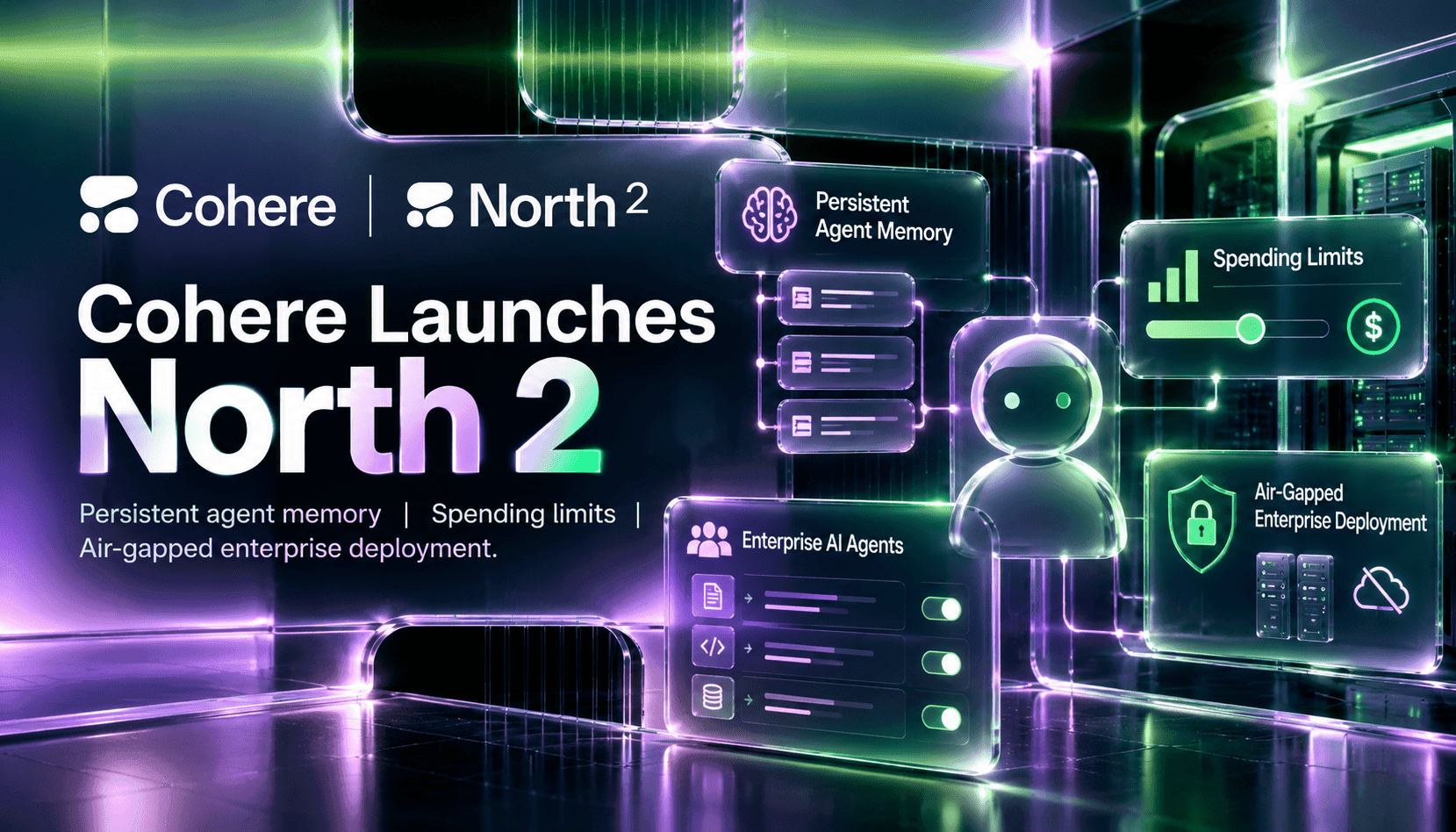
Cohere North 2 is a targeted answer to two operational headaches that plague enterprise agent deployments: loss of context across sessions and runaway, unpredictable token consumption. Rather than ship a single feature, North 2 refactors the agent stack: a redesigned orchestration harness coordinates multi-step automations; a cross-session memory system preserves relevant state; and a reusable skills and libraries model reduces duplication and prompts inflation. For organizations that have piloted agents and hit scale limits, North 2 promises more predictable behavior and a path to standardize how agents interact with corporate knowledge.
Memory is the headline capability but also the riskiest: persistent context enables continuity across days or workflows, which improves accuracy for cases like case-triage, contracts, and long-running investigations. Cohere’s approach emphasizes cross-session memory that is sharable via libraries and scoped per agent or team, paired with guardrails that limit what can be stored, how long it lives, and who can access it. That combination is a pragmatic attempt to deliver utility without exposing sensitive data or blowing compliance budgets.
Token governance in North 2 is operationalized through North Admin: rate limits, user and org spending caps, consumption tiers, and alert thresholds are first-class controls. For procurement and finance teams, that changes how you forecast AI spend — it converts token use from an opaque run-rate into a governable line item. Combined with the claim of model-agnostic deployment and hardware optimizations on NVIDIA stacks, North 2 targets reduced total cost of ownership through both software controls and inference efficiency.
Finally, the deployment story is an enterprise differentiator: North 2 supports cloud, VPC, on-prem, hybrid, and fully air-gapped installs. For regulated verticals — finance, healthcare, defense — the capacity to run agent orchestration and memory stores inside an air-gapped environment removes a major blocker to adoption. But air-gapped deployments also surface trade-offs in integrations, observability, and update cadence; teams must balance sovereignty with the operational overhead of maintaining isolated infrastructure.