

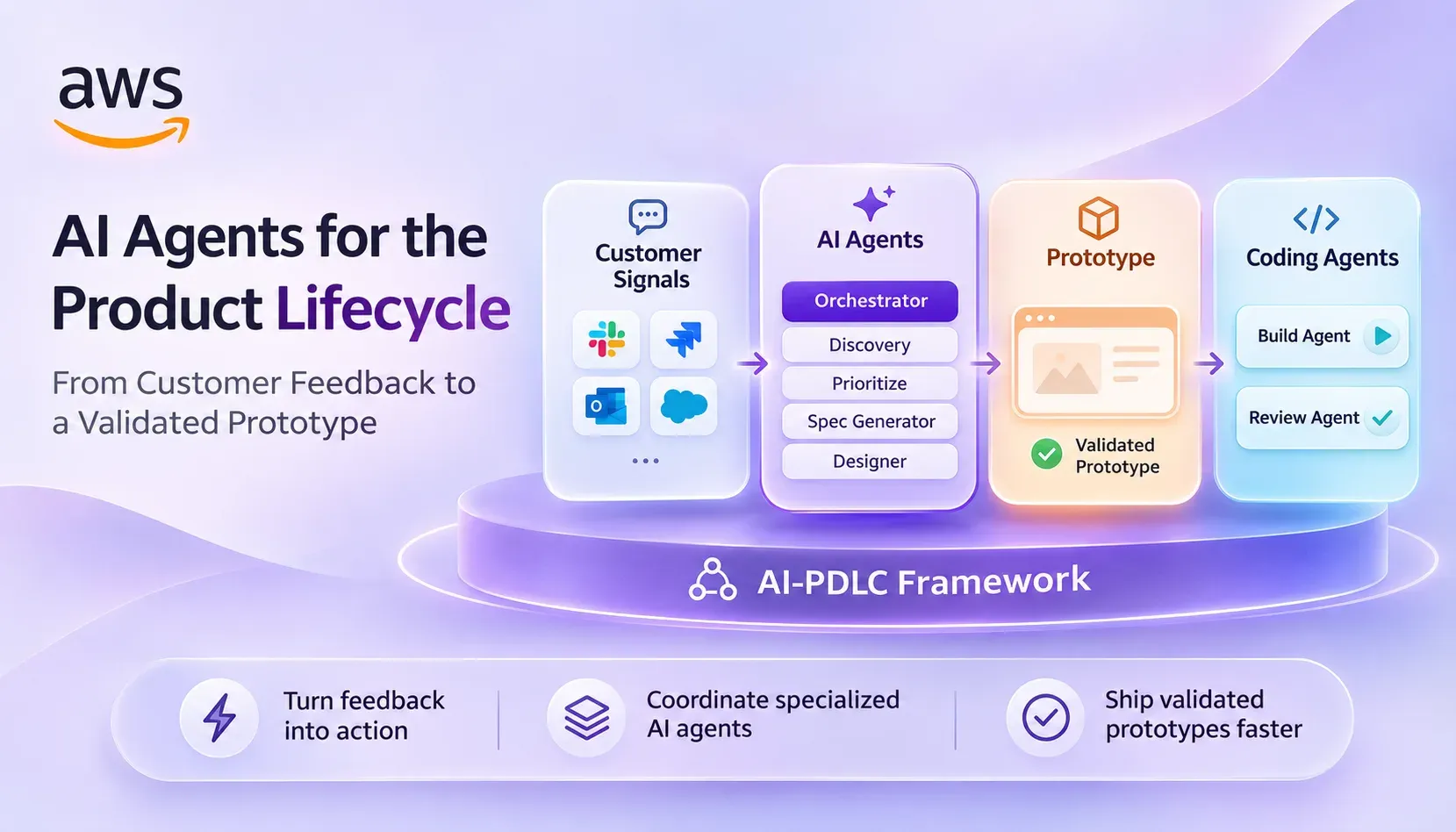
Product teams today face a paradox: coding is getting faster, but the cost of building the wrong thing has never been higher. Agents that automate implementation shorten time-to-code, but they don’t know which customer problem is most worth solving. This article reframes the competitive edge: invest agentic effort upstream. Use specialist agents to gather dispersed signals, score opportunities against transparent criteria, and produce artifacts that preserve the evidence behind every decision. The result is not merely speed; it’s a repeatable way to hand engineering a specification that aligns with customer value and business constraints.
The AI-PDLC approach breaks the upstream product process into discrete, auditable stages: Discover, Decide, Design, and Prototype. Each stage pairs a specialist agent with an Orchestrator that runs question frameworks, collects sources, and writes artifacts into a shared repository. Humans remain the gatekeepers—validating pain points, approving priorities, signing off specifications, and accepting prototypes. That human-in-the-loop gating is the feature, not an afterthought: it keeps contextual nuance, regulatory judgments, and market trade-offs visible and traceable, which is essential when downstream coding agents can implement specifications rapidly.
Practically, teams should configure connectors to Slack, Jira, Salesforce, support systems and research folders so the Discovery agent can extract direct customer quotes, incident patterns, and usage signals. Prioritize using two scoring frameworks in parallel—one tuned to agentic feasibility (LLM/tool fit, automation surface, user acceptance) and one tuned to business feasibility (impact, effort, regulatory risk). The Working Backwards agent forces a PR/FAQ-level stress test: if your idea cannot survive detailed customer and internal FAQs, you’ve learned something valuable before committing engineering cycles.
Design and Prototype stages convert validated concepts into build-ready deliverables: an acceptance-criteria-led spec, a UX handoff brief, and a clickable prototype that stakeholders can test within hours. The Spec Generator maps each requirement back to its evidence—pain point, prioritization score, and PR/FAQ rationale—so the coding agent receives an enforceable contract, not a wish list. That traceability also enables post-release learning: production telemetry and support feedback feed back into Discovery, closing the loop for continuous improvement.