

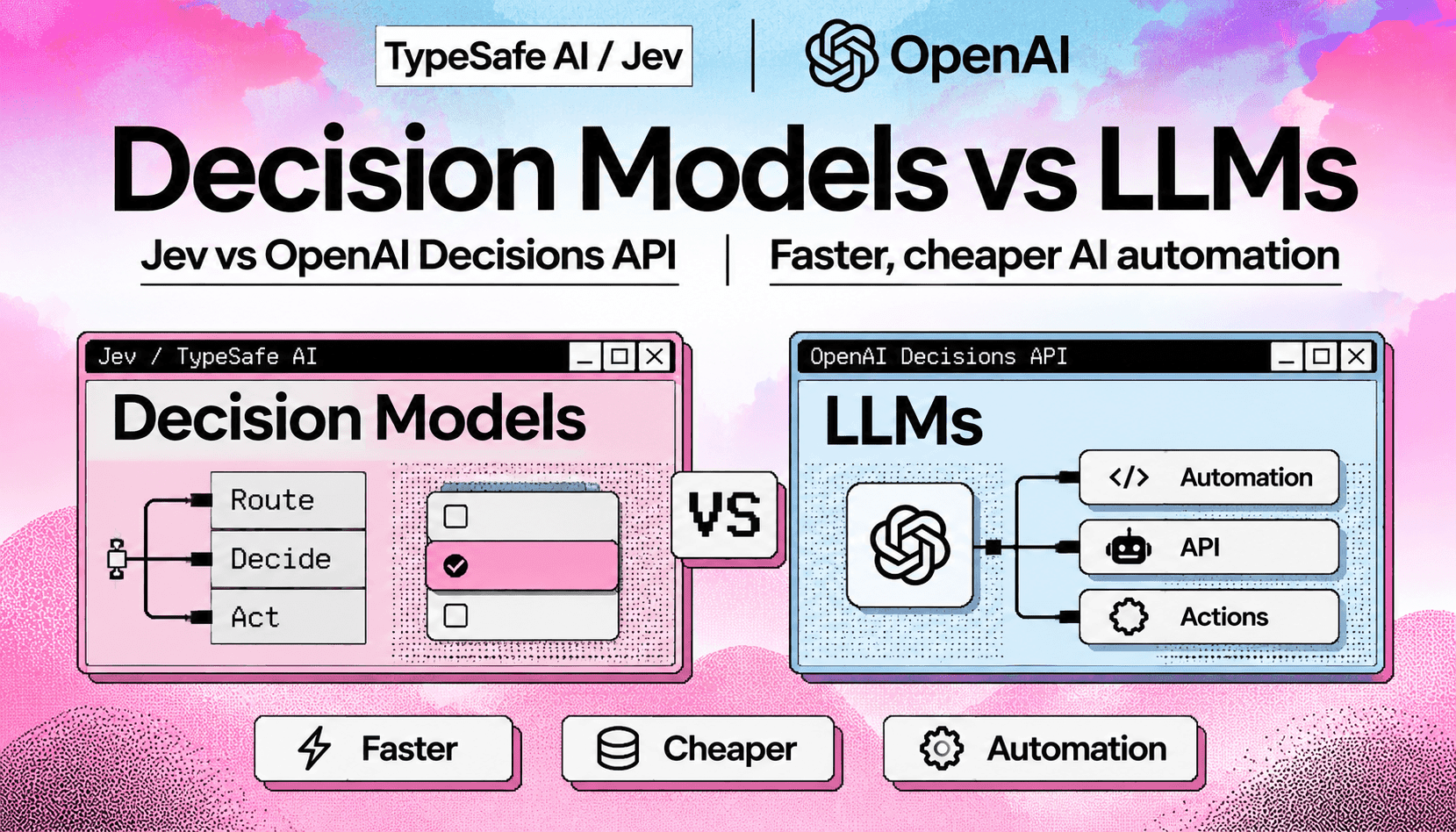
Enterprises building automation pipelines face a simple, persistent problem: generative LLMs are flexible but expensive and slow when used for every routing, scoring, or binary decision. A new class of compact decision models—represented by products like Jev and OpenAI’s Decisions API—targets those exact use cases. They are trained for deterministic classification, provide calibrated confidence outputs, and are engineered to run with lower latency and lower compute cost than a full reasoning LLM. This shift isn’t about replacing LLMs, but about matching model capability to the task to achieve predictable economics and performance.
Decision models excel at structured classification, routing, and policy enforcement where inputs map to a relatively small set of outcomes. In practice, that looks like fast intent classification, fraud/no-fraud routing, simple eligibility checks, or feature-rich scoring that feeds downstream agents. They can be deployed as microservices at the edge or inside a rules engine and used as an early filter before invoking a larger reasoning model. Because their outputs are compact and predictable, they enable tighter latency SLAs and simpler monitoring than handing everything to a generative model.
This article compares measurable angles—latency, cost per decision, confidence scoring, and explainability—between representative decision models (like Jev) and OpenAI’s Decisions API versus larger generative LLMs. It then sketches pragmatic architectures that mix decision layers with LLMs to reduce the number of expensive calls, improve reliability, and preserve reasoning capability only where it’s needed. I close with operational guidance: when to choose routing or scoring models, when to keep a reasoning path, and how to instrument the hybrid stack to detect and mitigate misroutes.