

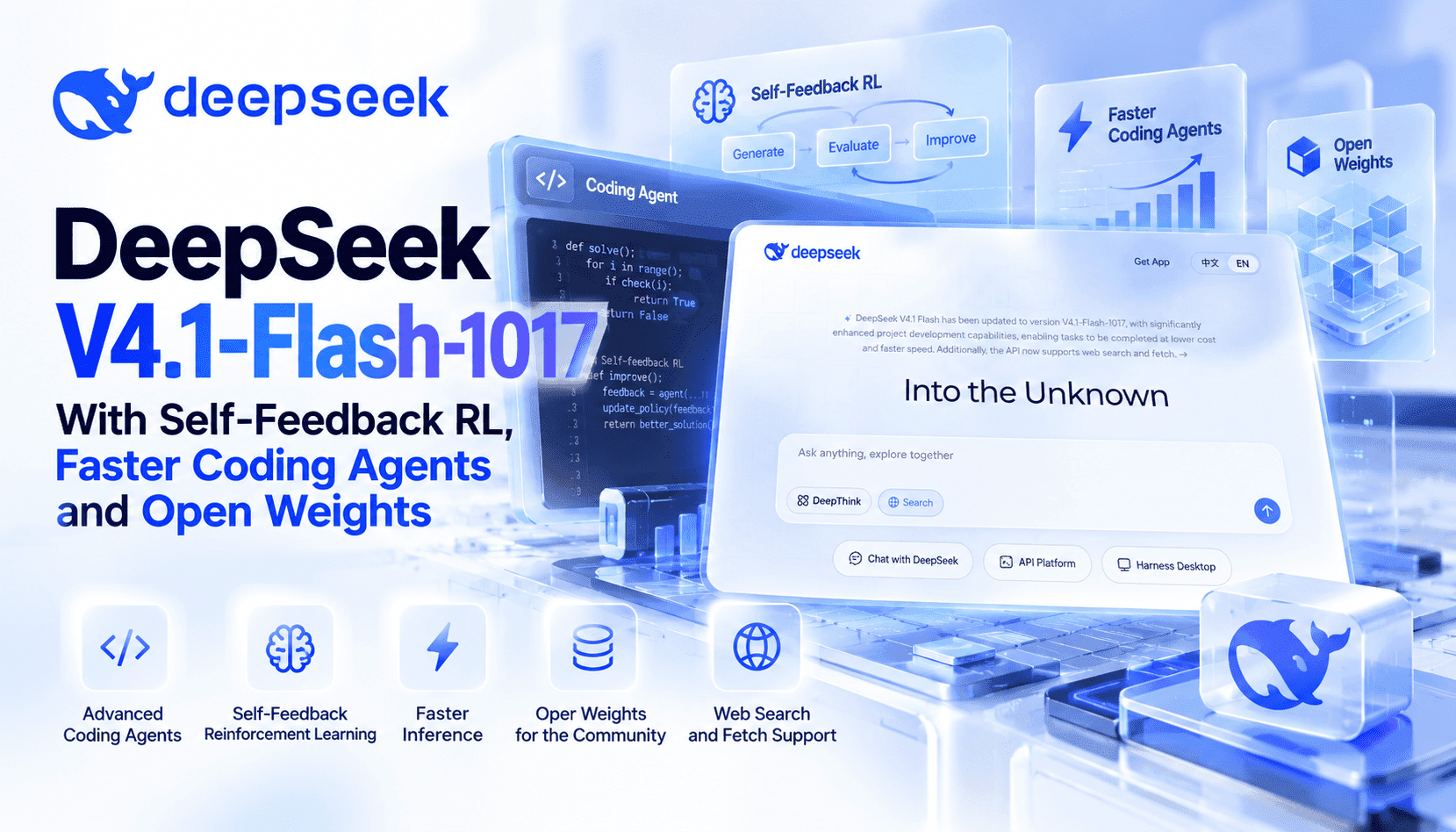
DeepSeek’s V4.1‑Flash‑1017 is pitched as a focused evolution: smaller, faster outputs, and tuned for agents that build complete projects rather than just snippets. The vendor emphasizes reinforcements learned via self‑feedback loops — agents iteratively assessing and correcting their own outputs during multi‑step tasks — to close gaps between single‑prompt code generation and full software delivery. Practically, that means DeepSeek aims to generate not only scaffolding but working builds: web apps with backend glue, playable game levels, and 3D scenes with asset references that require fewer manual corrections by developers.
The release highlights two operational moves that matter to teams: open‑weight availability and integrations with runtime tooling. DeepSeek‑V4.1‑Flash‑1017 is being published as an open‑weight model on public model hubs and packaged for local or cloud deployment, giving engineering teams the option to run models in their own VPCs or use hosted endpoints. That flexibility changes procurement and security conversations: teams can prioritize on‑prem inference to meet compliance needs, or opt for managed endpoints for speed and simplicity, while preserving the ability to fine‑tune or extend the model in closed environments.
DeepSeek stresses measurable efficiency gains compared with the previous Flash release: faster task completion, shorter outputs, and improved benchmark figures on vendor tests. Those are compelling claims for cost‑sensitive workflows because shorter outputs directly reduce token billing and speed up downstream evaluation steps. However, those metrics are DeepSeek’s own published results; they should be treated as vendor benchmarks until independent reproductions appear. For procurement teams and researchers, the right first step is repeatable, workload‑specific benchmarking that mirrors production tasks rather than relying on headline metrics alone.
Operationally, the release pairs the model with two product moves that affect agent builders: DeepSeek Harness upgrades for inside‑tooling orchestration and new Search & Fetch APIs powered by DeepSeek’s search stack. Those APIs provide server‑side web search and fetch capabilities for agents, with a listed cost tier for general use and a temporary free window for embedded calls via supported runtimes. For agent frameworks such as Claude Code or Codex, having a low‑latency search/fetch primitive built into the stack reduces integration complexity and can speed chain‑of‑thought retrieval and grounding across multi‑step software tasks.