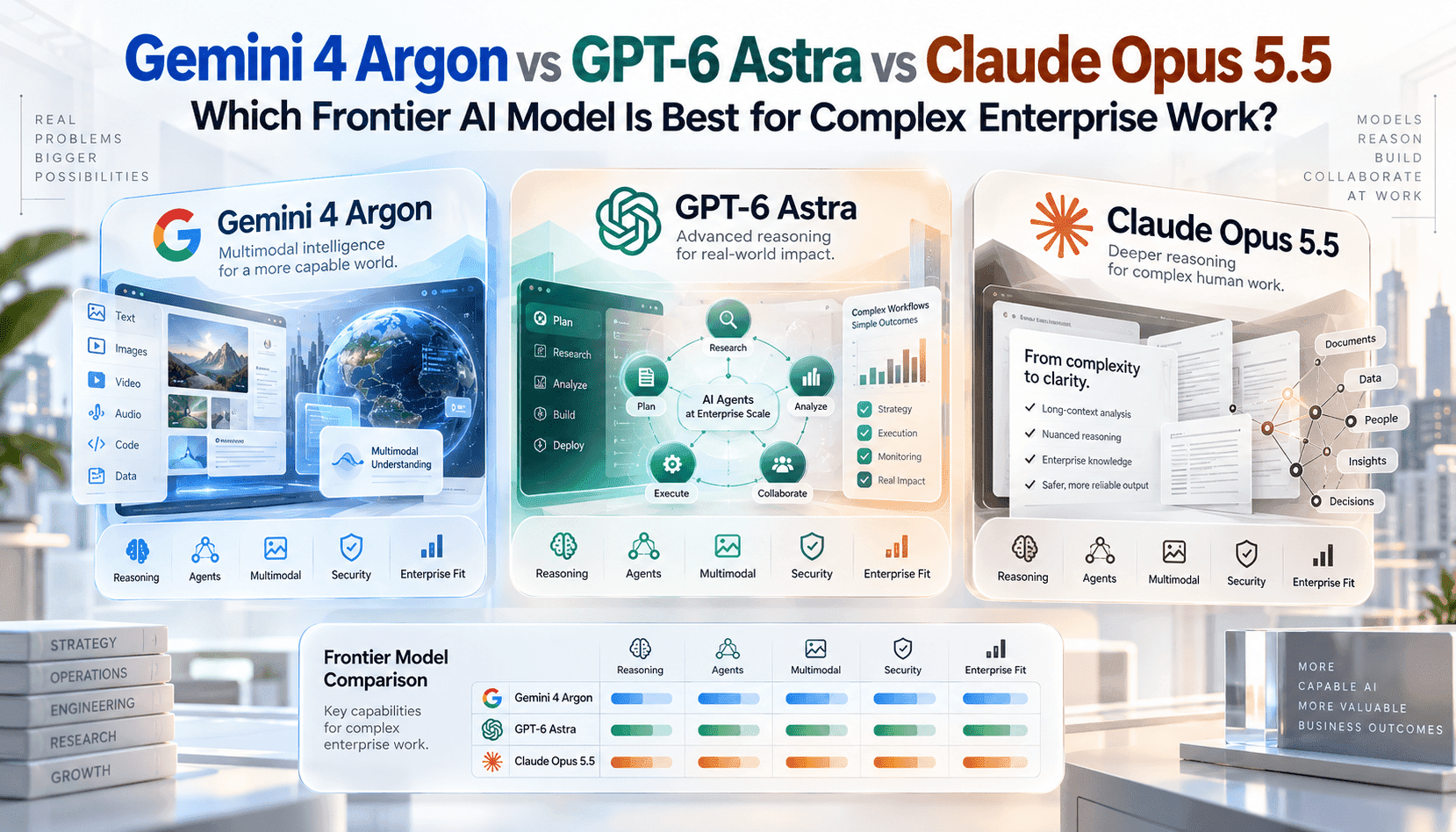
A practical, side-by-side evaluation of Gemini 4 Argon, GPT-6 Astra, and Claude Opus 5.5 for complex enterprise tasks. This piece compares coding, legal, finance, security, long-horizon reasoning and agent workflows, and highlights integration, pricing, and availability to help technical buyers choose for mission-critical work.
Enterprises evaluating frontier models face more than benchmark scores: they need predictable behavior, tool reliability, cost visibility, and integration paths. Gemini 4 Argon, GPT-6 Astra, and Claude Opus 5.5 each advance reasoning and multimodal capability, but they diverge in practical trade-offs. Argon emphasizes multimodal engineering depth and long-context synthesis with tight cloud integration; Astra positions itself as a general-purpose, highly agentic model with broad tooling and ecosystem maturity; Opus 5.5 leans into safety-first dialogue, structured reasoning, and enterprise-oriented guardrails. This article examines where each model is strongest for real-world high-value workflows and where buyers will need to architect around limitations.
Software teams should choose a model based on scale of codebase reasoning, autonomy needs, and toolchain compatibility. Argon’s reported wins in large-scale refactors and spatial-visual coding make it a strong candidate for monorepo surgery, robotics simulation, and visual UI generation when tight integration with Google Cloud and Gemini tooling is acceptable. GPT-6 Astra’s agentic capabilities and existing third-party integrations are attractive for firms standardizing on multi-agent workflows and enterprise orchestration platforms. Opus 5.5 is compelling where conservative output, auditable chains, and safety tuning are primary — for example, legal drafting templates and compliance-first code review flows.
For legal, finance, and scientific work the differences are operational, not merely accuracy metrics. Argon’s multimodal comprehension and long-context synthesis excel at analyzing large portfolios of legal filings, long regulatory PDFs, or multi-year financial models with embedded tables and diagrams. Astra offers flexible tool-calling and a mature ecosystem for structured workflows such as automated contract assembly with downstream verification hooks. Claude Opus 5.5 frequently limits risky hallucinations and supports conservative answer framing, which reduces false positives in legal reasoning and audit trails but may require more explicit prompting for creative problem solving. Buyers should map task risk tolerance to these characteristics.
Legal and finance: precision, auditability, and risk posture
What changed: models can synthesize thousands of pages of contracts, extract obligations, and draft negotiation playbooks. Why it matters: legal and finance teams face regulatory risk if outputs are incorrect or poorly grounded. Who is affected: GC offices, in-house counsel, compliance, FP&A. Analysis and implications: Argon’s long-context memory and multimodal parsing make it adept at stitching together exhibits, redlines and precedent; Astra’s structured tool-calls and agent orchestration are useful for automated approval workflows and audit logs; Opus 5.5 offers a safer default tone and stronger guardrails that reduce hallucination risk, a key benefit when outputs feed legal sign-off. Risks and limits: warranty disclaimers, model drift, and vendor lock-in with provenance systems. Practical next steps: require verifiable citations, use human-in-the-loop sign-offs for any contract or regulatory change, and budget for legal validation cycles.
Long-horizon reasoning, agents and tooling: orchestration trade-offs
What changed: models are being used as persistent agents that maintain state, run multi-step plans, and call external tools. Why it matters: complex workflows require memory, recovery behavior, and chain-of-trust. Who is affected: automation architects, platform owners, and product teams building agentic products. Analysis and implications: Astra currently leads in agent ecosystems and third-party tool adapters, enabling more portable agent stacks; Argon’s deep-context windows and multimodal strengths make it better for rich, stateful planning that incorporates documents, images, and logs; Opus 5.5 provides safer defaults for constrained agent behaviors where enterprise policy must be enforced. Risks and limits: runaway agent behavior, hidden costs from repeated tool calls, and inconsistent state management. Practical next steps: design agents with explicit checkpoints, human escalation triggers, and per-action approval budgets.
Pricing, context windows, availability and enterprise integration
What changed: providers publish pricing and context policies that materially alter total cost of ownership. Why it matters: token costs, caching, and context limits shape which workflows are economical to run. Who is affected: procurement, cloud architects, and finance teams. Analysis and implications: Argon’s introductory pricing (noted as lower input token cost with higher output token rates and deep caching) favors heavy-input, high-context tasks — useful for large-document synthesis or long-agent traces; GPT-6 Astra pricing and ecosystem may present a predictable per-call model with stronger marketplace integrations; Claude Opus 5.5 often markets enterprise SLAs, dedicated instances, and extra safety audits for a premium. Availability and lock-in: Argon ties best into Google Cloud and Gemini tooling, Astra benefits from broader third-party connectors, and Opus offers focused enterprise controls. Practical next steps: run TCO scenarios for representative workloads, include caching and agent call volume in cost models, and evaluate multi-vendor proofs-of-concept to avoid operational lock-in.