

NexusAi logo

NexusAi

  • Products
  • Category
  • Prompts
  • Search
  • Insights
  • Pricing
  • Promote
  • Contact
Sign In
NexusAi LogoNexusAi

NexusAI helps you discover, compare, and learn AI tools with ease. From expert insights to training resources, we empower individuals and businesses to harness AI technology for smarter decisions, innovation, and growth.

Useful Links

  • About Us
  • AI Products
  • AI Category
  • AI Prompts
  • AI Search
  • AI Insights

Services & Legal

  • Showcase & Promotion
  • Membership Plans
  • Terms & Conditions
  • Refund Policy
  • Privacy Policy
  • Disclaimer

Contact Us

88 Tribune Street
South Brisbane, QLD, Australia, 4101
Website: www.nexusai-tech.com
Email: info@nexusai-tech.com

© Copyright 2026 NexusAi All Rights Reserved

Developed by DStudio Technology
Home/AI Insight/AI Model & Platform Updates/Gemini Robotics 2 Puts Robots in Motion: Whole-Body Control, Dexterous Hands, and Teamwork
AI Model & Platform UpdatesRobotics Model Update

Gemini Robotics 2 Puts Robots in Motion: Whole-Body Control, Dexterous Hands, and Teamwork

A new robotics stack pairs a vision-language-action controller with embodied reasoning and on-device adaptation, giving humanoids full-body agility, fine finger skills, and multi-robot coordination. Here’s how this leap shifts deployment economics, safety governance, and data strategy—and how to run a credible 90-day pilot, from metrics to tooling.

NexusAI Research DeskJul 31, 20262.7K views9 min read
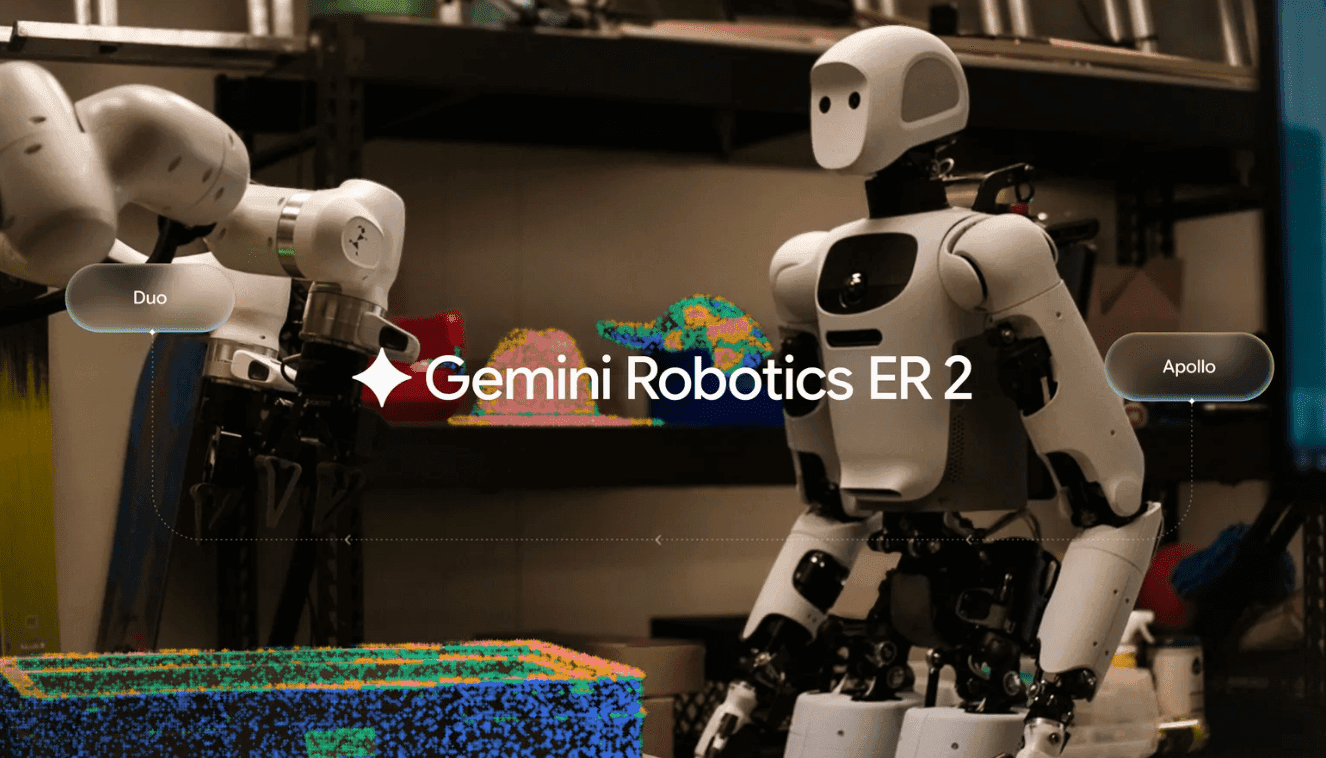
Gemini Robotics 2 Puts Robots in Motion: Whole-Body Control, Dexterous Hands, and Teamwork
AI Brief

Gemini Robotics 2 signals a shift from tabletop demos to whole-body, real-world capability. A unified VLA can drive full humanoid motion while an embodied reasoning agent plans multi-step tasks and coordinates teams of robots. Crucially, an optimized on-device model adapts to new embodiments with hours—not weeks—of data, lowering the cost to expand fleets and vendors. For operators and builders, this means pilots can now target end-to-end workflows—navigation, grasping, packing, and handoffs—rather than isolated skills. The catch: multifinger dexterity still lags, and safety orchestration must mature. The near-term playbook is a carefully scoped pilot with measurable throughput gains, robust uncertainty handling, and a data flywheel that compounds across robot types.

Premium Partner

Featured AI Partner

Promote your AI Tools

Gemini Robotics 2 compresses three threads—whole-body control, dexterous manipulation, and agentic reasoning—into a stack that looks deployable beyond labs. A VLA converts visual and language goals into motor control across legs, torso, and hands, while the ER layer sequences long-horizon tasks and coordinates multiple robots. The on-device variant trims latency and adapts quickly to new embodiments, widening hardware choices without retraining from scratch. Together, these shifts move robotics from single-skill automation toward general-purpose competence in cluttered, human-centric spaces.

For manufacturers, logistics operators, and services, this changes the pilot calculus. Instead of proving a single pick-and-place, leaders can test end-to-end tasks—walk, locate, regrasp, pack, and hand off—within a single control stack. Fast adaptation suggests a path to multi-vendor fleets where one intelligence layer spans humanoids, bi-arm arms, and mobile bases. Investors should read this as a move toward software-led margins: motion transfer and shared data pipelines amortize learning across form factors. But precision on multifinger tasks remains a bottleneck for delicate assembly or kitting at scale.

Execution will hinge on disciplined safety and measurement. The promise of agentic refusal, progress tracking, and collaboration must be backed by guardrails that intervene before unsafe tool calls, with human-in-the-loop playbooks. Teams should instrument evaluation beyond success/failure: cycle time distributions, error taxonomy, near-miss rates, proximity events, and recovery latency. A 90-day pilot should emphasize reliable data collection—teleop traces, human feedback, and failure replays—so adaptation accelerates with every shift and transfers to the next robot body with minimal downtime.

Key Takeaways

Pilot End-to-End, Not Isolated Skills

Use whole-body control and embodied reasoning to validate complete workflows—navigation, grasp, pack, and handoff—with one telemetry and safety surface. This shortens integration and exposes true bottlenecks.

Exploit Fast Adaptation for Multi-Embodiment Fleets

Design your data pipeline so episodes transfer across hands, grippers, and bases. Adaptation in hours enables multi-vendor hardware without re-architecting policies.

Instrument Safety and Recovery, Not Just Success

Track intervention causes, near-miss proximity, recovery latency, and safe-stop frequency. These metrics govern operator load, compliance, and insurability as much as cycle time.

What’s Actually New: From Arms to Whole-Body and Teams

The core change is breadth of control and task horizon. A single VLA can walk, crouch, balance, and manipulate—reducing brittle handoffs between locomotion and manipulation stacks. The ER layer plans multi-minute sequences, tracks events that mark progress, and coordinates different robots to divide work. Practically, this lets you scope pilots around full workflows—room tidying, shelf restocking, or kit packing—rather than building glue logic across separate controllers. It also compresses integration time: fewer APIs, fewer failure points, and one telemetry surface for reasoning and control.

Architecture and Data Flywheel

The VLA maps multimodal observations plus language goals to motor commands, while the ER agent handles task decomposition, tool selection, and self-correction. On-device models reduce latency and network risk, and quick embodiment adaptation (hours, <200 examples reported) implies strong priors and motion transfer. The compounding advantage is data reuse: teleop traces, failure replays, and success demonstrations refine policies that generalize across hands, grippers, and arms. Teams should treat data as an asset: standardize capture (RGB-D, force/torque, proprioception), label outcomes and interventions, and version policies with tight linkage to environment changes.

Deployment Playbook: A 90-Day Pilot That Matters

- Scope one constrained workflow with clear guardrails: e.g., pick, pack, and stage totes on two shelf levels. - Hardware: one humanoid or bi-arm base plus a gripper and a five-finger hand to compare dexterity trade-offs. - Data: collect 150–250 high-quality episodes mixing teleop and autonomous rollouts; log interventions with reasons. - Evaluation: define target cycle time, first-pass success (no regrasp), recovery latency, near-miss rate, and safe stop frequency. - Safety: require prox sensors, geofencing, and agentic refusal checks, with operator takeover under two seconds.

Economics, KPIs, and Where It Pays First

Early ROI is strongest where partial dexterity suffices and variability is high: backroom logistics, e-commerce restocking, and light kitting. Track blended metrics: cost per handled unit (including operator supervision), steady-state cycle time p50/p95, intervention rate per 100 tasks, and time-to-adapt for a new SKU or tool. A realistic goal over 90 days is a 20–35% cycle time reduction with stable safety metrics and <10% intervention rate. The strategic lever is multi-embodiment reuse: spreading one intelligence layer across platforms reduces integration spend and locks in a durable data advantage.

Risks, Safety, and What Still Breaks

Multifinger dexterity remains inconsistent for fine assembly and deformables, and longer sequences can drift without reliable event detection. On-device models mitigate latency but raise scheduling and thermal constraints; expect occasional policy slowdowns under high load. Safety orchestration must refuse unsafe motions, predict task impossibility, and escalate to humans early. Adopt red-teaming for proximity, pinch, and topple scenarios; require immutable safety layers (E-stops, torque limits) independent of the learning stack; and log safety tool calls for audit. Regulatory alignment for collaborative operation will demand documented hazard analyses and repeatable test suites.

Frequently Asked Questions

Is this ready for brownfield warehouses with clutter and people nearby?

Yes for scoped tasks like restocking or kitting on limited aisles with strict geofences and operator supervision. Require prox sensors, independent E-stops, agentic refusal checks, and p95 cycle-time targets. Start with off-peak shifts and expand by aisle, not by facility.

How much data do I need to adapt to a new robot or SKU?

Plan for 150–250 high-quality episodes per new embodiment or SKU variant to see meaningful gains—balanced across success demonstrations, teleop corrections, and failure replays. Prioritize diversity: lighting, placements, container types, and handovers. Version policies tightly with environment changes.

How do I avoid vendor lock-in while using a unified stack?

Standardize data formats (RGB-D, proprioception, force), log schemas, and evaluation suites. Maintain a hardware abstraction layer and keep safety interlocks vendor-agnostic. Choose models that demonstrate cross-embodiment transfer and insist on exportable telemetry and policy artifacts.

#google deepmind#Physical AI Systems#embodied intelligence#foundation models for robotics#Humanoid Robotics#robot manipulation#Humanoid Manipulation#In-Hand Manipulation#Human-Robot Collaboration#Human-Robot Interaction#On-Device Reasoning#edge inference for robots#vision-language grounding#Action Models#embodied ai#Vision-Language-Action (VLA)#humanoid robots#Dexterous Manipulation#Multi-Robot Collaboration#On-Device Robotics#Robotics Safety#Embodied Reasoning#Motion Transfer#Robot Fleet Orchestration

AI Insight Newsletter

Get the latest AI updates, tool news, and insights delivered to your inbox.

No spam. Unsubscribe anytime.
On This Page
1.What’s Actually New: From Arms to Whole-Body and Teams2.Architecture and Data Flywheel3.Deployment Playbook: A 90-Day Pilot That Matters4.Economics, KPIs, and Where It Pays First5.Risks, Safety, and What Still Breaks
Share this article

Related Articles

Pacing the Frontier: Building Brakes for Self‑Improving AI Before It Outpaces Safety
AI Model & Platform Updates

Pacing the Frontier: Building Brakes for Self‑Improving AI Before It Outpaces Safety

Jul 29, 2026

AI-Accelerated Vulnerability Discovery Is Overloading Patch Tuesday Operations
General AI Industry News

AI-Accelerated Vulnerability Discovery Is Overloading Patch Tuesday Operations

Jul 20, 2026

ZML LLMD Targets Multi-Chip LLM Inference Without Nvidia Lock-In
AI Product News

ZML LLMD Targets Multi-Chip LLM Inference Without Nvidia Lock-In

Jul 9, 2026

NEO’s 25‑DoF Tendon Hands Make Humanoids Read‑Write Instruments
AI Model & Platform Updates

NEO’s 25‑DoF Tendon Hands Make Humanoids Read‑Write Instruments

Jul 15, 2026

GPT-5.6 Turns Frontier AI Into a Scalable Work Engine
AI Model & Platform Updates

GPT-5.6 Turns Frontier AI Into a Scalable Work Engine

Jul 10, 2026

Related AI Tools

View All
Gemini Robotics 2: Vision-Language-Action and Embodied Reasoning Models for General-Purpose Robots

Gemini Robotics 2: Vision-Language-Action and Embodied Reasoning Models for General-Purpose Robots

Robotics & Physical AI

1X: NEO Humanoid Home Robot for Chores & Physical AI Assistance

1X: NEO Humanoid Home Robot for Chores & Physical AI Assistance

Robotics & Physical AI

Sponsored AI Tools (0)

Promote your AI Tool