

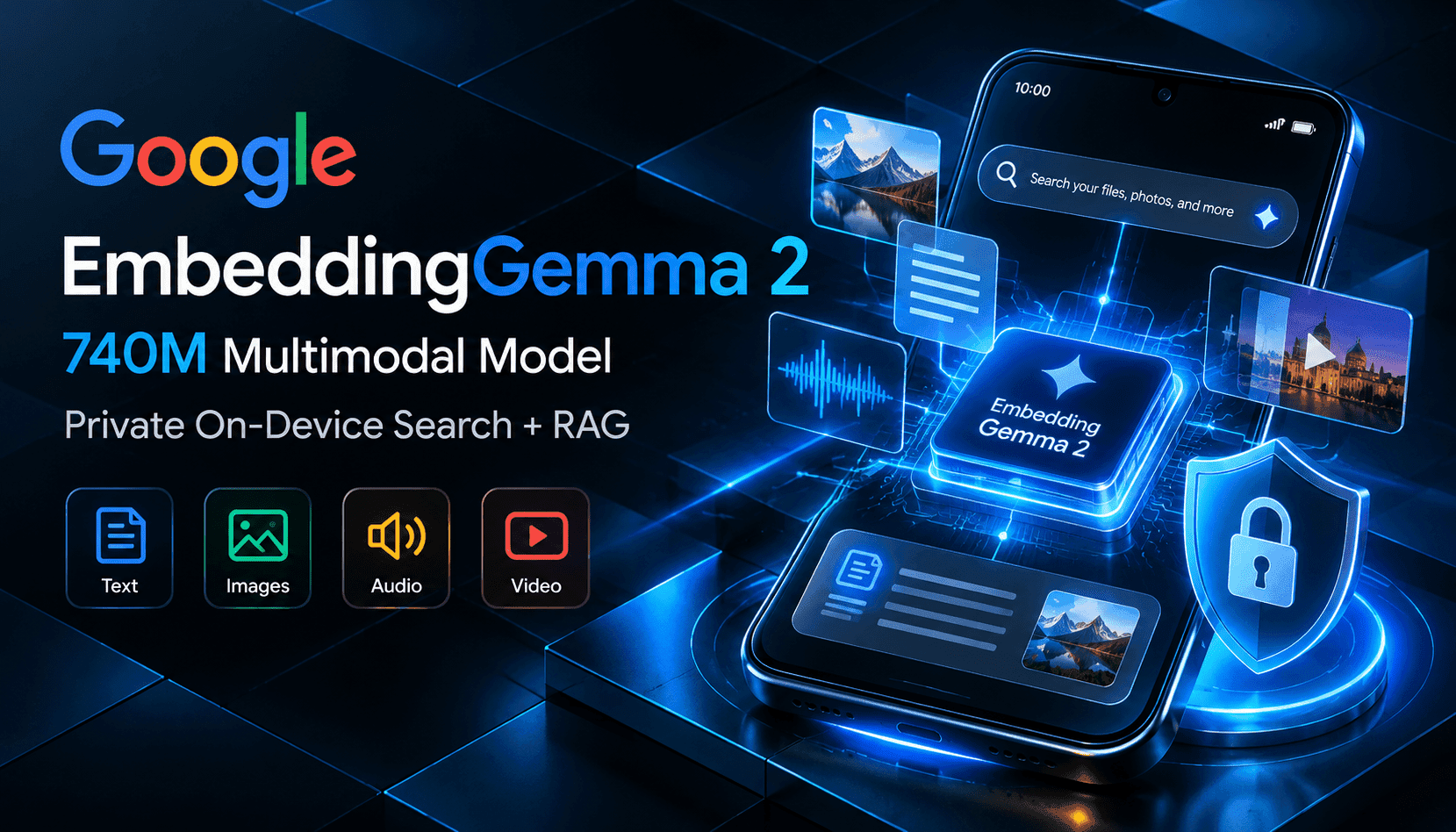
EmbeddingGemma 2 marks a pragmatic, developer-focused step toward truly private multimodal search. At 740 million parameters and released under Apache 2.0, the model is explicitly designed for on-device inference: it combines a compact core with optional modular encoders so teams can tailor the footprint to text-only or full multimodal needs. That combination of permissive licensing and practical sizing lowers the barrier for embedding-driven features in consumer apps, enterprise agents, and local-first RAG systems that cannot send user media to cloud services.
Technically, EmbeddingGemma 2 is notable for two linked efficiencies. First, its modular architecture allows text-only deployments at ~270M parameters, with additional vision and audio encoders available as needed. Second, Matryoshka Representation Learning (MRL) allows vectors to be truncated from 768 down to 512, 256 or 128 dimensions, delivering up to 6x storage reduction for local vector databases. For product teams, that reduces device storage and memory pressure without requiring separate low- and high-dimensional indexing pipelines.
From a quality perspective, the model punches above its size class across text, code, image and audio benchmarks. Google reports meaningful improvements on code embeddings and parity with larger models on vision and audio tasks, which makes EmbeddingGemma 2 especially useful for coding-agent retrieval and unified media searches. Because it shares tokenizers and audio encoders with larger Gemini models, the model integrates smoothly into RAG pipelines where a generative model supplies reasoning while embeddings handle retrieval.
For practitioners, the value is practical: run semantic search over voice memos, locate exact video moments with short text queries, or power codebase indexing locally. On-device deployment metrics are realistic — quantized weights that fit within a few hundred megabytes of RAM on common flagship hardware — and the extended 8K token context means the same embedding pipeline can handle longer audio clips and interleaved multimodal inputs without frequent truncation. That simplicity lowers engineering overhead for privacy-centric features.