

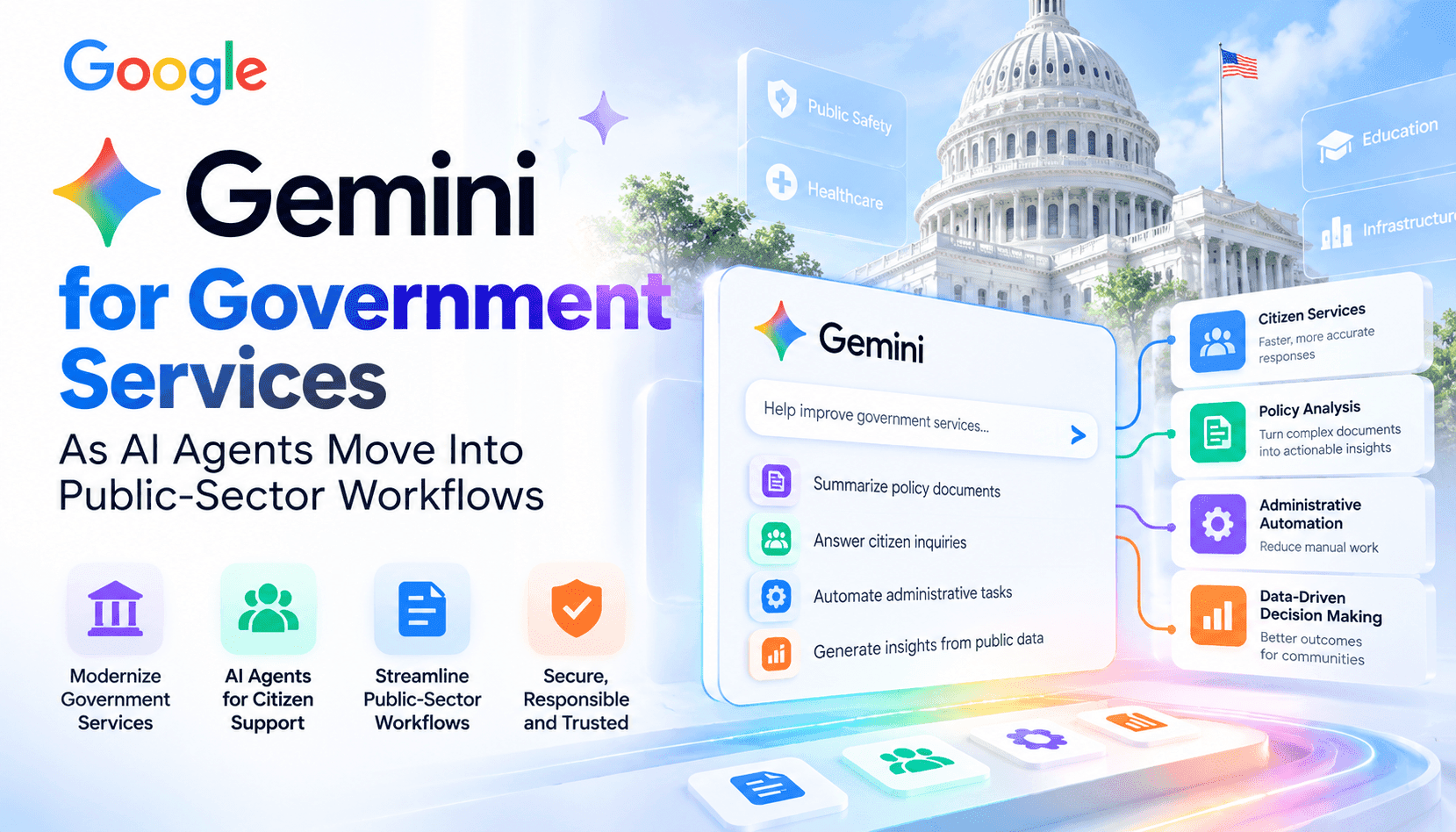
Google’s Gemini for Government Services packages the Gemini agent with government-specific skills, secure connectors, partner agents and a central governance plane. Unlike consumer-facing copilots, this offering is explicitly built to respect statutory constraints, personnel and data residency requirements, and the patchwork of legacy systems agencies run. By surfacing citations to source documents, tying actions to identity and role controls, and partitioning workloads by cost and reasoning requirements, Gemini aims to make agent automation operationally acceptable inside public-sector workflows rather than a risky experiment.
The practical use cases are concrete and immediate. Agents can automate FOIA discovery by scoping custodian- and date-bound searches across archives, propose statute-labeled redactions and produce audit-ready exports. They can ingest grant invoices and audit line items against Uniform Guidance, detect unallowable costs, and generate citations so auditors can triage exceptions faster. In procurement, agents can score multi-volume bids against RFP criteria and FAR rules, producing documented rationales that reduce back-and-forth and speed award decisions. These are not speculative benefits; they map directly to labor-intensive, citation-heavy tasks that agencies struggle to staff efficiently.
Government deployments change the engineering and product requirements. Agents must honor record-level permissions in systems of record, execute inside an agency’s cloud perimeter, and never use constituent data for model training without explicit consent. That requires hardened connectors, VPC and CMEK configurations, Assured Workloads-style personnel controls, and an auditable control plane that enforces policy across skill libraries and partner agents. The operational costs are not just compute; agencies must build governance playbooks, approvals for consequential steps, and reviewer workflows to preserve accountability.
For vendors and systems integrators, Gemini for Government Services changes the value equation. Pre-built partner agents accelerate deployments for common tasks like FOIA discovery and redaction, but agencies still need integration work to align connectors, templates, and SOPs. System integrators that can codify agency rules into reusable skills, validate outputs against authoritative sources, and implement human-in-the-loop gates will capture the bulk of early project value. Investors and procurement leads should evaluate partners on their experience with compliance frameworks, not just model performance.