

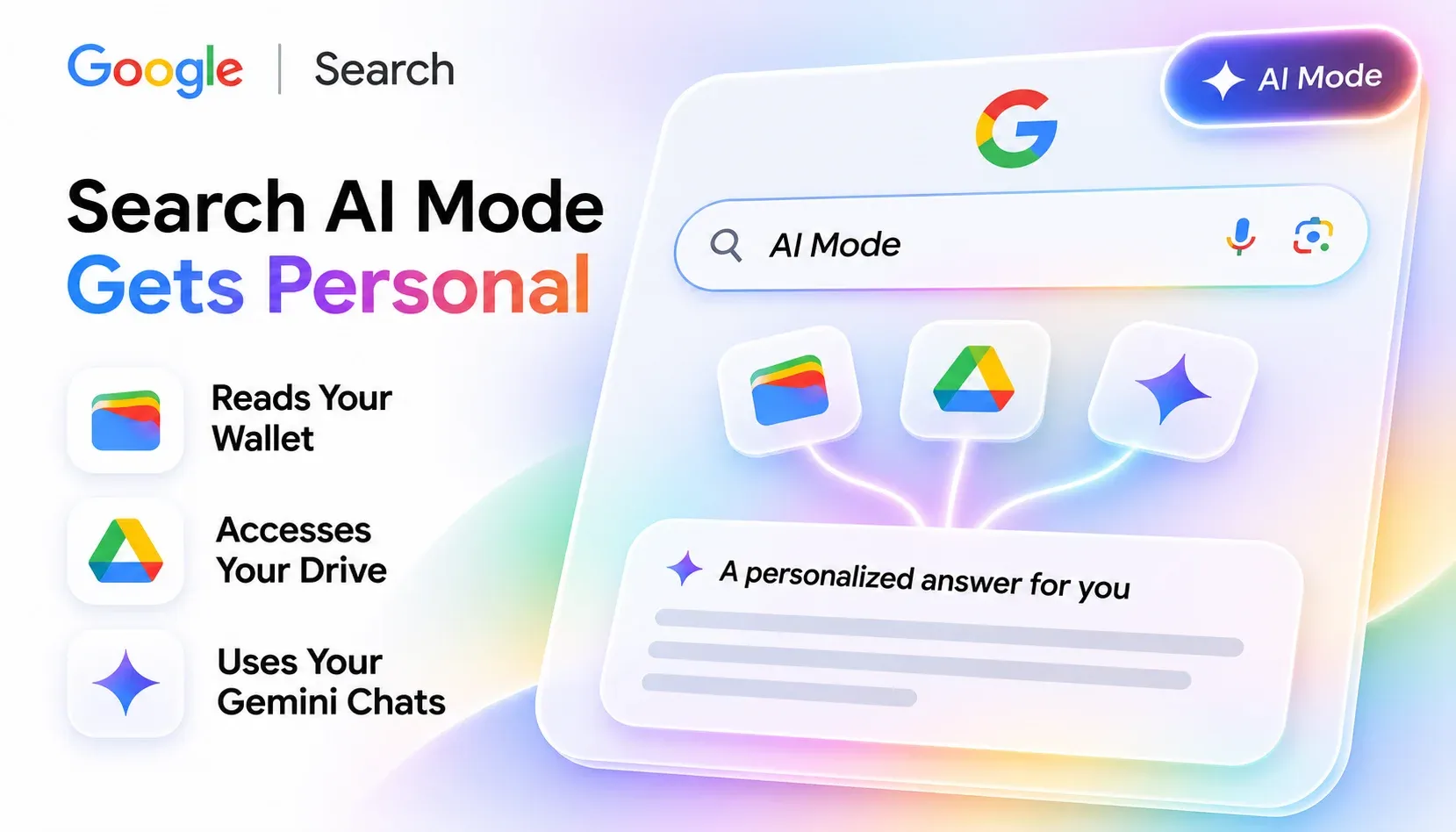
On November 23 Google extended Personal Intelligence in AI Mode so users can opt in to connect Google Wallet, with Google Drive and the Gemini app to follow. The move stitches more of a user’s private digital life—spending histories, documents, and conversational threads—into Search’s generative layer. Unlike a standalone chatbot that only reasons from session inputs or web context, Search can now draw on years of privately held signals to shape responses. For product teams, that combination enables new value: search results that factor in your financial habits, a project plan that reads across your spreadsheets, or a research summary that picks up where your Gemini chat left off.
Practically speaking, Google describes Wallet access as read-only: AI Mode can read purchase and card metadata to identify spending patterns or card-reward opportunities but cannot move funds or execute transactions on the user’s behalf. Drive integration will allow Search to synthesize scattered files—documents, slides, and sheets—into concise, task-ready outputs such as a tax-prep checklist that references specific spreadsheets. Gemini connections mean conversational context can travel between the phone-based Gemini app and Search AI Mode, reducing repetition and improving thread continuity across devices and touchpoints.
For decision-makers — founders, product managers, and enterprise buyers — the update has three immediate practical implications. First, designers must surface clear affordances and revocable consent screens so users understand what data is read and how it’s used. Second, analysts building internal search or assistant layers should reconsider how private signals augment retrieval and prompting pipelines. Third, security and compliance teams need to test policy boundaries: read-only access still introduces inference risks and affects downstream logs, caching, and third-party export behavior.