

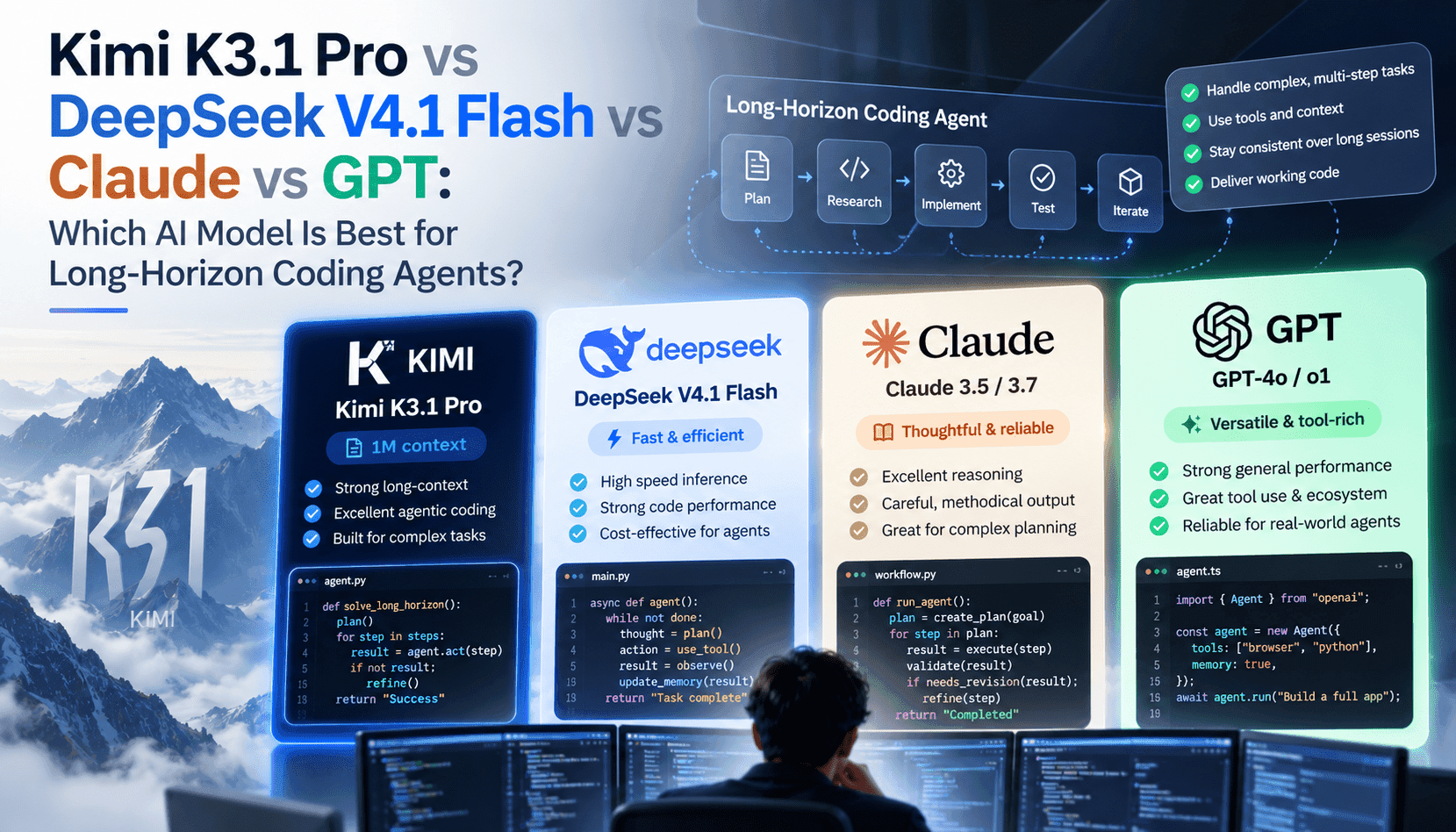
Long‑horizon coding agents are evaluated on a different axis than single‑turn code completion. They need durable reasoning across many tool calls, robust state caching across sessions, efficient delta updates, and predictable cost per developer task. Kimi K3.1 Pro’s 1M-token window and thinking-mode primitives explicitly target this flow; DeepSeek’s Flash variant prioritizes latency and streaming throughput, Claude emphasizes safety and controllable reasoning, and GPT-class models bring a broad ecosystem and often the best-in-class conversational toolchain. For engineering teams, the question is not which model is objectively “best” but which fits their repository size, CI/CD cadence, budget profile, and risk tolerance.
Practical tradeoffs emerge when you map model features to agent workflows. A 1M context helps when agents must reason about histories spanning multiple modules, long design docs, and cumulative tool outputs—think multi‑PR refactors or cross-repo migrations. But that power is only useful if the agent uses selective compaction, retrieval-augmented prompting, and session cache strategies to avoid sending irrelevant tokens. Faster inference (K3.1 Pro Highspeed or DeepSeek Flash) shortens wall‑time and reduces developer wait, yet cost per token, batch sizing, and I/O overhead determine whether faster models actually lower operating expense in production.
Open‑weight models change the deployment calculus: teams can run agents on private hardware, control telemetry, and avoid vendor lock‑in, but they inherit operational burdens—serving latency, sharding long context, and keeping safety filters updated. Proprietary frontier models still buy time: better out-of-the-box reasoning, integrated tool ecosystems, and managed guardrails reduce engineering lift. The right choice depends on whether the organization prioritizes data privacy and on‑prem latency or wants to minimize integration effort and rely on provider SLAs for safety updates and model improvements.
Beyond raw capability, evaluate how models behave inside multi‑tool agents: do they support deterministic tool call specifications, structured thinking modes, streaming tool outputs, and permissioned approvals? Kimi’s thinking mode and session controls aim to reduce hallucination across long flows; DeepSeek’s Flash performance reduces timeouts in tight CI loops; Claude’s safety-first heuristics make it attractive for enterprises with strict compliance needs; and GPT-class models benefit from rich ecosystem connectors and third‑party orchestration frameworks. Weigh each model’s integration friction, auditability, and recovery behavior when a tool fails mid-plan.