

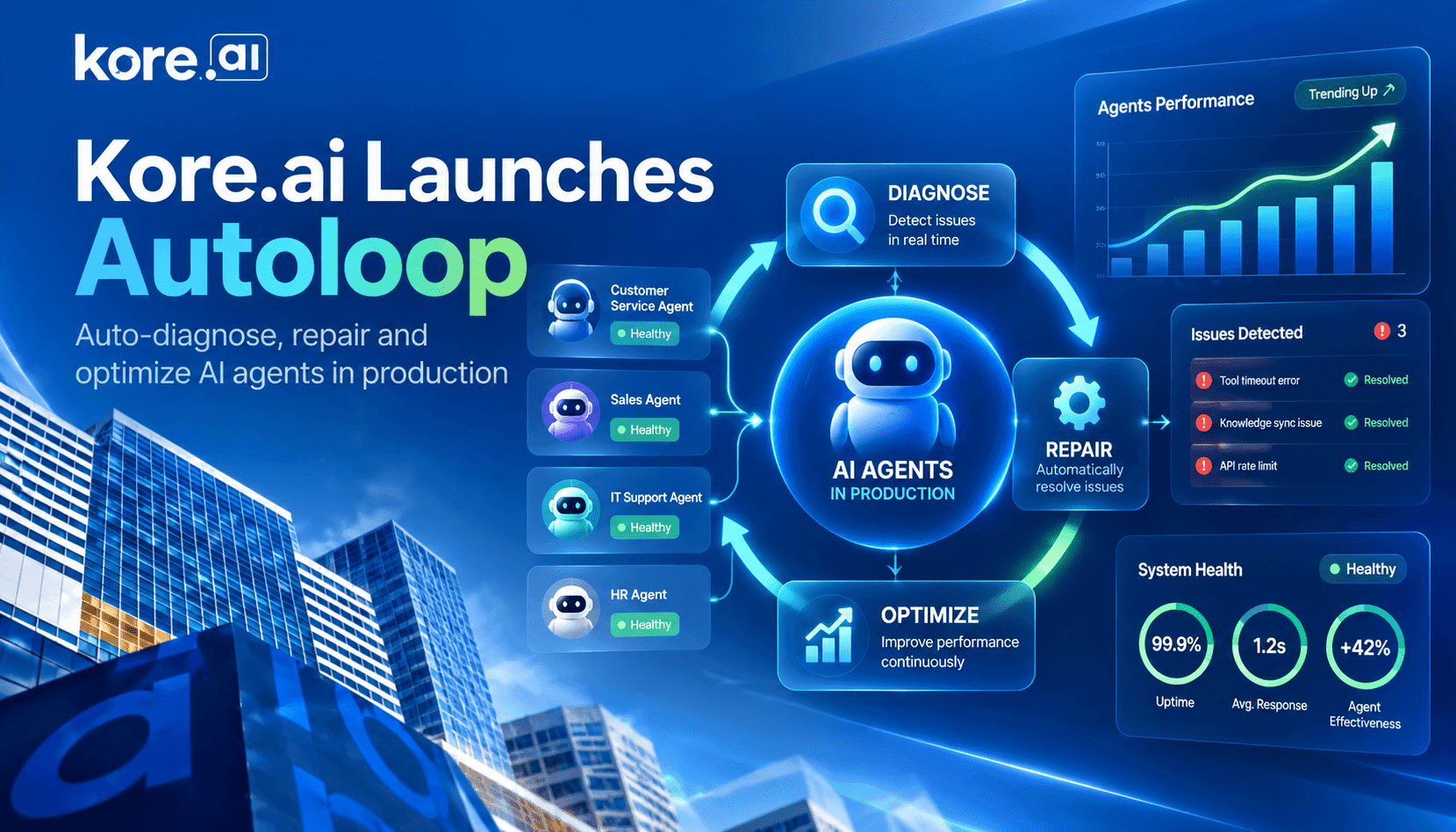
Kore.ai’s Autoloop is not another paraphrase-and-test optimizer; it’s an operational engine built to keep complex agent networks reliable at scale. Rather than relying solely on a single aggregate score and model-generated patches, Autoloop pairs deterministic diagnostics with targeted, compile-level repairs. Runtime traces follow a user turn across handoffs, state changes, tool calls and routing decisions so teams can see which exact construct created a failure. That visibility lets the system apply a surgical fix—a routing rule change, a contract correction, or a small blueprint edit—and then re-run a full verification suite that checks all seven configured goals before accepting the change.
The value proposition is practical: manual review and trial-and-error patches break down as agent landscapes grow. In enterprises, agents are rarely standalone. They share verification state, call internal tools, and depend on routing and contract contracts that do not surface in conversation transcripts. A human reviewer can miss a silent state omission—no log, no obvious error—yet that omission can permit unauthorized actions or create a downstream failure. Autoloop’s StateTrace exposes those silent handoffs and ABL (Agent Blueprint Language)-aware repair mechanisms let the system change the exact construct rather than rewriting prompts or applying surface-level mitigations.
Operationally, Autoloop enforces a readiness ladder for every journey: compilation, contract completeness, simulation, robustness tests and behavior validation. Proposed changes must pass gates that validate against the full goal set—task completion, accuracy and grounding, business-rule adherence, token/cost efficiency, end-user experience, robustness, and guardrails/safety. This gate model prevents improvements in one axis from regressing another, for example preventing a prompt tweak that reduces token cost but breaks identity verification and thus fails business-rule adherence.
For teams, Autoloop supports three operating modes: Autopilot applies verified changes automatically, Copilot proposes changes for human approval, and Advisor recommends fixes without applying them. That design recognizes governance boundaries: some repairs (identity, legal policy, or financial routing changes) should be approved by humans, while low-risk optimizations can be automated. The system also surfaces non-automatable blockers—missing tools, unavailable datasets, or policy decisions—so teams know when human work or new capabilities are required.