

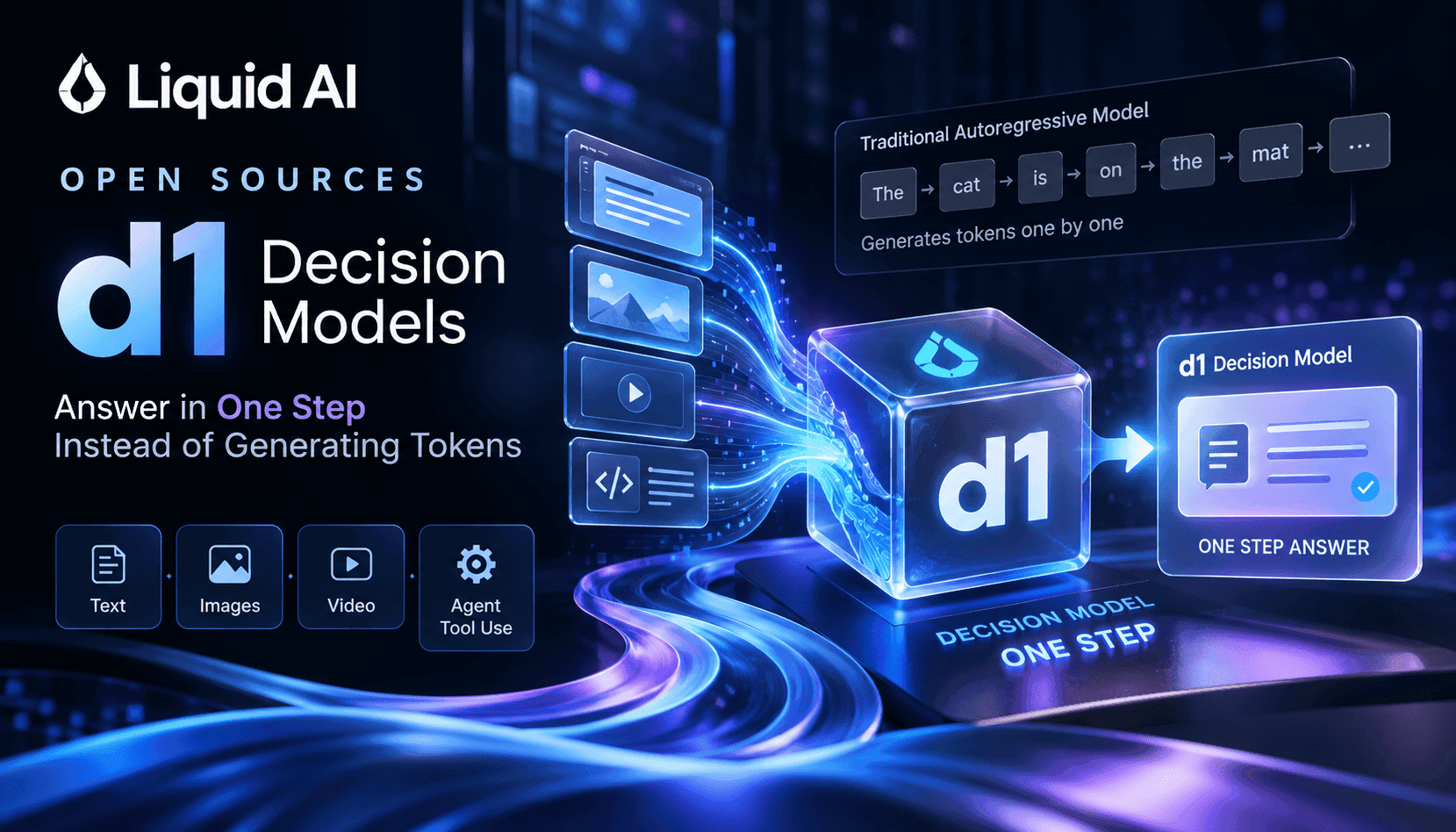
Liquid AI’s d1 release marks a deliberate shift away from autoregressive token generation toward models designed to emit structured decisions: calibrated probability distributions over discrete labels in one forward pass. Unlike LLMs that compose answers token by token, these decision models evaluate an input and return a compact vector of confidences. That change looks subtle at the API level but has major implications for systems that need deterministic, fast, and auditable outcomes rather than conversational text.
Practically, d1-3B and d1-omni-600M are targeted at scenarios where throughput and interpretability matter more than generative fluency. Ticket routing, spam filtering, content moderation, manufacturing quality-control triage and industry classification benefit from a single-step decision because it shortens the request path, removes decoding variance, and yields probabilities that can be thresholded, calibrated, logged, and fed into downstream rule engines or automation pipelines without extra parsing or hallucination risk.
For engineers and product owners, the operational lift is real: deterministic outputs simplify monitoring, reduce retries triggered by tokenization quirks, and lower compute costs because you avoid autoregressive decoding loops. For compliance and audit trails, a probability vector plus a model version is easier to record and reason about than free-form text. That said, adopting decision models requires new evaluation practices — you must validate calibration across production slices and design pragmatic fallback behavior for out-of-distribution cases.
This article walks through what changed, how to measure the value of one-step decision outputs, deployment patterns at the edge and cloud, integration pitfalls, and a short operational checklist for teams that want to replace token-generation solutions with calibrated decision models in production workflows.