

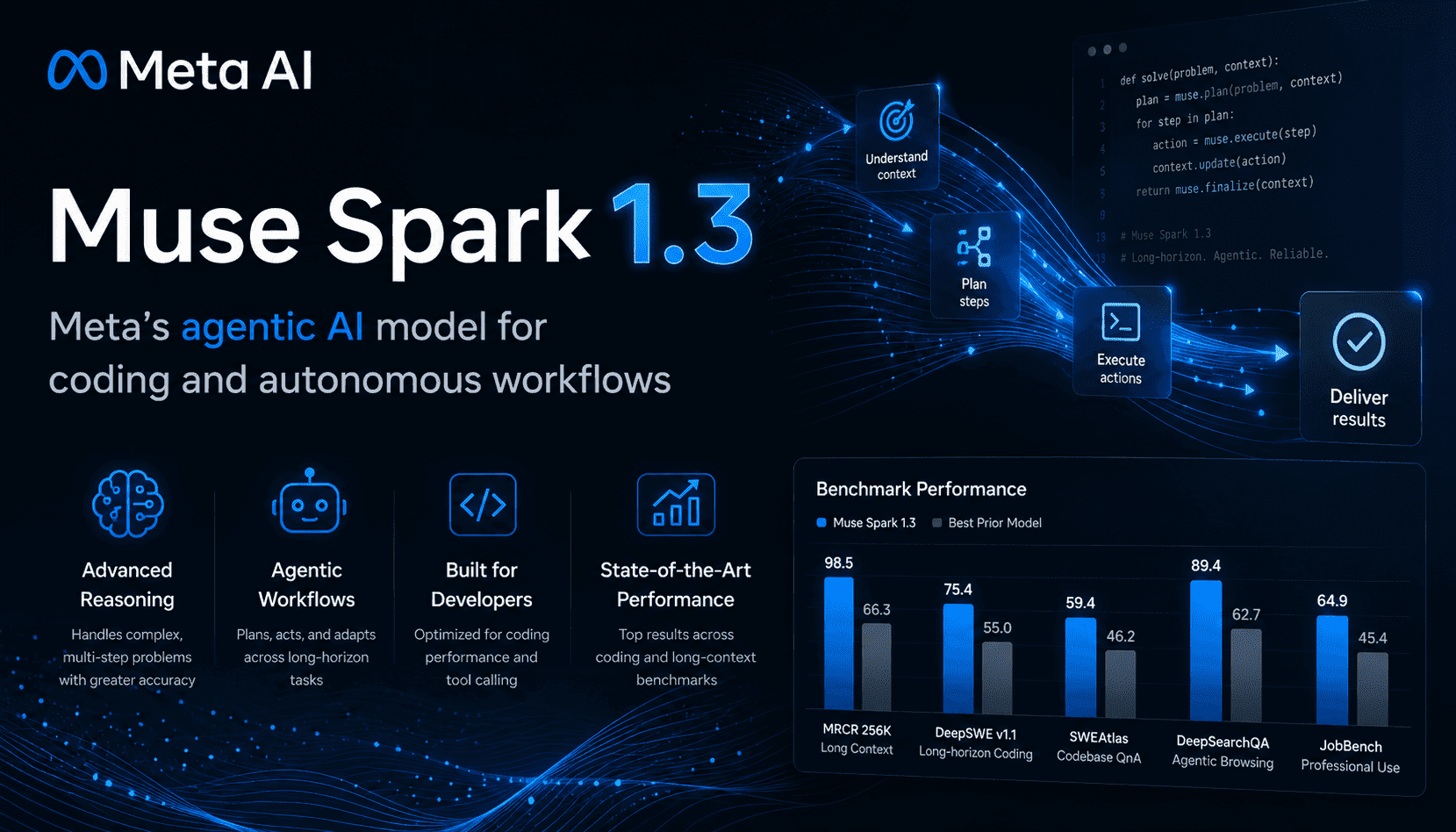
Meta’s latest Spark 1.3 centers on a practical question dominating the agent race: can a smaller, faster model shoulder always-on work without burning the budget? The update targets better coding quality, sturdier tool use, and lower perceived latency—precisely where agents spend most of their time. In a week crowded with model refreshes across the industry, Spark’s differentiation isn’t a single dazzling benchmark but an operational thesis: keep tokens cheap, cycles short, and loops predictable so developers can leave agents running continuously for code maintenance, integration plumbing, data chores, and ticket routing.
For coding agents, reliability often hinges on structured outputs, function calling fidelity, and recovery from partial failures. Spark 1.3 is positioned to improve those areas, which matter more than headline pass rates once an agent orchestrates tools, repos, and CI. The result should be fewer “stall” states, less verbose chain-of-thought bloat, and faster correction cycles. If the update meaningfully reduces retries while keeping price parity with the prior Spark, the effective cost per successful action drops—freeing teams to allocate budget to context windows, memory stores, and evaluation harnesses rather than raw model spend.
Agent economics depend on three levers: action success rate, tokens per loop (including tools), and loop cadence. A lighter model wins when it raises success probability enough that retries don’t erase its price advantage. Conversely, if your tasks are open-ended research or multi-tool planning with fragile preconditions, a frontier model may still pay off by consolidating steps. Spark 1.3’s promise is to move routine, repetitive code and integration work below the frontier line—where deterministic wrappers, schema checks, and CI feedback can contain errors without human intervention.
Teams should pilot Spark 1.3 in two lanes: (1) persistent coding bots that prune lint, bump dependencies, fix flaky tests, and generate scaffolding; and (2) integration agents that read API specs, propose adapters, and maintain connectors. Track cost-to-closure with a simple model: monthly cost ≈ (avg tokens per loop × loops/hour × hours/day × days)/1e6 × price per MTok. Instrument retries, tool errors, and PR acceptance rates. If Spark holds accuracy while shrinking tail latency and rework, it becomes the default for 24/7 agents, reserving premium models for escalations and reviews.