

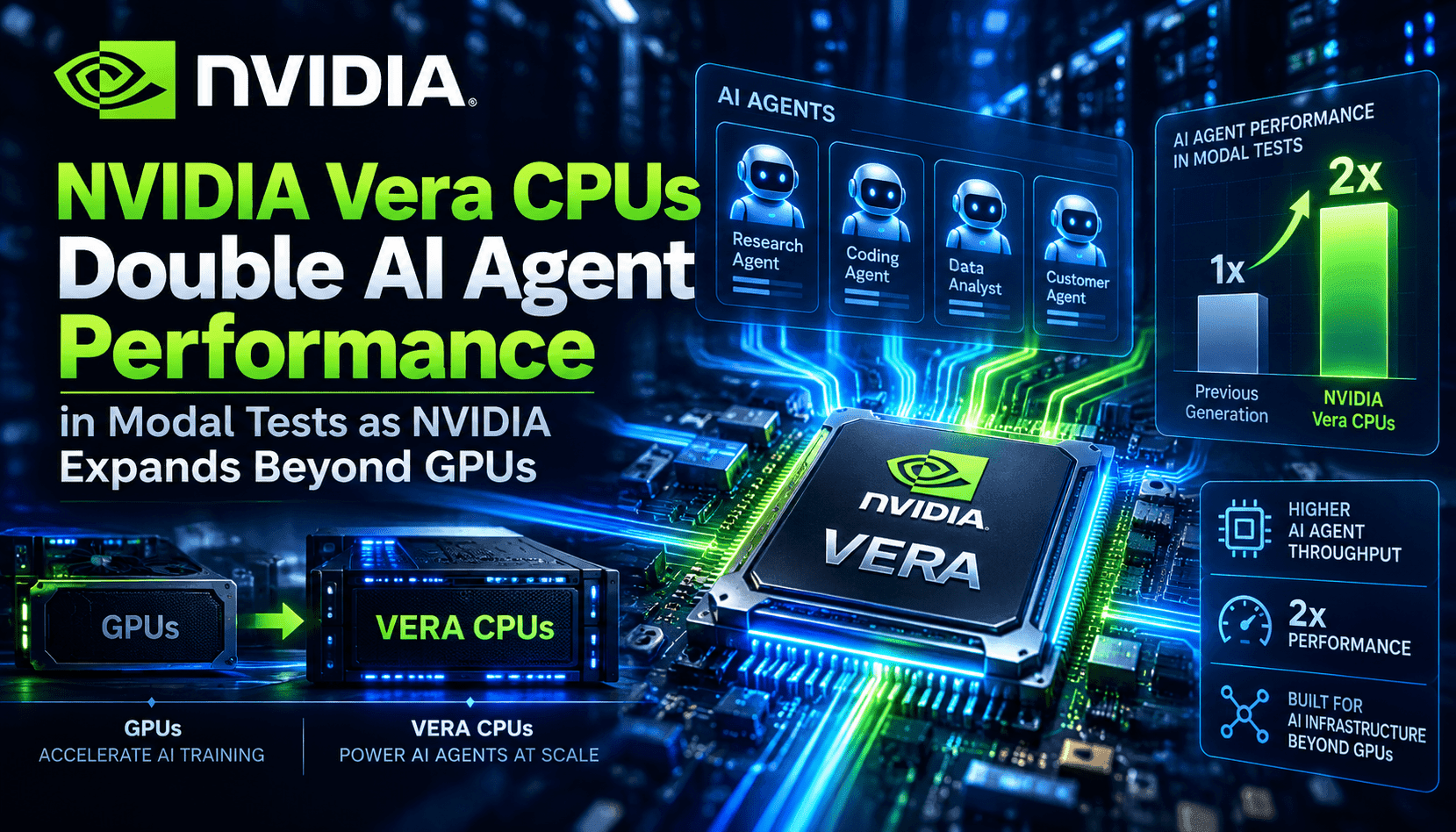
Modal’s early infrastructure tests with NVIDIA’s Vera processor reportedly show roughly double the task performance of comparable Intel and AMD systems when running long‑lived AI agents. Those agents spend a lot of cycles orchestrating tools, managing context windows, serializing and deserializing data, and handling conditional logic between GPU calls. In that mixed workload, CPU microarchitecture, memory throughput and system I/O latency matter more than raw GPU FP performance. Modal’s result is not a universal benchmark, but it signals that shifting some performance-critical work back onto a modern CPU design can materially improve end‑to‑end agent throughput.
CPUs regain prominence for agent workloads because those systems are not just running dense matrix multiplies: they manage event loops, orchestrate multi‑step reasoning, handle retrieval and enrichment, and implement tool integrations. These tasks create many small, latency‑sensitive operations and unpredictable memory access patterns where single‑thread performance, cache behavior and memory bandwidth matter. A CPU that reduces syscall latency, speeds serialization, and sustains high throughput for many concurrent lightweight threads will cut wall‑clock time for agents far more than adding GPU flops. That shift changes where performance optimizations and cost tradeoffs deliver the biggest gain.
NVIDIA’s dual strategy — Grace for memory‑centric workloads and Vera for CPU tasks — aims to stitch a coherent platform where GPUs remain the heavy inference engines while CPUs and memory fabrics shoulder orchestration and data plumbing. For cloud and on‑prem providers this can simplify system balance: fewer CPU bottlenecks feeding GPUs, tighter memory coherency for context windows, and reduced overhead in multi‑node agent pipelines. The practical caveats: early silicon and software stacks need maturity, compilers and runtimes must be tuned, and total cost of ownership depends on actual workload mixes, not headline throughput numbers.