

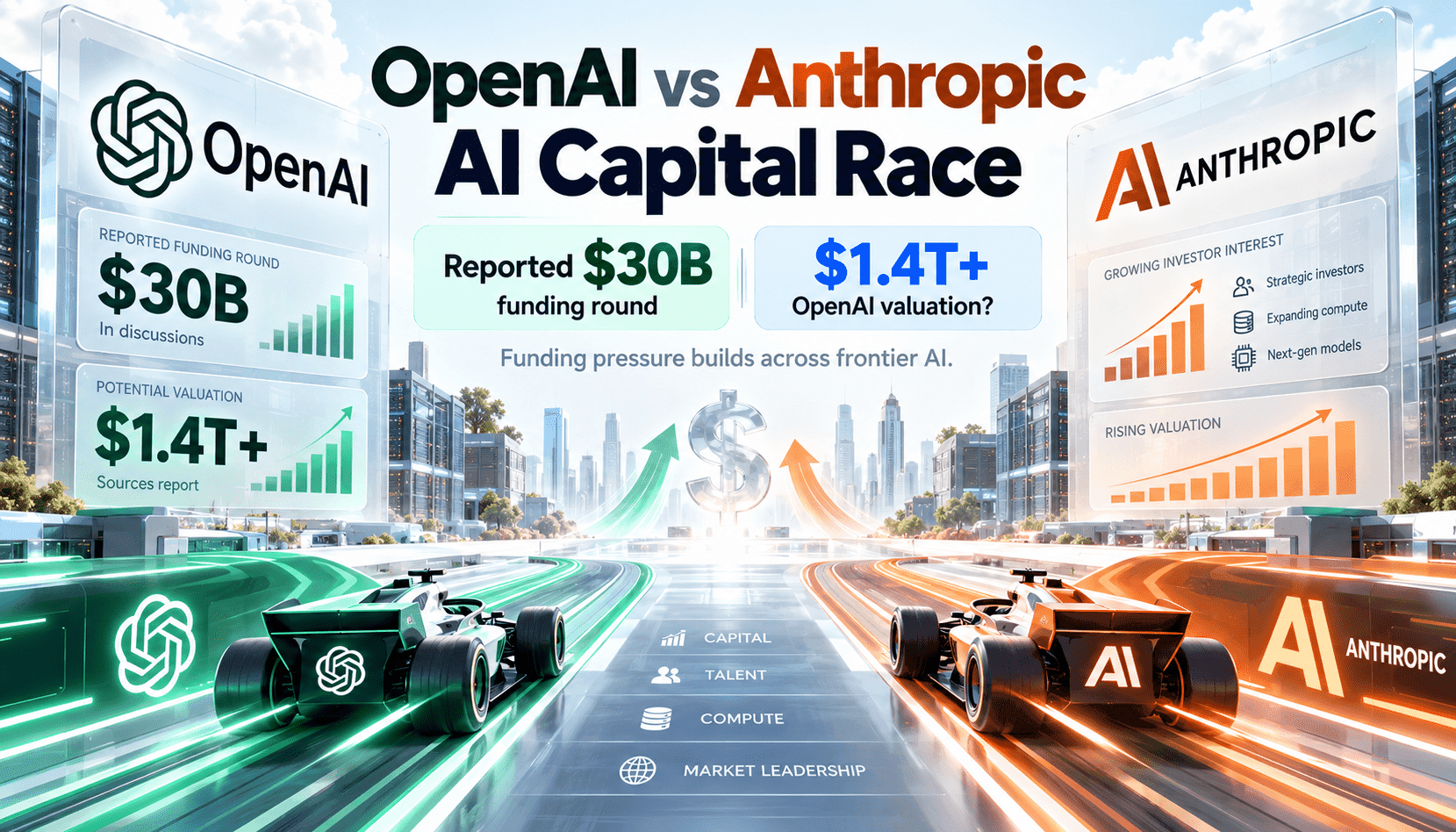
The headlines about a $1.4 trillion implied valuation obscure the more consequential story: frontier-model companies are rapidly converting recurring API receipts into commitments that look and feel like capital projects. OpenAI’s reported drive to speed a roughly $30 billion raise is an attempt to square expanding top-line revenue with the fixed, long-duration obligations tied to GPUs, custom racks, data-center capacity and specialist engineering. For operators and investors, the question is not whether revenue exists today but whether that revenue scales quickly enough and with sufficient margin to service multi-year infrastructure economics.
Revenue growth in AI platforms is real and accelerating, but the unit economics differ from typical SaaS. Each step-up in model capability usually requires orders-of-magnitude increases in training compute, persistent inference fleets and attendant engineering support. Margins on API calls can be attractive at scale, but they are highly sensitive to model size, latency requirements, and customer SLAs. That sensitivity forces a mix of strategies — long-term cloud commitments, custom co-location deals, and even self-funded data-center builds — and each strategy has a different capital and operating profile that raises questions about dilution, leverage, or operating partnership.
Investors face trade-offs: underwrite fast share-of-wallet growth for large enterprises at the cost of underwriting heavy upfront capital commitments, or demand capital discipline and slower capability rollouts. A large pre-IPO or late-stage round can do more than tidy up a cap table; it can secure multi-year vendor commitments, buy down per-hour costs via bulk hardware purchases, and shield operations from cyclical GPU supply shortages. But raising at scale also concentrates execution risk: missed efficiency gains or lower-than-expected enterprise monetization would magnify the burn problem.
For customers, partners and competing startups, the capital race reshapes procurement and partnership calculus. Enterprises negotiating deals should extract more predictable pricing, capacity allocation guarantees, and clear SLAs tied to model versions. Cloud providers will use capital-rich incumbents to lock in long-term demand, intensifying bilateral dependency. Startups building on top of these platforms must model both API price volatility and the risk that providers prioritize captive enterprise features over open-platform economics.
Finally, policymakers and corporate boards should track how these funding patterns translate into market concentration and systemic risk. Very large funding rounds can accelerate capability but also raise questions about resilience — single-vendor outages, geopolitical exposure in supply chains, and incentives that favor scale over safety or cost efficiency. For strategic buyers and investors, the immediate task is pragmatic: stress-test vendor economics under multiple compute-cost and customer-adoption scenarios, and plan contractual protections accordingly.