
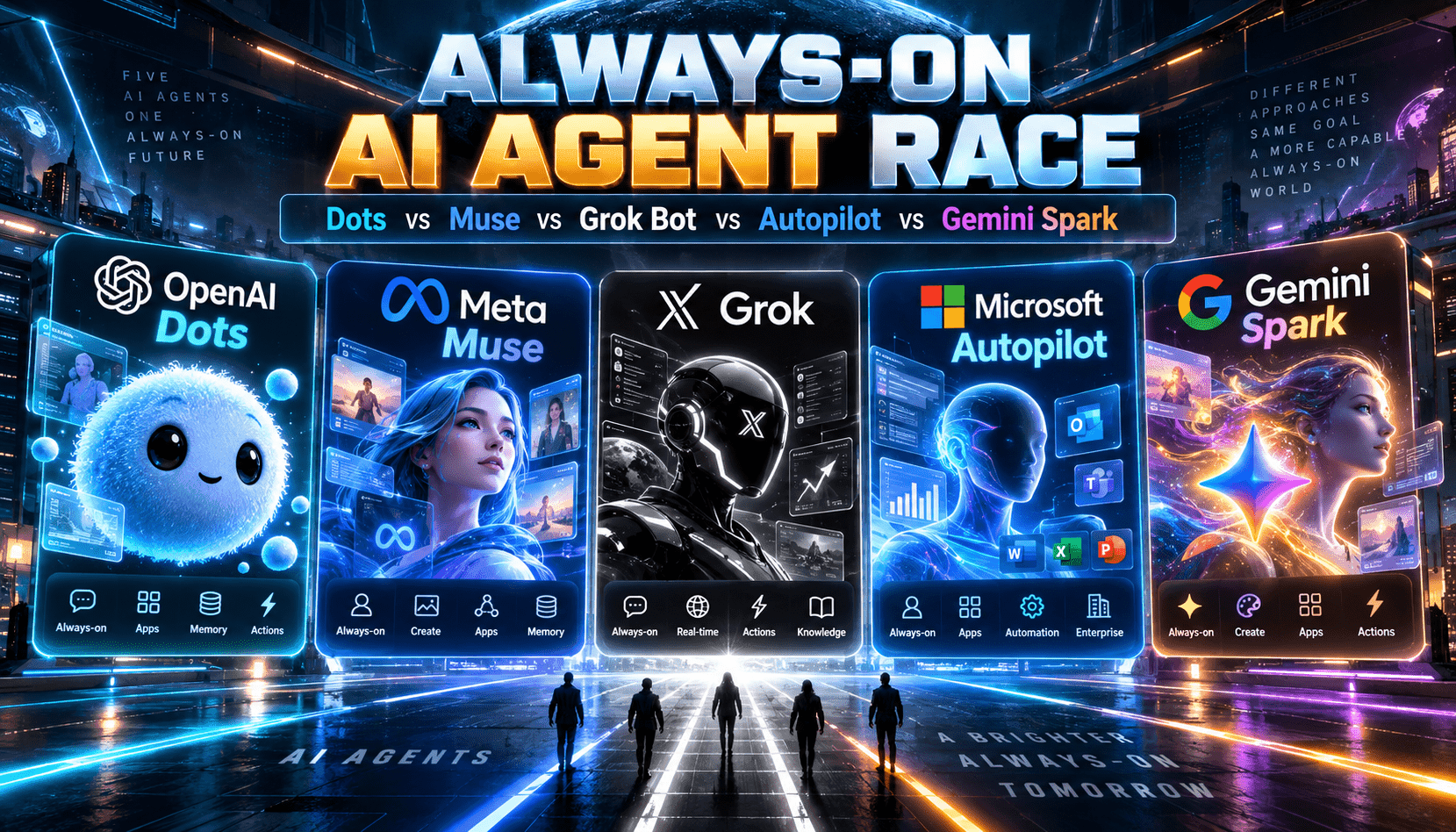
Always-on agents are graduating from chat to continuous work. OpenAI’s Dots center the model on a dedicated cloud computer and first‑class browser that can research, draft, and execute tasks across connected apps. Meta Muse leans into ambient presence across social and messaging surfaces. Grok Bot emphasizes fast, web‑aware reasoning with a looser, generalist persona. Microsoft’s Autopilot threads through the Microsoft 365 substrate with deep graph context. Gemini Spark pushes multi‑surface reach across Google’s properties. Together, they are testing where persistent autonomy lives and how much control users must retain.
The design fork is not cosmetic: it determines how these agents behave when you log off. Dots explicitly promise background “proactive research,” gated by read‑only defaults and action reviews for sensitive steps. Autopilot inherits Microsoft’s enterprise identity, permissions, and lifecycle policies, making it the most familiar for IT but also the most policy‑bound. Muse and Grok skew personal and conversational, prioritizing responsiveness and lightweight actions over heavy, auditable workflows. Spark sits between search, Workspace, and Android surface integrations, with an emphasis on quick context carryover rather than long‑running projects by default.
In the enterprise, Salesforce Agentforce and Oracle Fusion Claw point to a different archetype: governed agents with explicit roles, scoped credentials, and system‑of‑record guardrails. These agents are less about ideation and more about reliable execution inside CRM/ERP boundaries—invoice routing, entitlement checks, quoting, and controlled outreach—where approvals, audit trails, and data residency trump speed. Expect tiered autonomy: background read‑only monitoring, self‑service execution within safe envelopes, and mandatory human sign‑off for anything that affects customers, cash, or compliance.
For buyers, the practical question is not who “thinks” best, but which agent can safely act. Evaluate five axes: compute substrate (own cloud computer vs browser automations), app connectivity (breadth of plugins and native suite depth), memory and identity (personalization vs enterprise directory), approvals and observability (action reviews, activity views, system logs), and governance (policy inheritance, data boundaries, incident response). Personal agents will shine in creative drafting and small automations; enterprise agents will win on repeatable outcomes, SLAs, and compliance. Many organizations will deploy both—so integration and policy alignment matter more than persona.