

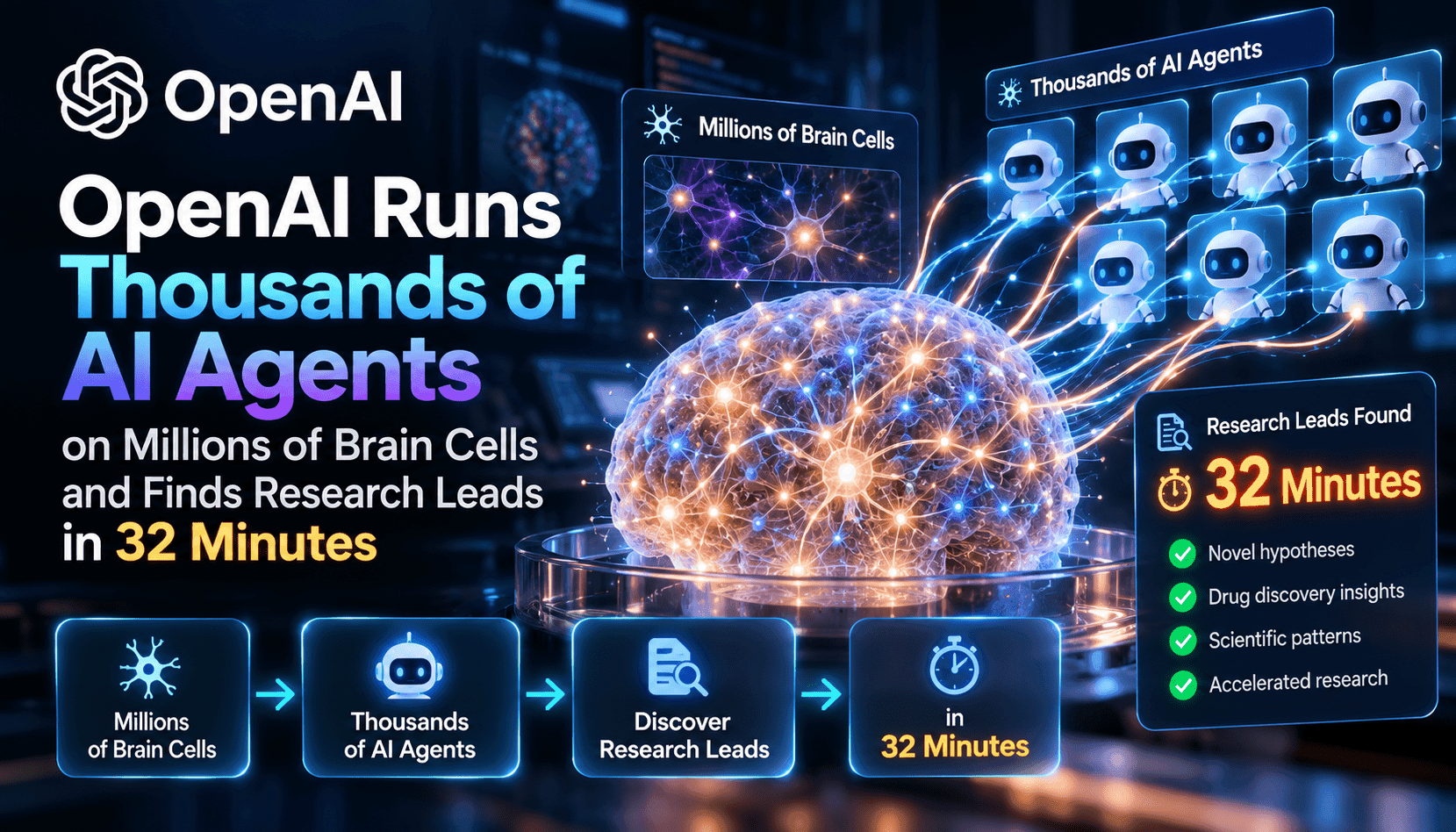
Large-scale biological experiments now produce orders of magnitude more results than a human team can exhaustively investigate. OpenAI’s collaboration with PerturbAI and Scripps Research used a whole-brain CRISPR atlas of mouse cells to demonstrate an alternative: thousands of lightweight GPT‑Rosalind agents running in parallel, each assigned a focused perturbation to analyze. In aggregate, those agent reports were assembled into a reasoning atlas that mapped genes to cellular responses, pertinent literature, and mechanistic hypotheses — all within a timeframe that would otherwise take months of manual analysis.
The engineering choice to distribute tasks across many specialized agents is central to the result. Rather than one generalist process trying to cover hundreds or thousands of perturbations sequentially, the system split the workload so individual agents could dig deeper into a single gene’s cellular signatures and cross‑reference domain papers. This parallelism increased breadth (many perturbations analyzed) and depth (more literature cited per perturbation), producing a web of candidate explanations that human experts later judged to be both novel and actionable in blinded comparisons.
Crucially, the agents did not produce validated discoveries — they generated prioritized, literature‑grounded hypotheses and connections worth experimental follow‑up. Examples flagged by the system included differential effects of Tsc1 versus Tsc2 in cerebellar neurons and a potential link between intracellular cholesterol handling and neurodegeneration tied to Dctn1 perturbations. These leads illustrate how agent swarms can accelerate the path from large datasets to concrete lab experiments, but they do not replace targeted bench validation and mechanistic study.