

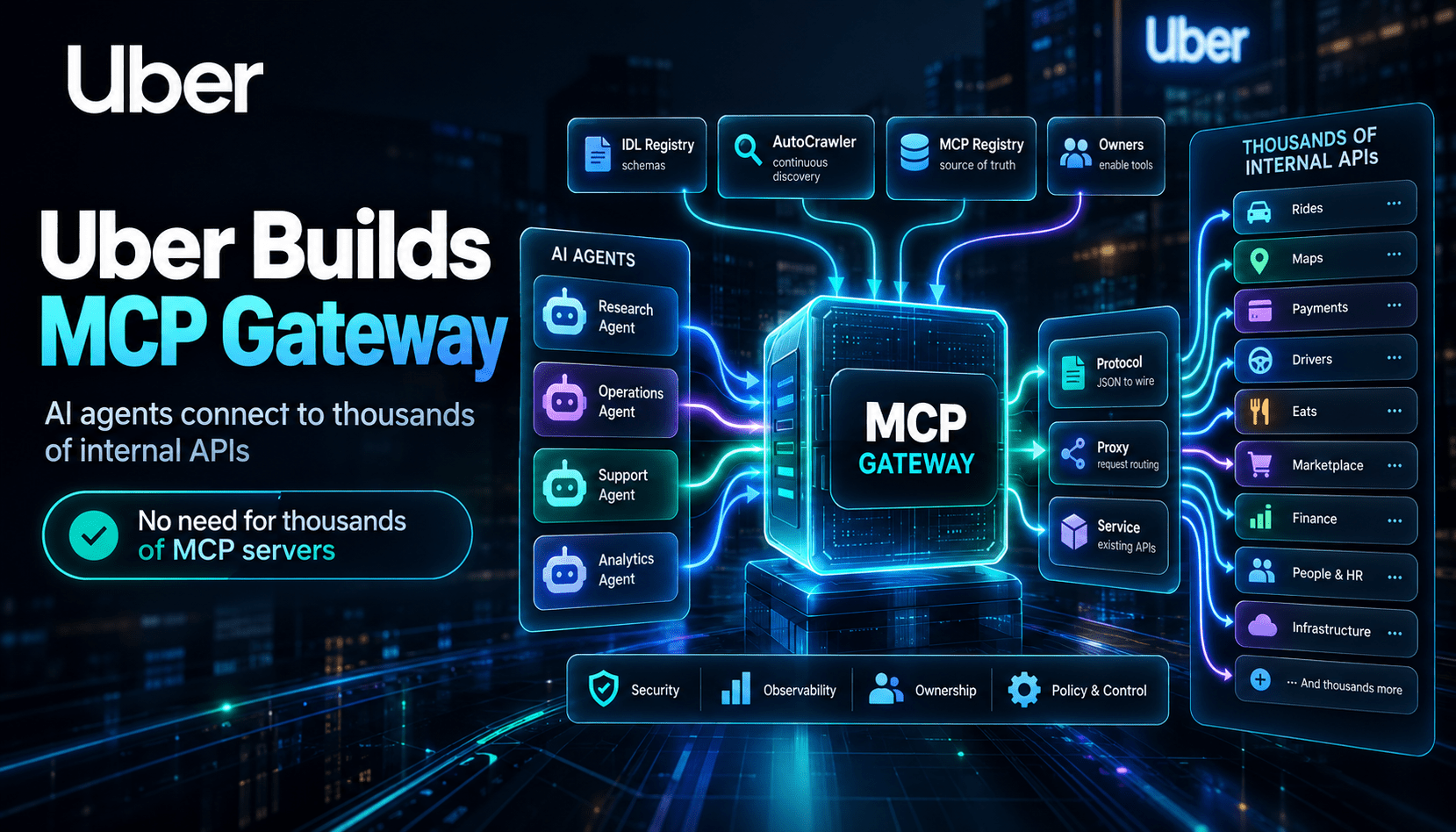
Enterprise AI agents become useful only when they can access reliable, current business context and act on it. Uber’s MCP Gateway answers a specific but unavoidable question: how do you give agents governed, discoverable access to thousands of preexisting APIs without forcing every service team to implement an MCP server? The Gateway centralizes discovery, translation and enforcement so service teams stay off the critical path — they don’t need to rewrite endpoints, and owners retain review and enablement control. That trade-off reduces duplicated infra and aligns governance while preserving operational independence for teams.
Architecturally the Gateway splits into a control plane (the MCP Registry and AutoCrawler) and a data plane (Proxy Gateway). The Registry is the single source of truth for virtual servers and tools; AutoCrawler continuously derives tool definitions from IDLs and native MCP servers so the catalog scales automatically. The Proxy Gateway materializes virtual MCP servers at runtime, translates MCP calls into HTTP/gRPC/TChannel, delegates execution to the service mesh sidecar (Muttley), and returns MCP-compatible results. This separation enables fast iteration, real-time config refreshes, and a consistent execution model for diverse agent clients.
AutoCrawler is the crucial operational lever that makes the whole system viable. Rather than relying on manual authoring, Uber uses a Cadence-driven workflow that scans the IDL registry, monitors native MCP heartbeats, parses protobuf/Thrift definitions, and generates initial tool manifests. These generated tools remain disabled by default; ownership and enablement rest with service teams. AutoCrawler also enriches schemas and descriptions using LLMs to produce agent-friendly documentation — a pragmatic compromise that balances machine-driven scale with human review and security gating.
Security, policy and operational safety are built into the gateway layer rather than scattered across teams. The platform enforces tool- and server-level charter policies through Uber’s internal access-control system, performs PII redaction on responses, and applies rate limits and auditing uniformly. Third-party MCP integrations are supported without weakening policies: the gateway relays internal tokens while third-party services exchange them for external credentials, keeping central controls intact. This model offers a practical middle path between flexibility and enterprise governance.
From a cost and performance perspective, the Gateway addresses two scaling blockers for agentic workflows: context bloat and token costs. Omni MCP provides incremental discovery — tools to find servers, list tools, fetch schemas and invoke tools — so agents don’t have to preload hundreds of tool definitions. Response Projection trims responses at runtime to requested fields only, and Code Mode (via aifx) makes CLI-based coding agents write outputs to disk instead of loading everything into model context. Together these patterns reduce unnecessary model context, latency and API spend at enterprise scale.