

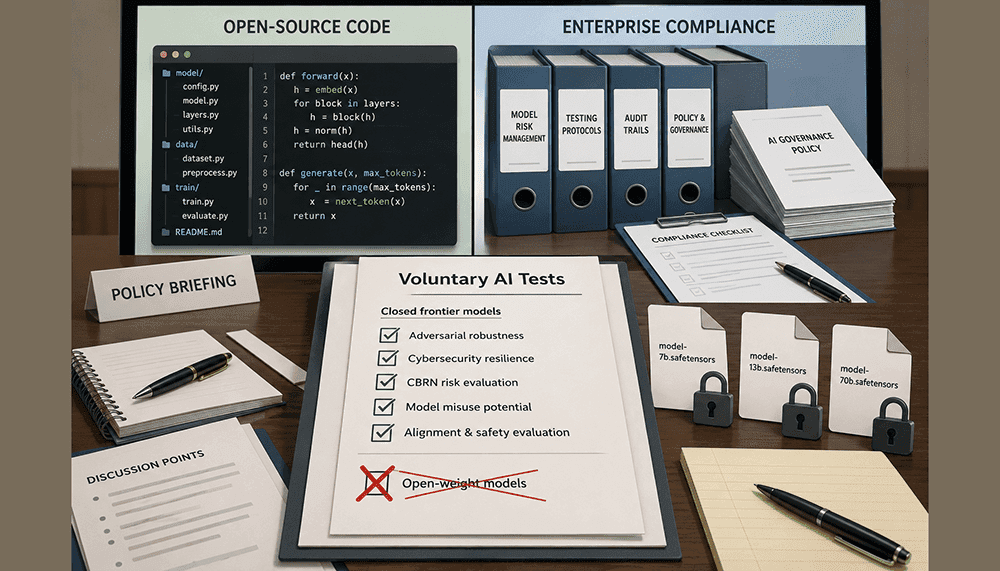
The US plan for voluntary AI model testing is a milestone for governance, but the reported decision to exclude open-weight systems creates a structural blind spot. Capabilities are increasingly pushed through open or semi-open releases that can be fine-tuned, quantized, and composed with tools and agents. Without a standardized test lane, these models will propagate into products and research with fragmented or ad hoc evaluations, raising uncertainty for buyers, CISOs, and compliance leads who must answer whether a model meets safety and policy requirements across contexts and versions.
Voluntary programs often anchor procurement norms, risk disclosures, and insurer questionnaires. When open-weight models sit outside that anchor, deployers inherit the burden of proof. This means constructing evidence that covers misuse risks, bio/chem/harm facilitation, deceptive use, model spec compliance, child safety filters, and security posture across weight variants and fine-tunes. It also complicates model provenance: once weights are downloaded, chains of custody and patch management become enterprise responsibilities, not just vendor assurances, and require new operational controls to remain audit-ready.
The practical effect will be a two-speed governance market. Closed providers can point to official test participation, while open-weight providers and integrators must ship their own attestations, red-team artifacts, and benchmark reproducibility. Enterprises will respond by hardening intake: mandating supplier SBOMs for models, signed weight manifests, controlled fine-tune pipelines, and incident response playbooks tied to specific checkpoints. Legal teams will push for warranties around prohibited capabilities post-fine-tuning, while security teams will insist on isolation and egress policies where model modifications are possible. Procurement will increasingly differentiate on assurance maturity, not just accuracy or latency.
Strategically, the gap may accelerate innovation in open-weight assurance: standardized model attestations, community-run eval suites, and interoperability for safety signals. But it could also fragment compliance as US buyers, EU/UK regulators, and sectoral bodies adopt divergent expectations. Savvy builders should anticipate convergence via procurement: large buyers can require harmonized evidence packs that mirror public tests. The winners will package open-weight flexibility with verifiable controls—versioned checkpoints, signed adapters, transparent safety mitigations, and continuous evaluations aligned to real misuse scenarios relevant to regulated industries.