

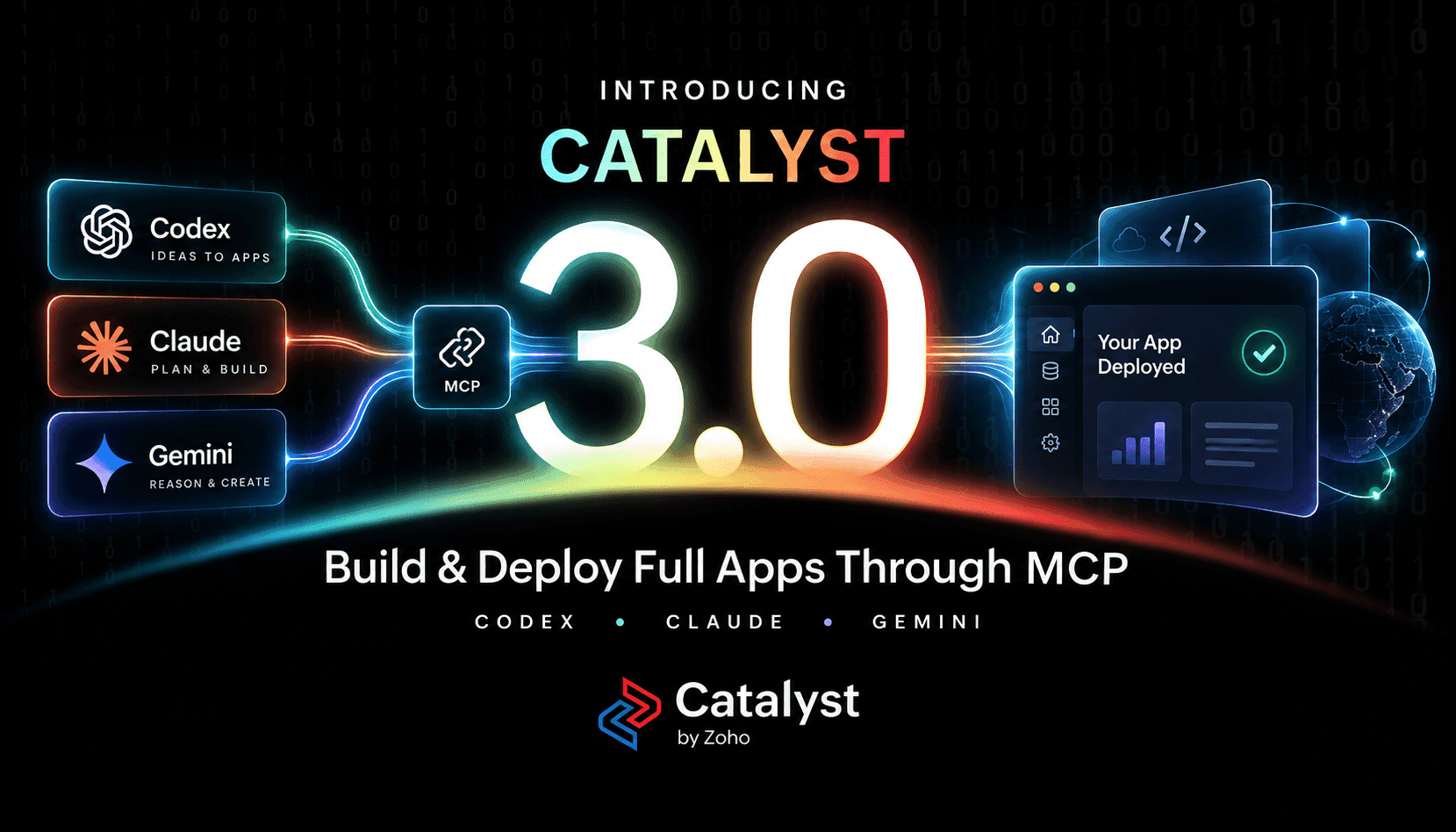
Agentic coding has raced ahead of traditional DevOps, but most teams still stall between “it runs on my laptop” and “it’s live with guardrails.” Catalyst 3.0 tackles that handoff by teaching agents the platform and exposing infrastructure as schema-defined calls. Instead of guessing parameters or clicking through dashboards, an agent can fetch operation schemas, provision a relational table, wire event triggers, deploy a function, and return a working endpoint. That workflow removes the noisiest failure modes—misconfigured arguments, stalled CLIs, and UI dead ends—while keeping human approval where it matters: promotion to production.
The strategic shift is subtle but profound: prompting now extends beyond code synthesis into deterministic infrastructure orchestration. Catalyst’s Agent Skills compress platform knowledge into routable, up-to-date guidance, so agents choose between serverless functions or AppSail containers with awareness of regions, deprecations, and quotas. MCP provides the execution rail so every call is validated before action. Combined with a non-interactive CLI, agents avoid modal prompts and destructive operations, making automation predictable enough for enterprise policy while still fast enough for iterative build loops.
Early results point to real delivery gains. Teams report higher task completion with fewer interventions when agents can both see platform context and act through structured tools. That unlocks new economics for SIs and internal platform teams: smaller crews can ship full-stack apps, not just prototypes. Importantly, Catalyst preserves organizational control—agents run under scoped collaborators, actions are logged across app, platform, and MCP layers, and production remains a manual gate. The outcome is a cleaner division of labor: agents automate the scaffolding and plumbing; humans curate requirements, reviews, and release risk.
For buyers, the practical question isn’t whether agentic development is coming—it’s how safely to adopt it without re-stitching ten vendors. Catalyst’s full-stack posture reduces coordination tax across storage, compute, identity, and events, which is where most agent-led builds previously bogged down. If your roadmap includes data-heavy workflows, moderate backend complexity, and the need for rapid iteration under governance, Catalyst 3.0 offers a credible route from prompt to production-ready infrastructure without inventing a bespoke orchestration layer.