

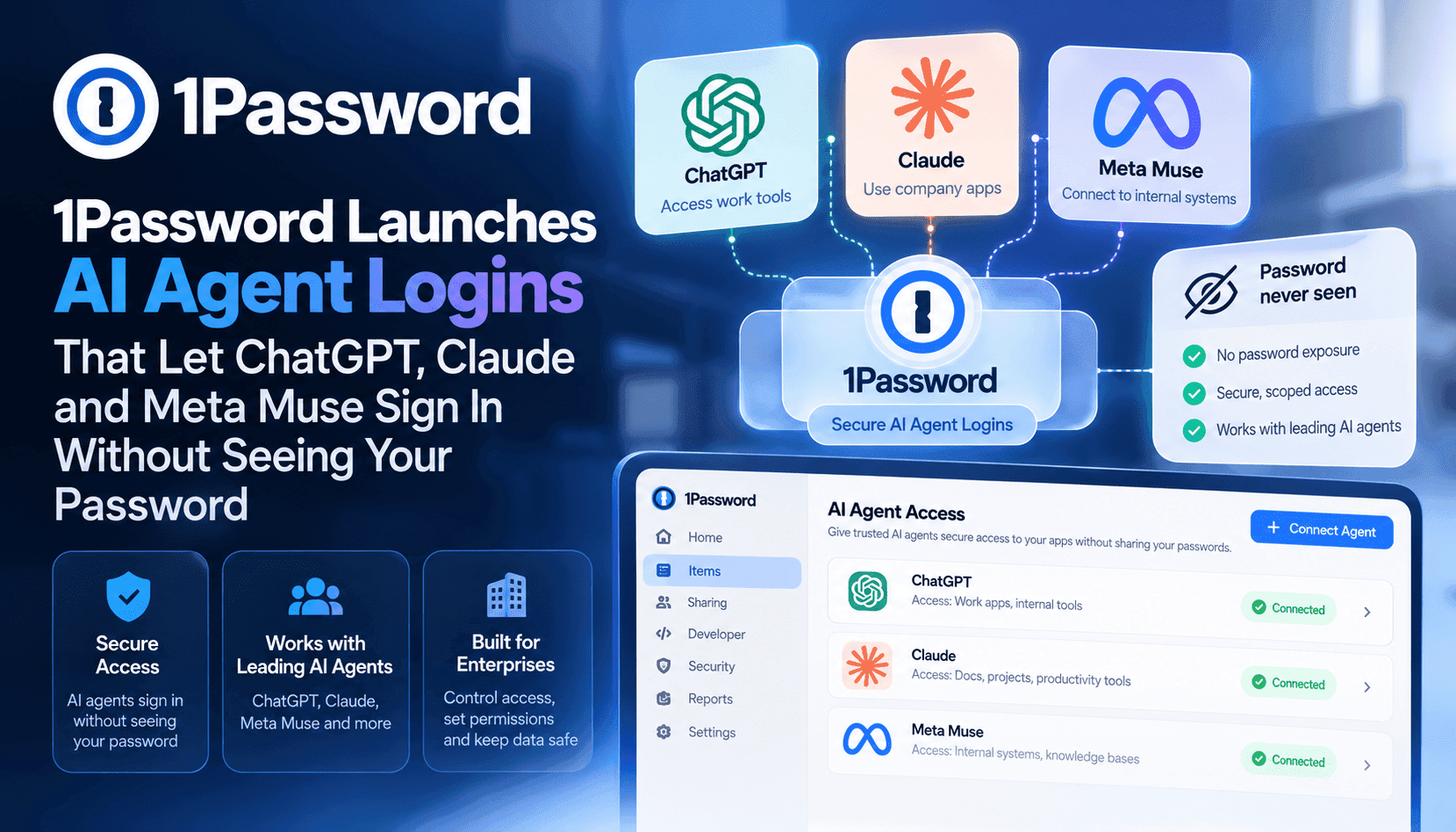
1Password for Agents is less a consumer feature and more an infrastructural primitive for the next generation of assistant-driven workflows. At its core the product separates identity and credential possession: an agent proves its identity with a digital key, 1Password surfaces a confirmation to a user’s trusted device, and the manager performs the credentialed action — filling and submitting credentials or issuing ephemeral tokens — without revealing the underlying secret. That design preserves the human user’s ultimate control while enabling agents to complete multi-step tasks that require authentication.
Technically, the flow replaces a brittle pattern — copy-pasting passwords or baking credentials into agent prompts — with a mediated delegation handshake. When an agent requests access, 1Password receives a signer assertion from the agent, not the user, and sends an approval push or modal to a device in the user’s trust circle. On approval, 1Password either performs the login directly or provisions a session-scoped credential that the agent can use for the duration of the task. For security teams, that means shorter blast radii, auditable delegation events, and no persistent secret copies in agent logs or profiles.
This system is already positioned to integrate with major agent providers: OpenAI, Anthropic and Meta are supported options in the initial rollout, and 1Password has signaled broader partner expansion. For product teams and integrators that build agent-to-service bridges, the change is operational: instead of designing around raw API key rotation or creating bespoke credential vaulting per agent, build to a delegated login model where the password manager mediates and the agent consumes ephemeral access. That shift also affects legal, compliance and customer-support workflows — each login now produces an approval event tied to a user device.
For users and enterprises, the practical upside is immediate in certain verticals: shopping and travel agents can complete bookings without long-lived credentials, and workplace automation can onboard into SaaS apps for a single session without exposing admin passwords. But the approach isn’t magic — banks and high-security services may demand additional attestations, step-up authentication or transaction-level approvals. Organizations must therefore combine session-scoped agent access with role-based controls, monitoring, and policies that distinguish permitted automated actions from risky ones.