

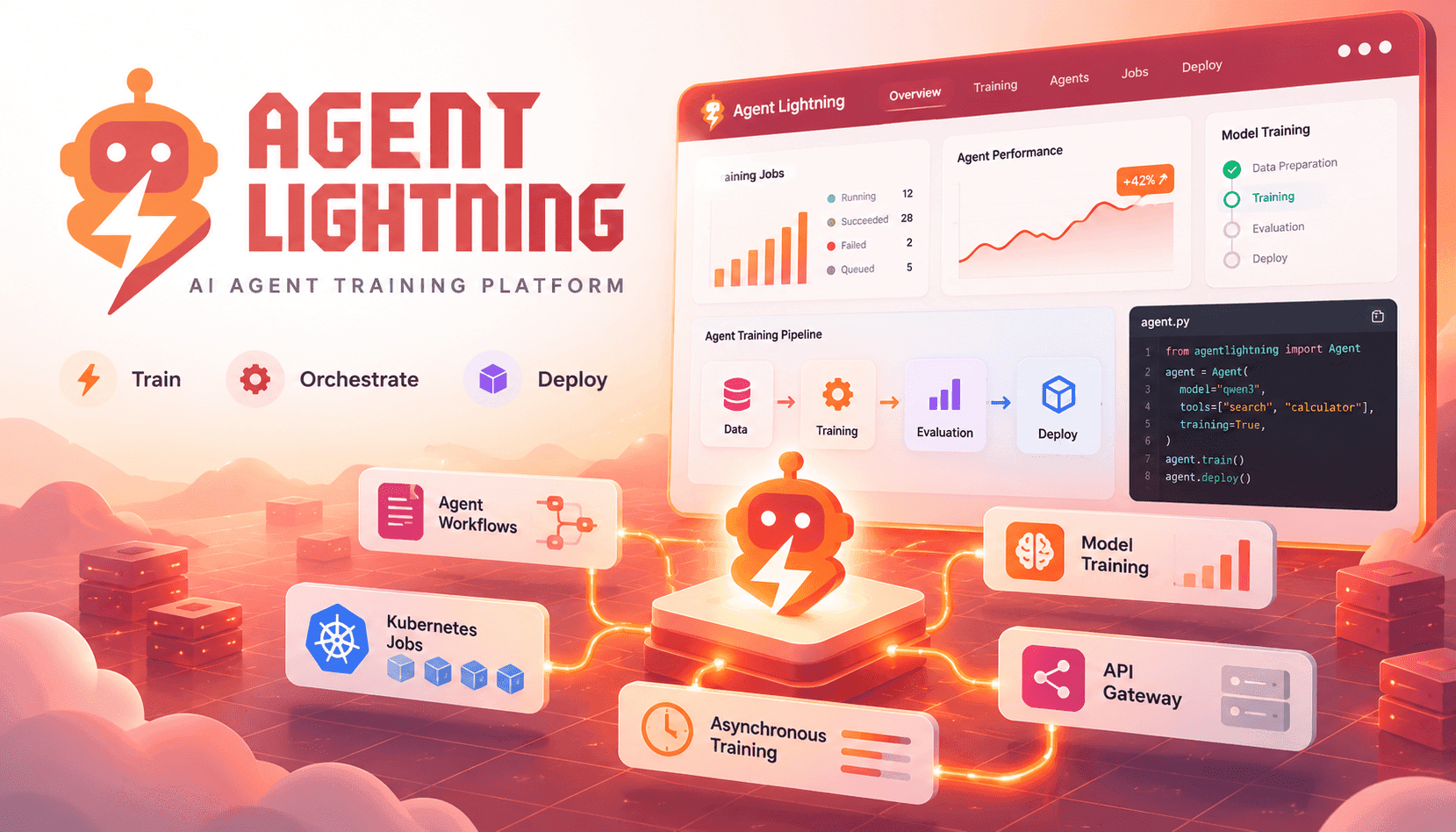
Agent Lightning v1.0 is designed for teams that want agents to learn from the actual tools and workflows they use in production. Instead of asking engineers to reimplement agent logic for a separate training stack, Agent Lightning interposes a proxy and rollout collector so the same control flow, tool calls, retrieval context and environment remain intact while trajectories are recorded. That preserves the agent’s real-world inputs and side effects—critical for training behavior that depends on tool outputs, long-running contexts and orchestration logic that prompt-only tuning cannot reliably simulate.
The project’s engineering philosophy is straightforward: keep the core small (roughly 3,500 lines of Python), focus on rollout-driven training, and run agents where they already run. Native Kubernetes support lets teams execute rollout jobs as Kubernetes Jobs, avoiding fragile sandbox or emulator layers for execution. That design reduces operational surface area for teams already invested in Kubernetes while enabling scalable collection of trajectories across many concurrent agent instances and real tool integrations.
Microsoft’s published examples illustrate practical impact, not just architecture. In a coding-agent MoE pipeline, Qwen3.5-35B-A3B showed a jump from 47.8% to 61.6% on a verified software-engineering benchmark after reinforcement learning on only 1.8K examples. The released coding-agent guide also covers data cleaning, reward-hacking mitigation and end-to-end training scripts—showing how rollout-driven RL can produce measurable accuracy gains faster than large-scale prompt engineering experiments. Those examples matter because they demonstrate that keeping real tools and tests in the loop yields better aligned improvements for task-driven agents.