

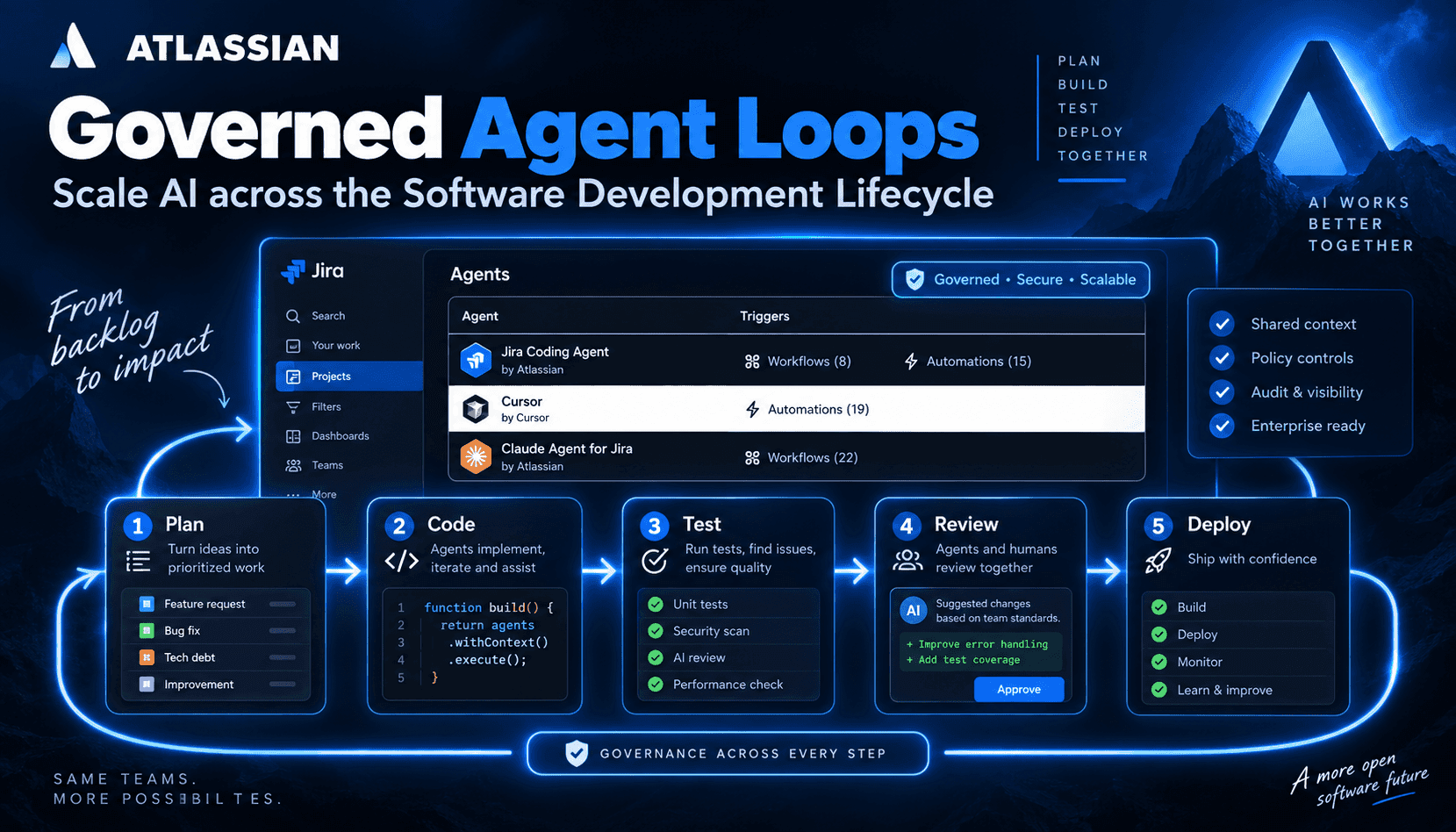
Atlassian is pushing agentic automation beyond demos by formalizing governed agent loops across the software development lifecycle. The bet is simple: most teams can get agents to produce code, but very few can let them run continuously without tripping over permissions, standards, or audit needs. By welding a shared context layer to granular controls, automated standards enforcement, AI-assisted reviews, and usage analytics, Atlassian is turning Jira-centric backlogs into supervised execution engines rather than prompt-by-prompt experiments.
The architecture matters. Code Context, underpinned by a graph of code and work artifacts, aims to give agents high-fidelity awareness of repositories, dependencies, and decisions. Agent Context Controls scope what agents can see and where they may act, so context and permissions move in lockstep. Agent loops in Jira continuously scan for eligible issues, delegate implementation and tests to a coding agent, and open ready-to-review pull requests. Standards centralize organization rules per repo, and AI Review applies them on every PR. The result is a managed loop: intent and guardrails in, parallel execution out, with humans retaining the merge button.
Scaling this is less about model prowess and more about operating discipline. Platform teams need to define agent scopes, set SLOs for loop latency and PR quality, and enforce change windows when standards or contexts update. Developers shift from crafting long prompts to curating issues into loop-ready units with clear acceptance criteria and test hints. Security and compliance map policies to repositories, while finance tracks agent usage and cost per merged change. With AI Review and dashboards for agent adoption and throughput, leaders can see where loops help, where they stall, and how to tune the guardrails without choking velocity.
The competitive angle is equally important. By embedding governance primitives at the workflow layer, Atlassian is positioning its stack as the operating plane for enterprise agents—where standards, code context, and approvals already live. That could pressure adjacent toolchains to deepen policy and telemetry features or risk becoming an ungoverned sidecar. Buyers should test fit on multi-repo complexity, standards portability, and PR review quality, and probe how easily policy, metrics, and cost controls follow the work when loops span teams, services, and compliance zones.