

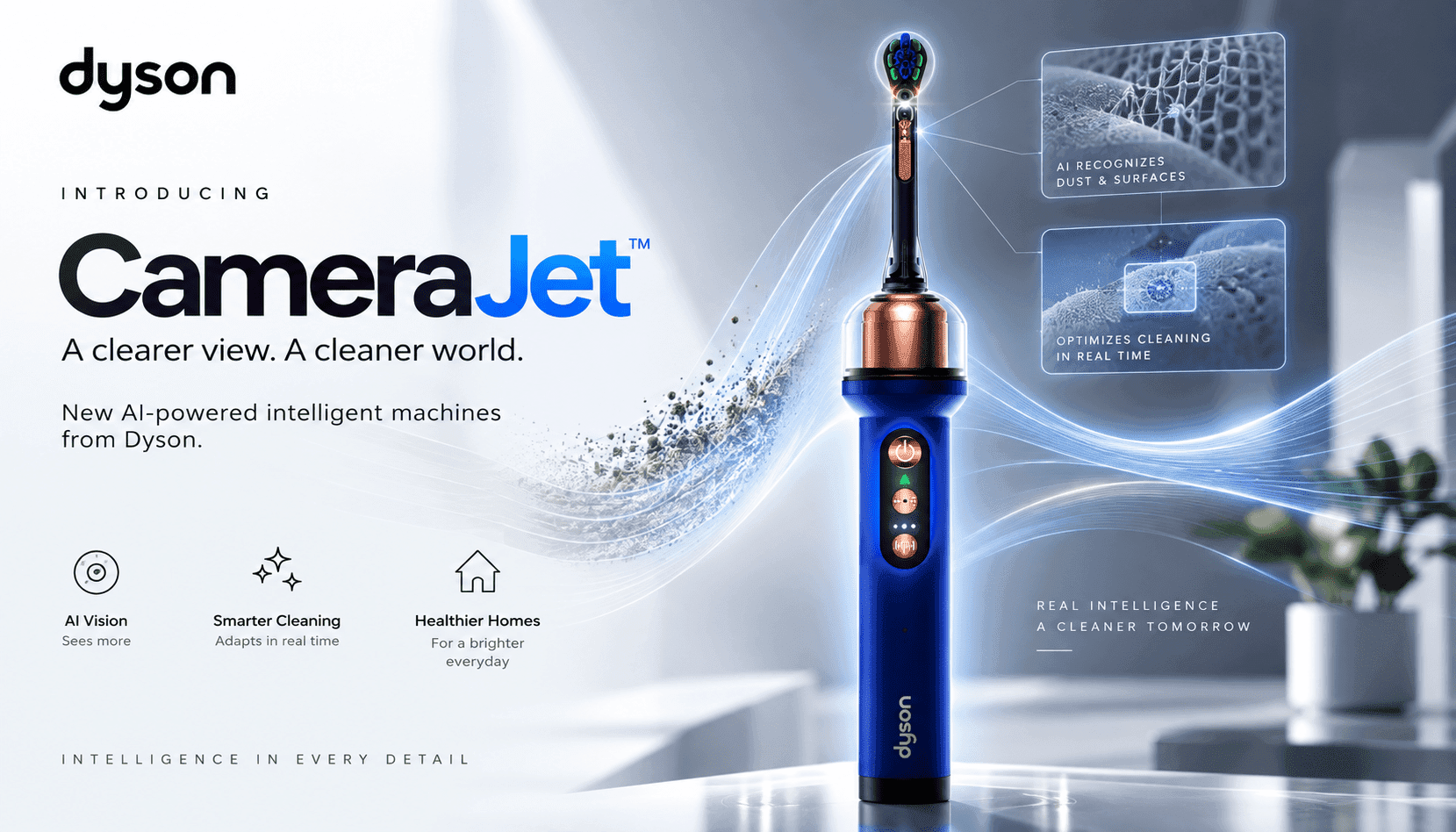
Dyson’s latest lineup reframes consumer hardware as intelligent perception systems, not just motors and plastics. CameraJet pairs brushing and liquid flossing with a 100,000‑pixel macro camera capturing 28 images per second. Its Gap Optical Targeting algorithm identifies interdental spaces and triggers a directed rinse. Dyson says images aren’t recorded or stored on-device or in the cloud, and live guidance runs through the companion app. The pitch is not novelty but measurable coverage and hygiene—an upgrade path where optics, embedded ML, and fluidics work together to solve a specific task with repeatability.
Nurovi robots extend the same logic to floors and surfaces. The flagship Spot+Scrub UV model combines wet/dry cleaning, UV illumination, and green lighting with computer vision to classify nearly 200 household substances and objects, then adapts suction, hydration, and roller behavior—up to 30,000Pa with a 12‑point hydration system and an edge roller that extends 40mm. The R2 relies on Reuleaux triangle pads to reach corners; the R1 Dry emphasizes 21,000Pa suction and particulate separation. Rather than a generic “smart” label, Dyson is staking on task-specific perception-to-actuation loops that can be benchmarked in homes.
HushJet purifiers carry the design theme into airflow control: large‑room coverage, long‑range laminar jets, and multi‑stage filtration with acoustics tuned for quieter operation. What’s notable is the portfolio coherence: cameras and ML where classification matters, precision kinematics where contact matters, and engineered airflow for environmental outcomes. It’s a product strategy that moves AI talk away from chat interfaces and toward embodied sensing stacks, firmware orchestration, and parts that can be serviced, updated, and validated in the field.
Commercially, Dyson is signaling an early‑look cadence before broad launches, with regional pricing and timelines still unconfirmed in some markets. In the U.S., reported price points place the Nurovi R3 at the premium end, with lower tiers designed to seed adoption. For buyers and channel partners, the due diligence now includes battery endurance under perception workloads, sensor calibration drift over months, and the software path for on‑device model updates—all of which determine whether these machines remain “smart” after the honeymoon period.