

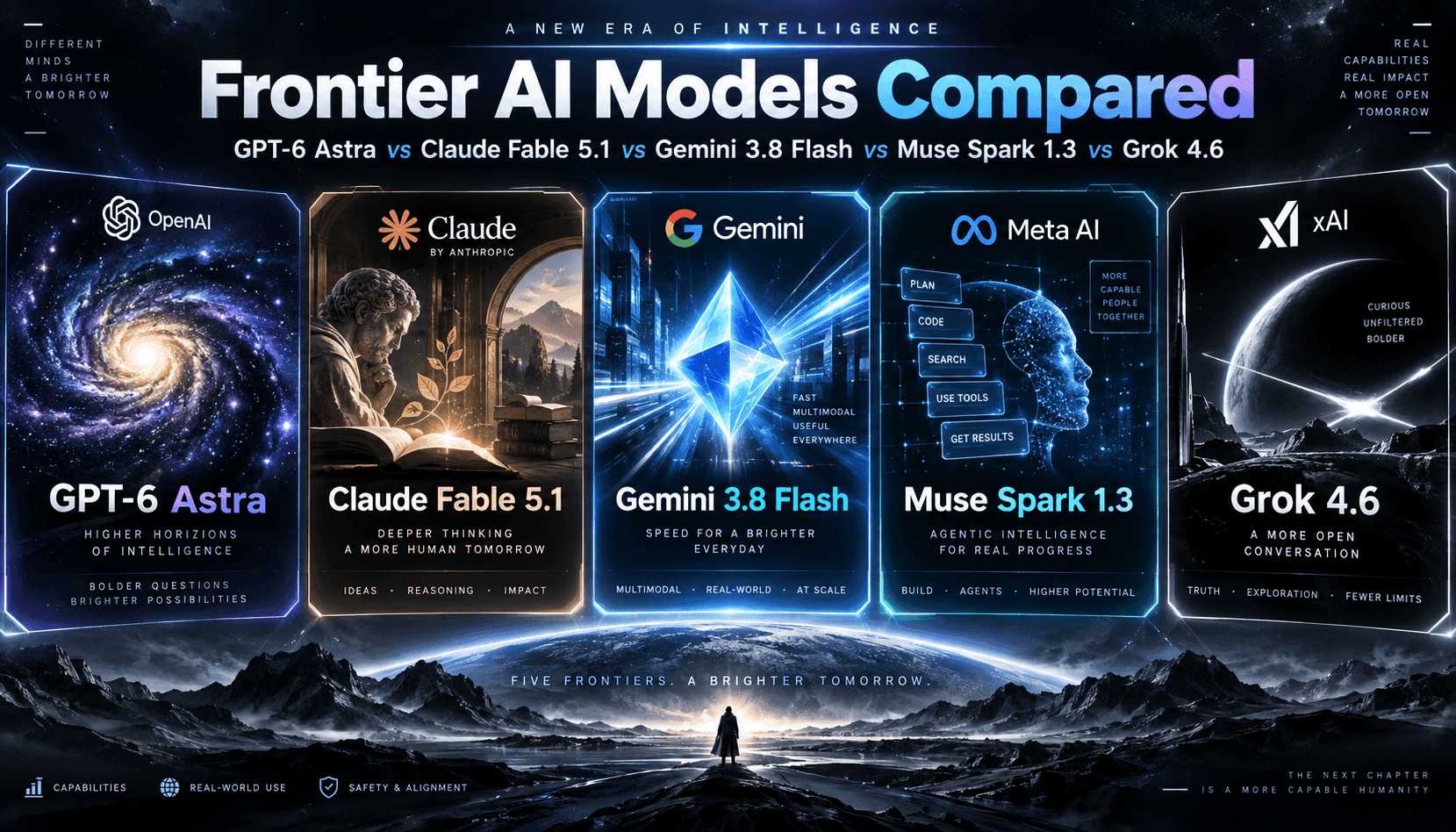
The frontier model race has split by job-to-be-done. Instead of chasing a single “best” LLM, leading teams are mapping models to workload classes: deep reasoning and coding, agentic end-to-end computer work, cost-dominant high-volume pipelines, and balanced engineering tasks. In that lens, Claude Fable 5.1 typically leads aggregate intelligence and code reliability, GPT-6 Astra is the most consistent end-to-end operator inside real software environments, Gemini 3.8 Flash compresses cost and latency for scale workloads, Muse Spark 1.3 shines for affordable agentic orchestration, and Grok 4.6 sits in the middle with competent code and agent performance at moderate pricing.
For developers who equate frontier with coding precision under ambiguity, Fable remains the most frequent top pick, particularly when tests mix multi-file edits, edge-case reasoning, and long-horizon refactors. Astra’s coding on pure pass@k may be within striking distance, but Astra pulls ahead when you need the model to operate the computer: reliably invoking tools, navigating UIs, and closing loops with fewer babysitting interventions. Grok 4.6 has matured into a practical middle path—competitive in coding while maintaining respectable agent behavior and economics for teams that cannot justify the very top-tier price points on every task.
If you’re operating high-volume production lines—summarization, tagging, retrieval-augmented Q&A, data cleanup, and synthetic variants—Gemini 3.8 Flash tends to win on cost per task and end-to-end response time without collapsing quality. Throughput and time-to-first-token enable tighter SLAs and cheaper autoscaling. This is where engineered prompts, structured outputs, and distillation-backed guardrails convert raw cost advantage into dependable pipelines. For multi-step office or operations automations, Muse Spark 1.3 often hits the value sweet spot: stable tool use and concurrency at a price that supports broad deployment across back-office queues.
Under-remarked but crucial: the real frontier advantage is operational reliability, not just single-turn benchmark scores. Astra’s appeal is repeatable end-to-end success and low operator friction. Fable’s appeal is fewer logic slips under long-horizon reasoning. Gemini Flash’s appeal is predictable latency and cost curves at scale. Muse’s appeal is agentic value density in everyday workflows. Grok’s appeal is balanced competence that covers coding sprints and lightweight agents without budget shocks. The right answer is rarely one model—most teams are standardizing on two to three and routing by workload, confidence threshold, and budget envelope.