

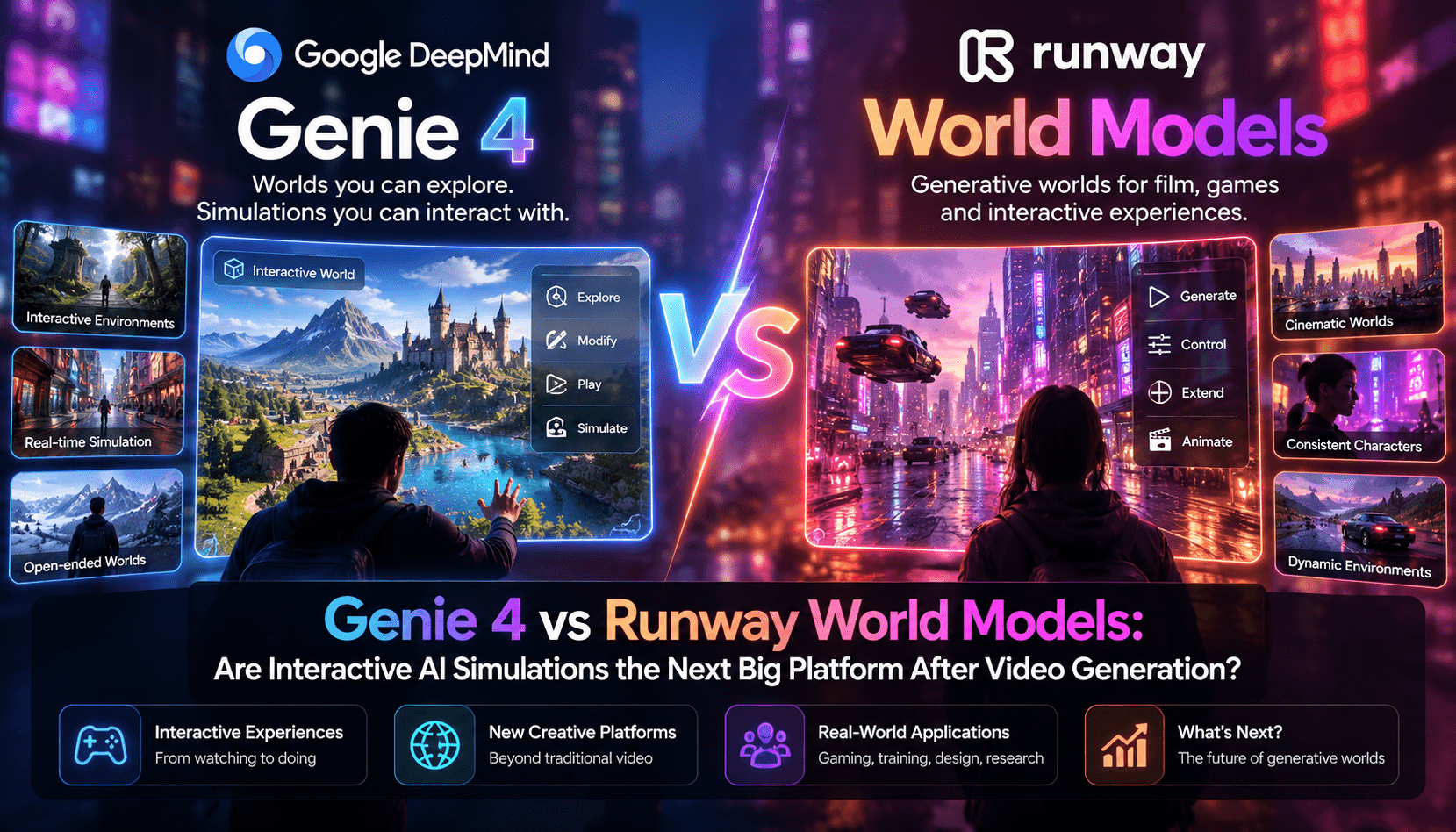
World models are graduating from demo reels to functional platforms. Genie 4 bundles multimodal synthesis, real-time physics approximations, and an agent-in-the-loop reasoning layer to produce continuous, interactive environments. That matters because the value of a simulation scales with persistence: a world that remembers, enforces causality, and accepts corrective inputs unlocks iterative workflows—training a robot repeatedly on edge cases, replaying and modifying traffic incidents for AV validation, or letting a director improvise staging inside a photoreal scene. Video generation, by contrast, is optimized for one-shot realism and cinematic control; it cannot, by design, support long-term state or interactive agents without external orchestration.
Comparing Genie 4 and Runway-style models reveals complementary product paths rather than direct feature parity. Runway and similar labs have driven rapid improvements in photoreal frame synthesis, temporal consistency, and user-friendly editors for short-form content. Genie 4 layers agentic reasoning (Gemini-guided planning), native audio, and a physics-informed world representation that can respond to user-driven events. Practically, that means Genie 4 targets workflows where continuity and causal fidelity matter: iterative RL training, multi-step task validation, or interactive storytelling where characters and objects must retain properties across time.
But world models face hard limits before they can fully displace conventional game engines or scientific simulators. Current architectures trade exact, provable physics for statistical plausibility; long-horizon stability, determinism for validation, and computational predictability remain weak spots. Integration complexity—exporting precise collision meshes, force models, and sensor-accurate renders—still favors purpose-built engines. For practitioners and buyers, the immediate opportunity is hybrid workflows: use world models to generate diverse, photorealistic scenarios and procedural behavior traces, then port those scenarios into deterministic engines for final validation or control-loop certification.
For product and research teams, the key question is how to combine strengths: leverage world models for data diversity, human-in-the-loop exploration, and early-stage iteration, and retain physics engines where correctness, repeatability, and certification matter. That layered approach reduces engineering risk, accelerates edge-case discovery, and lets teams experiment with interactive narratives and mixed-reality creation without prematurely abandoning the safety guarantees and tooling ecosystems that game and robotics engineers depend on today.