

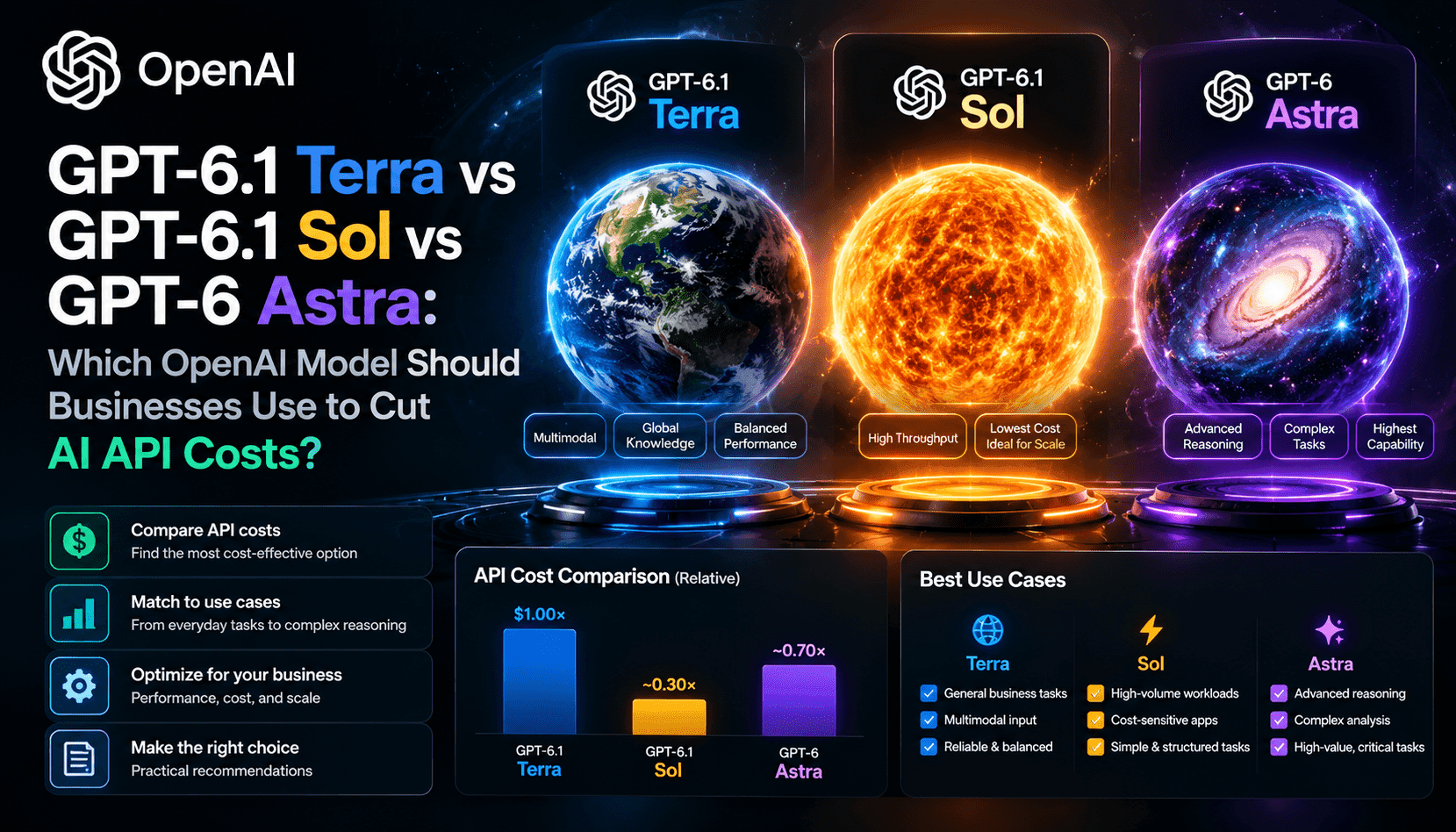
Enterprise AI teams now have multiple high-capability models available from OpenAI with distinct cost and capability trade-offs. GPT-6.1 Terra is optimized for high-volume, latency-sensitive workloads where predictable, lower-cost inference is critical. GPT-6.1 Sol offers a stronger general reasoning and coding profile at higher compute costs, while GPT-6 Astra targets visual reasoning and multimodal agents. This article lays out concrete rules and architectures so teams can route routine tasks to Terra and reserve Sol or Astra for exceptions that materially need their strengths.
The right model-routing strategy reduces API spend by combining coarse-grain classification with fine-grain execution. Start by classifying incoming requests by complexity, latency tolerance and modality. High-volume, templated text generation, simple translations, metadata extraction and deterministic formatting are excellent Terra candidates. Use Sol for complex reasoning, synthesis across documents, hard code generation and creative rewriting. Reserve Astra for tasks requiring image understanding, layout parsing, and browser-driven visual agents. The remainder of this guide quantifies those trade-offs and proposes sample pipelines.
Cost-conscious routing isn’t just an engineering trick; it requires measurement, guardrails and staged rollout. Teams should build adaptive routing middleware, collect per-model metrics (latency, cost-per-successful-inference, error rate, human escalation rate), and put fallback and sampling rules in place so model substitution doesn’t erode UX. We include concrete monitoring KPIs and a checklist to avoid common pitfalls such as feedback loops that push complexity back to expensive models, data drift that reduces Terra effectiveness, and insufficient telemetry for regulatory audits.
Below are detailed sections covering pricing and throughput examples, routing architectures for common enterprise use cases, implementation checklist, operational monitoring best practices, and a compact FAQ for teams ready to pilot a mixed-model deployment. Each section is written to be operational: you can copy the architecture patterns, telemetry schema and decision rules directly into procurement and engineering plans.