

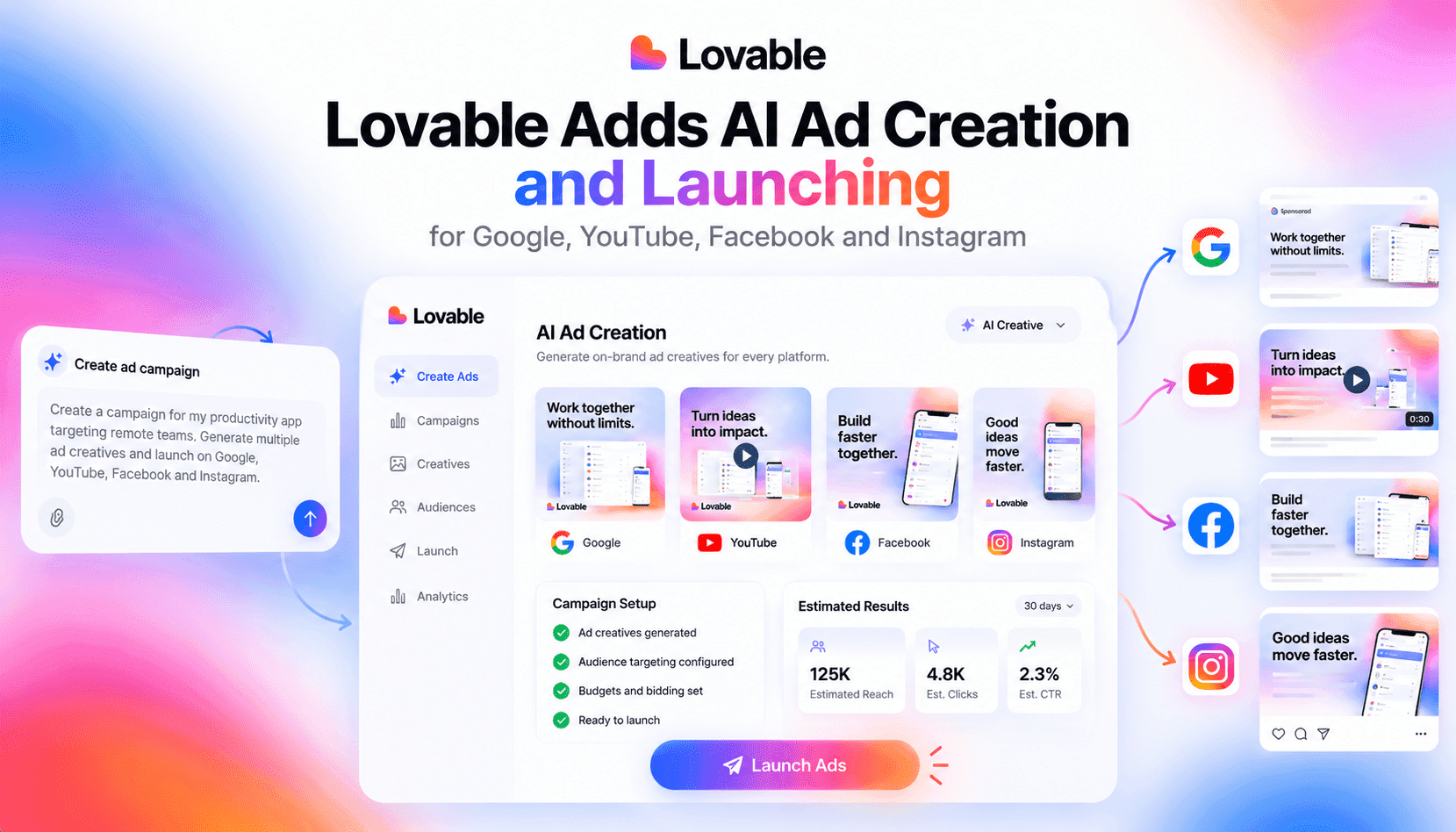
Lovable’s expansion from an AI app-creation environment into integrated ad generation and campaign launching is a notable step toward an end-to-end product-to-marketing stack. Instead of stopping at scaffolding an app or prototype, Lovable now ingests project content, drafts headlines, creatives and short-form video cutdowns, assembles basic landing experiences and offers one-click publishing to major ad platforms. That streamlined path reduces friction for a founder who wants to ship and acquire users without stitching multiple vendors together.
Practically, the most immediate gain is speed: teams can spin up hypothesis-driven campaigns in hours rather than days. Lovable’s asset templates and targeting primitives let builders iterate creative-to-landing combinations directly from the same project that generated the product’s copy and UI assets. For lean startups and solo makers this compresses the learning loop — product tweaks, creative variants and acquisition tests can share a single source of truth instead of being lost across Figma files, separate landing builders and ad managers.
However, centralization has trade-offs. Off-the-shelf creative is rarely enough for brands that require nuanced design systems, advanced CRO, or complex multi-step funnels. Ad platforms also impose policy, format and measurement requirements that a unified builder must respect to avoid poor performance or rejected ads. Lovable appears aimed at rapid experimentation first, and more sophisticated teams will still need to integrate or export assets to dedicated design, analytics and tag-management tools as campaigns scale.
For investors and operators, the strategic implication is that category boundaries between product builders and marketing tooling are blurring. If Lovable executes well, we can expect incumbents in landing-page builders, stock creative marketplaces and ad-management suites to respond either by building similar integrations or by leaning deeper into specialty features that an integrated builder cannot replicate. For buyers, the right evaluation is pragmatic: use integrated launch features to validate demand, then invest in specialized tooling when unit economics justify extra complexity.