

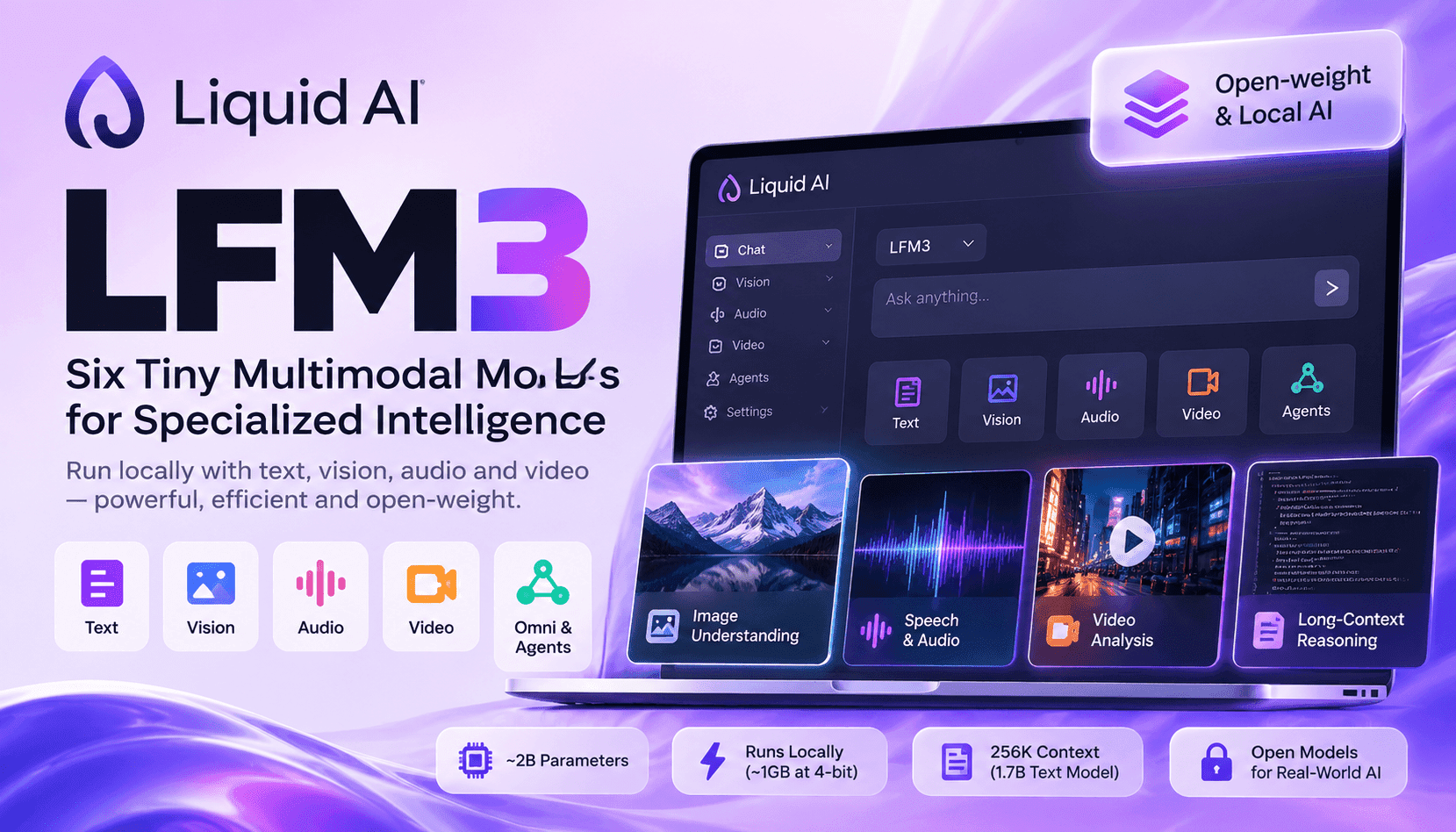
Liquid AI’s LFM3 release marks a pragmatic pivot: rather than chasing larger generalist models, the team built a family of six specialist models all branched from a single 1.7B backbone. The result is tightly optimized multimodality — text, vision, audio, omni and decision models — that prioritize on-device throughput, long-context handling and local fine-tuning. For practitioners this matters because the stack deliberately targets real deployment constraints: small RAM/flash budgets, single-GPU training, and latency-sensitive interactive workloads.
Technically, LFM3 leans on a tri-hybrid architecture mixing gated short convolutions, sliding-window attention and selective global attention; that design gives more capability per parameter and keeps long-context costs tractable. The flagship text instance, LFM3-1.7B, supports a 256K-token context window and can be quantized to roughly 1GB in 4-bit formats. That combination — ultra-long context and a tiny quantized footprint — enables continuous background agents, large-document reasoning and tooling inside private environments where sending data to cloud APIs is not acceptable or is cost-prohibitive.
Beyond raw architecture, Liquid AI ships new vision and audio encoders that compress compute while improving video and speech handling. Vision takes paired-frame temporal slices to halve sequence length for video processing, and the audio model supports streaming speech, multilingual ASR/TTS, and tool-calling workflows. Together, these allow hybrid agents that listen, watch and act with low time-to-first-token — a critical property for conversational in-car assistants, embedded robotics and private enterprise agents operating over multimodal data.
For teams evaluating LFM3, the practical question is where and how to replace cloud APIs. LFM3 is tailored to scenarios where privacy, throughput, and predictable latency outweigh absolute top-end accuracy: enterprise assistants with sensitive data, on-premise automation for regulated industries, embedded perceptual stacks on AI PCs and edge appliances with limited connectivity. This review walks through deployment patterns, fine-tuning on a single GPU, performance trade-offs versus cloud models, and the operational risks to manage during migration.