

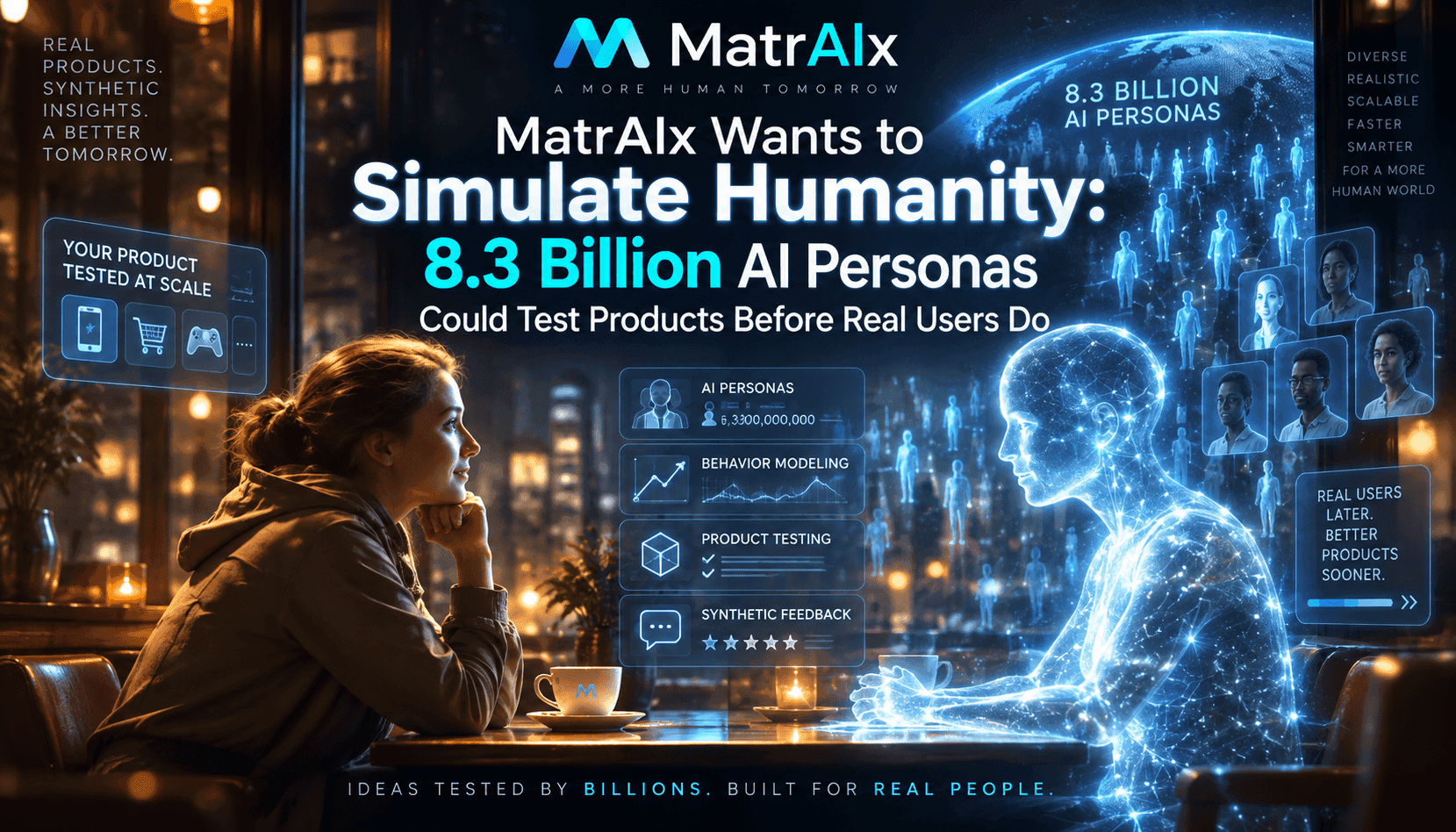
If AI products are built for billions, testing with a few hundred users and a handful of static benchmarks is no longer defensible. MatrAIx puts forward an alternative: evaluate with a synthetic mirror of humanity—8.3 billion personas spanning 1,290 categorical dimensions—so teams can see how products behave across cultures, intents, abilities, devices, and constraints before a single real user is exposed. The reported validation shows personas upheld assigned traits 91.5% of the time across trials, suggesting stable, controllable behavior for pre-deployment stress tests and controlled experiments.
Under the hood, the value is not just scale; it’s stratification and task diversity. Four environments—Survey, AI Chatbot, Web, and App—span realistic interaction modes, with more than 1,000 tasks across over 25 domains and tens of thousands of evaluation runs. That structure lets builders probe subgroup performance gaps, replay high-risk flows, and generate targeted training data or safety rules. A quality-filtered public coreset of roughly one million personas—600k grounded in human data, 400k synthetic—creates a shared benchmark for cross-vendor comparability and auditability.
For product leaders and risk owners, the commercial implication is speed-to-signal. Teams can plug synthetic user cohorts into CI/CD, run scenario libraries that reflect strategic markets, and enforce go/no-go thresholds tied to subgroup deltas, harmful response rates, or task success KPIs. Synthetic A/Bs can quantify the impact of prompt changes, retrieval tweaks, or UI guardrails on specific populations. Done well, this reduces regressions that only surface at scale, compresses iteration cycles, and raises confidence in market launches and regulatory reviews.
The approach is not a silver bullet. Persona realism must be calibrated against real telemetry and user research to prevent misplaced confidence. Governance is essential: define what constitutes material harm, set acceptance thresholds per priority cohort, and document how synthetic findings translate into production mitigations. With that discipline, population-scale simulation becomes a durable layer in AI assurance, procurement, and product analytics—bridging the gap between lab performance and the messy diversity of the real world.