

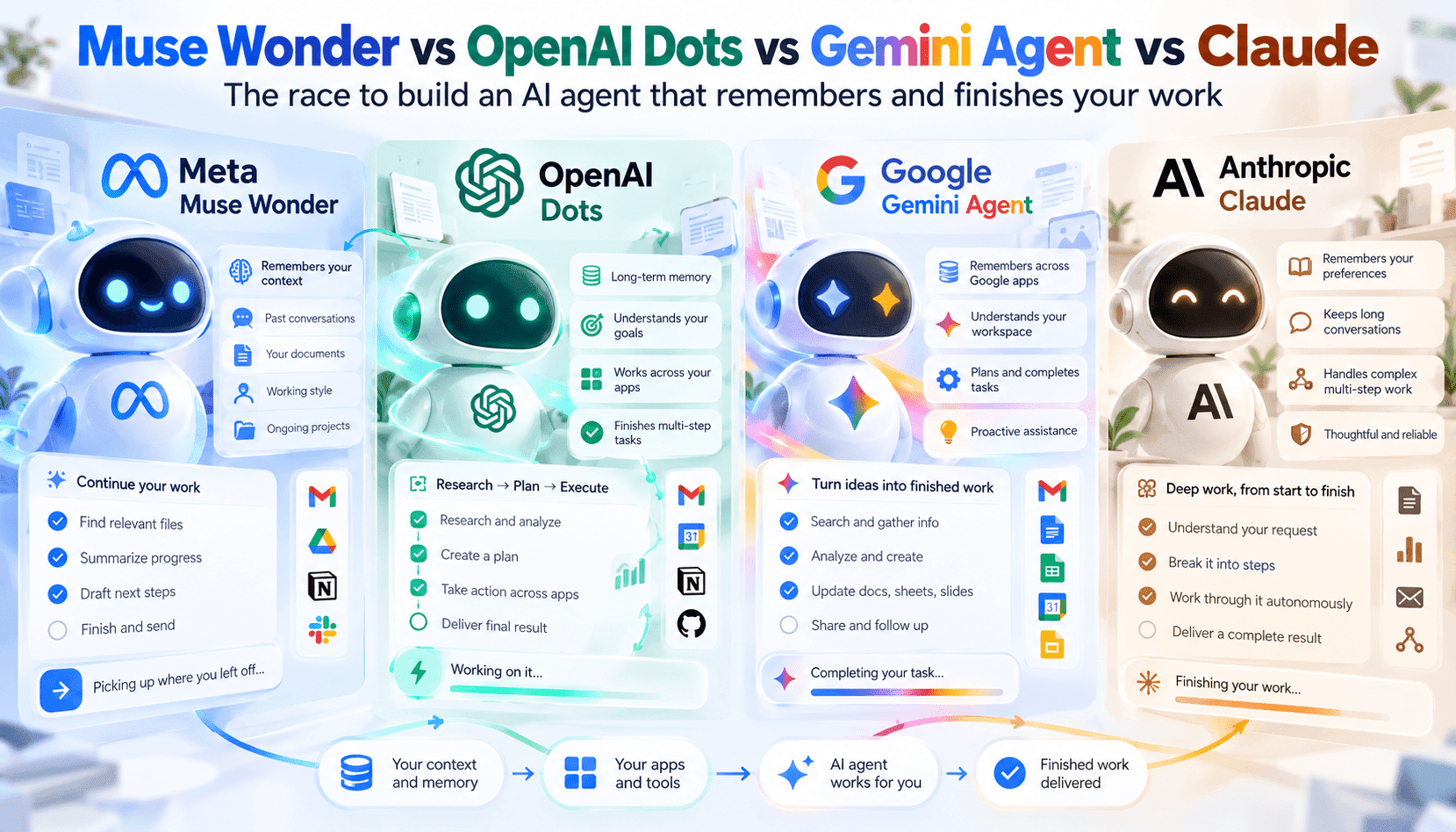
Meta’s Muse Wonder release is notable because it treats memory and persistent work as first-class capabilities rather than add-ons. Muse frames Active Memory as a scoped, task-aware store and Active Focus as a persistence pattern for long-running work—features that try to bridge the gap between conversational assistants and autonomous digital workers. For product leaders, the practical implication is straightforward: this generation of models is pushing vendors to answer operational questions—how memory is surfaced, who can read or write it, how approvals are enforced, and how an agent recovers and resumes interrupted tasks.
Comparing Muse to OpenAI Dots, Google’s Gemini Agent, and Anthropic’s Claude shows a split between capability-first designs and governance-first designs. OpenAI’s Dots aims for broad tool composability and developer ergonomics, with a fast-moving tool ecosystem and emerging persistent contexts. Gemini emphasizes deep integration with Google Workspace and browser-based actions, which helps with web-first workflows but raises enterprise data-mapping questions. Claude prioritizes safety and controlled memory patterns, favoring predictable behavior over aggressive autonomy. Muse sits between these poles by combining frontier coding and domain expertise with explicit memory and recovery primitives.
From an engineering and governance perspective, the differences matter. Muse’s Active Memory appears designed for selective persistence and task scoping, which can reduce leakage risk if access controls are enforced. OpenAI’s Dots ecosystem gives developers flexibility to stitch tools together quickly but leaves integration and governance responsibilities largely to adopters. Google’s strength is enterprise integrations and identity-aware tooling; Anthropic’s Claude offers conservative defaults and richer safety checks. Teams choosing a platform must weigh integration speed versus the clarity of access controls and audit trails.
For buyers and builders, the immediate decision is not solely about which model is most capable on benchmarks. It’s about whether a platform gives repeatable behavior when tasks span days, across messages, calendar events, documents, and third-party apps. That means testing multi-day task flows, partial failure recovery, approval workflows, and administrative controls at scale. The remainder of this piece breaks down what changed with Muse Wonder, how the other platforms compare in practice, operational risk areas to watch, and a practical checklist teams can apply in procurement or pilot planning.