

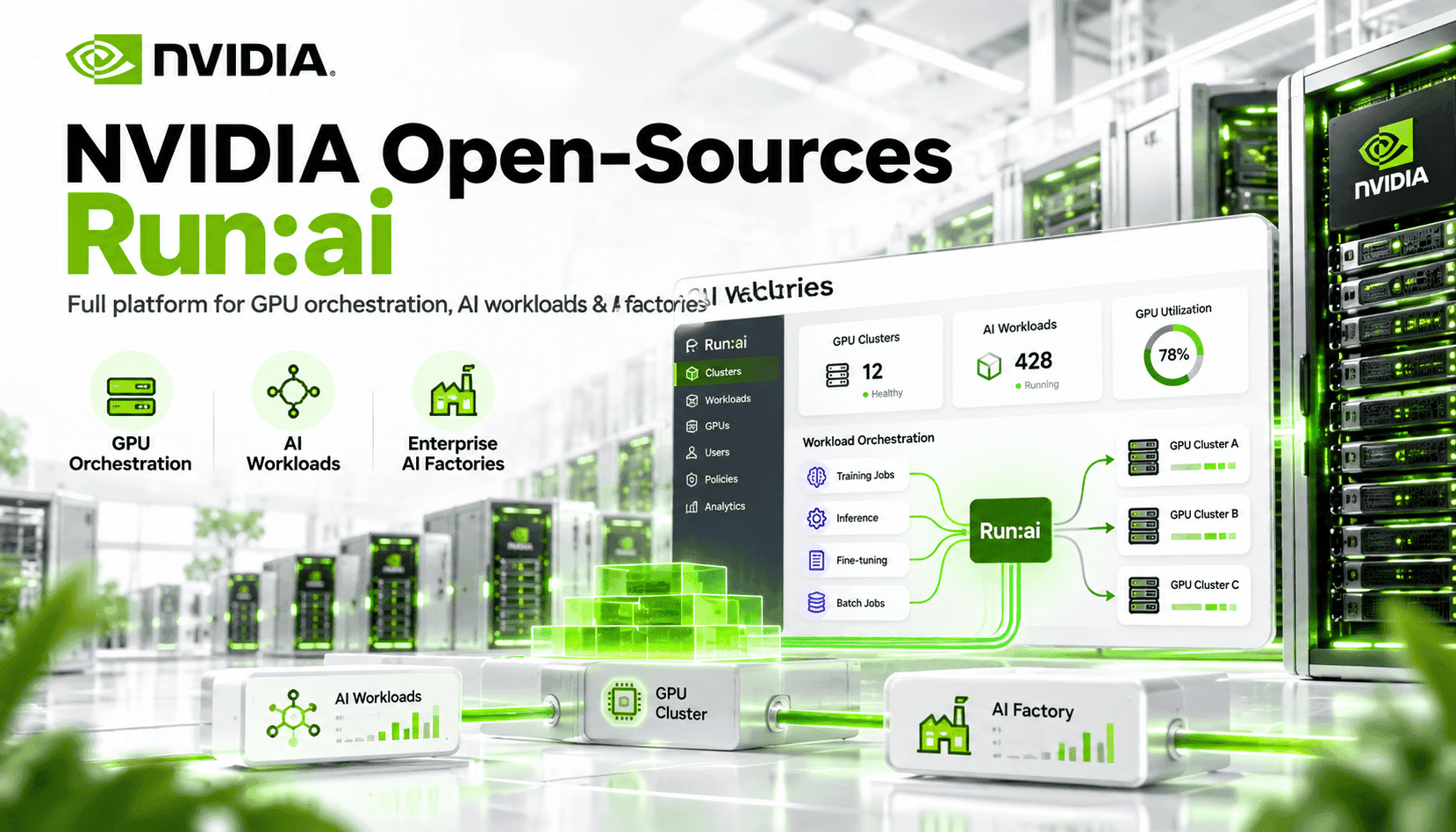
NVIDIA’s open-source release of the complete Run:ai platform marks a practical inflection point for enterprises building private AI infrastructure. Instead of adapting a closed scheduler and sharing layer, organizations can now inspect and modify the KAI Scheduler, GPU Fractioning Operator, KAI Resource Management, and Workload Map. That visibility matters: platform teams gain a production-tested, Kubernetes-native foundation that already encodes gang scheduling, topology awareness, fair-share quotas, and CUDA-native memory fractioning. The net effect is immediate: fewer home-built hacks, faster integration with existing cluster tooling, and a common contract for multi-component AI workloads.
Operationally, Run:ai addresses three persistent enterprise pain points. First, GPU underutilization: by enabling hard GPU fractions and scheduler-aware sharing, teams can run many smaller workloads concurrently without oversubscribing memory. Second, multi-team governance: KAI Resource Management introduces an org-aware quota model so research, platform, and prod can receive explicit guarantees and fair-share enforcement. Third, workload heterogeneity: Workload Map standardizes different CRDs and multi-pod jobs so tooling and SRE processes treat them consistently. Together, these features reduce manual scheduling work and permit more predictable capacity planning.
From a stack perspective, Run:ai fits naturally into Kubernetes-first AI factories. KAI Scheduler is a purpose-built scheduler contributed to the CNCF sandbox; it can be deployed alongside other schedulers, integrating topology-aware placement, gang semantics, and GPU-sharing signals. The GPU Fractioning Operator bridges CUDA 13.4 native fractioning with Kubernetes, exposing per-pod memory allocation and metrics. Workload Map removes repeated CRD plumbing across dashboards, autoscalers, and cost tools. For enterprises already running Kubernetes, this means fewer bespoke controllers and a clearer migration path from ad hoc scripts to declarative orchestration.
Practical adoption choices vary. Smaller teams may deploy the components they need — for instance, adding GPU Fractioning Operator to lower-cost notebook and inference runs while keeping an existing scheduler. Platform teams aiming for unified control will adopt KAI Scheduler and KAI Resource Management together and consider upstreaming site-specific improvements. Ecosystem partners and managed service vendors will offer pre-integrated, validated stacks for teams that need faster time-to-production or enterprise support. In every case, the open-source nature lowers integration friction and expands where fixes and innovations can appear.