

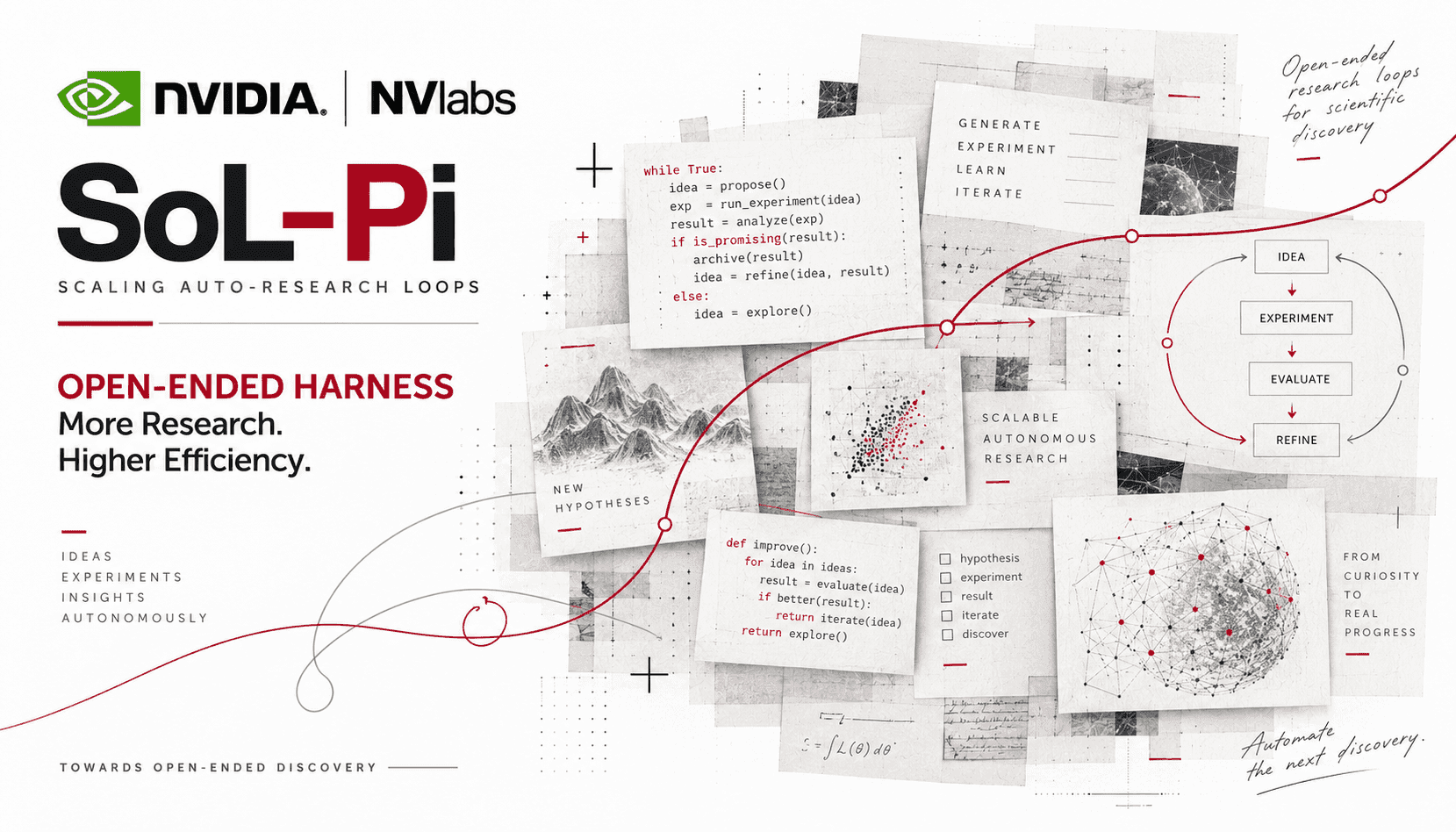
For years, efficiency meant better prompts or larger, more capable models. SoL-Pi flips that emphasis to the scaffolding around the model—the harness that plans tasks, collects observations, calls tools, evaluates outputs, and re-prompts. Its core idea is automation: recursive auto-research loops generate diffs to the harness (e.g., observation filters, planning depth, log policies), then run controlled trials to keep winners. The result is a steady stream of small improvements that compound into material savings. In coding agents, that shows up as fewer turns and less wasted context, with wall-clock speedups and cost cuts—without retraining or swapping the model.
Why does this work? Most agent stacks burn tokens in avoidable ways: repeated system prompts, verbose tool schemas, replayed file diffs, and debug logs that leak into observations. SoL-Pi hunts these patterns with structured probes and ablation tests, then proposes alternatives—delta prompts instead of full-context replays, log sampling and redaction, early-exit checks for trivial cases, adaptive depth for planning and search, and compression of tool I/O. Those optimizations reduce both token volume and step counts, pushing down latency while keeping success rates stable. In practice, the harness becomes the optimization layer you can iterate hourly, not quarterly.
For engineering and product teams, the implication is operational: treat token budget, step budget, and harness policies as first-class SLOs. Add counters for per-step tokens, observation size distributions, and tool-call roundtrips; create canary tasks and shadow evals; and gate rollouts with guardrails on pass@k, regression risk, and human override. The CFO benefit is straightforward—lower unit costs per ticket, PR, or merged change—but reliability also improves, because fewer steps mean fewer ways to drift. The art is finding optimizations that generalize across repositories and task types without overfitting to benchmarks or a single model’s quirks.
SoL-Pi also reframes vendor strategy. Optimization outside the model travels well across providers and versions, extending the life of your current model and buying time to evaluate upgrades on clearer ROI. It pairs cleanly with enterprise constraints—PII scrubbing, policy redaction, and reproducible traces—because many gains come from deciding what not to send. Expect this pattern to spread: harness-level compilers, schema minimizers, and observation planners that sit between agents and tools, tightening feedback loops and making every token count.