

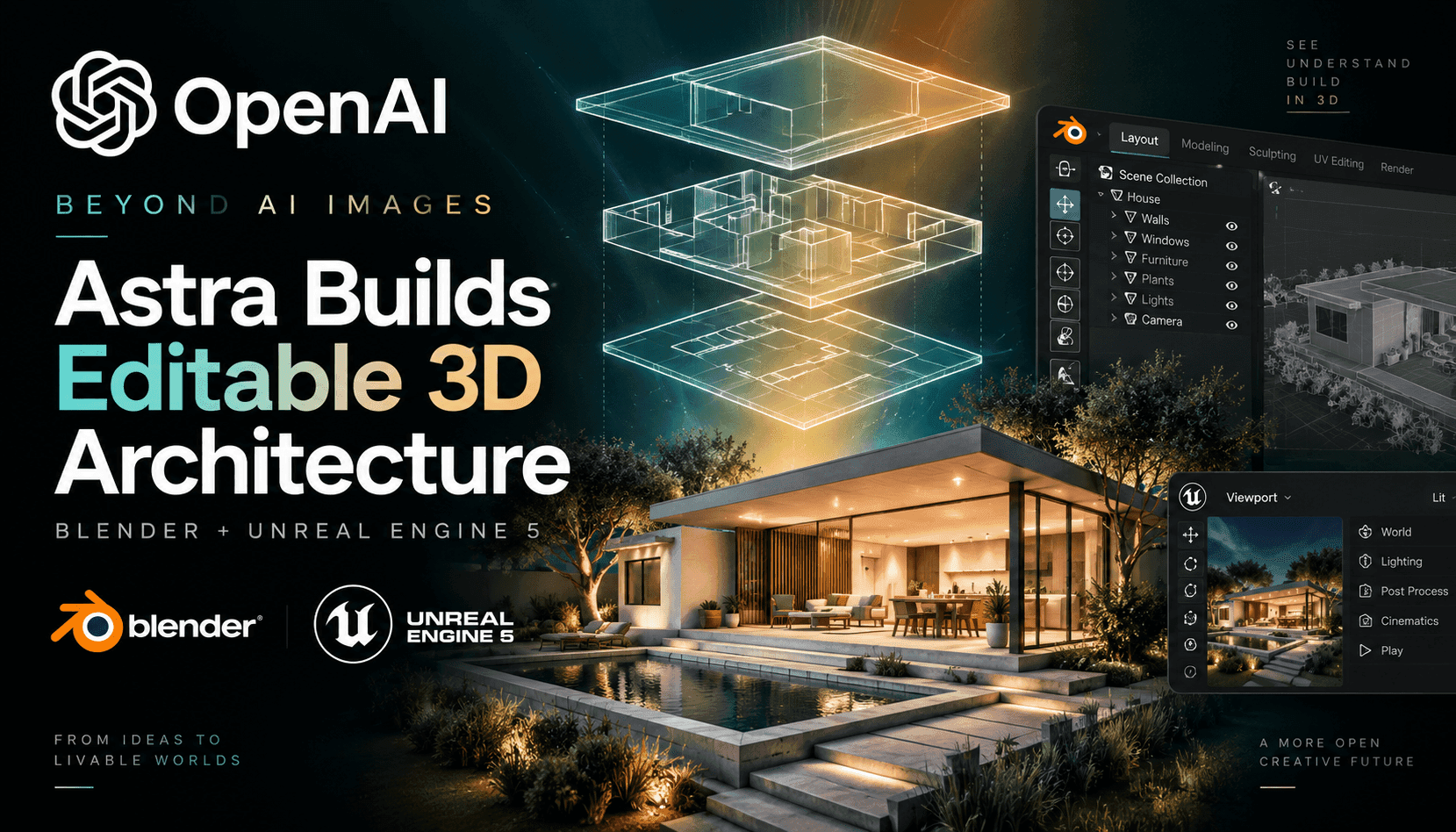
The headline with Astra isn’t another photorealistic image—it’s editable 3D. Instead of producing a single hero render, Astra scripts Blender to build rooms, furniture, materials, lights, and cameras as real, named objects you can inspect, adjust, and reuse. That structural change flips the value proposition: designers get geometry they can iterate on, engineers get a clean handoff into Unreal Engine 5, and marketers get an interactive environment rather than a storyboard. The human still sets the brief and judgment, but an agent can now execute 3D tasks across tools, speeding the loop between concept, cinematic studies, and real-time walkthroughs.
Practically, Astra composes scenes through Blender’s Python API, modeling joinery and furnishings with usable topology, assigning PBR materials, and placing cameras for review shots. It can refine furniture scale, fix mesh normals, standardize UVs, and stage golden-hour lighting without breaking editability. When the concept reads well, the pipeline extends to Unreal Engine 5: assets are organized, exported with naming and material conventions, and assembled for a playable tour. Existing asset libraries slot in—scanned wood textures, vegetation packs, or props—while the agent focuses on layout, composition, and consistency checks that normally consume human time.
For studios, developers, and real estate teams, the implications are immediate. You can run more design options in the same week, keep geometry source-of-truth inside Blender, and ship an interactive experience to stakeholders early enough to steer decisions. Asset reuse improves with disciplined naming, units, and LOD strategies that persist into UE5. The tradeoff is moving from “best single still” to “production-ready scene”: you must validate poly budgets, collision, texel density, and shader counts, and set pass/fail gates for performance. Those guardrails turn Astra from a demo into a dependable part of the 3D pipeline.
Adoption should start with a scoped pilot: one pavilion or a core living space, not an entire campus. Measure success with concrete metrics—tri counts, draw calls, average FPS on target hardware, and edit turnaround time after client changes. Standardize exporters, material templates, and directory structures before scaling to multi-room or multi-building projects. Keep human approvals for spatial planning, code compliance, lighting balance, and art direction. With that discipline, Astra becomes a lever: faster iterations, higher asset reuse, and a credible path from rough idea to cinematic render to an interactive sales or tenant experience.