

NexusAi logo

NexusAi

  • Products
  • Categories
  • Prompts
  • Search
  • AI Insights
  • Pricing
  • Promote
  • Contact
Sign In
NexusAi LogoNexusAi

NexusAI helps you discover, compare, and learn AI tools with ease. From expert insights to training resources, we empower individuals and businesses to harness AI technology for smarter decisions, innovation, and growth.

Useful Links

  • About Us
  • AI Products
  • AI Category
  • AI Prompts
  • AI Search
  • AI Insights

Services & Legal

  • Showcase & Promotion
  • Membership Plans
  • Terms & Conditions
  • Refund Policy
  • Privacy Policy
  • Disclaimer

Contact Us

88 Tribune Street
South Brisbane, QLD, Australia, 4101
Website: www.nexusai-tech.com
Email: info@nexusai-tech.com

© Copyright 2026 NexusAi All Rights Reserved

Developed by DStudio Technology
Home/AI Insight/AI Model & Platform Updates/Reka Releases Edge 2603: A Low-Cost Multimodal Model Built for Edge and Agent Workloads
AI Model & Platform UpdatesAgent Infrastructure

Reka Releases Edge 2603: A Low-Cost Multimodal Model Built for Edge and Agent Workloads

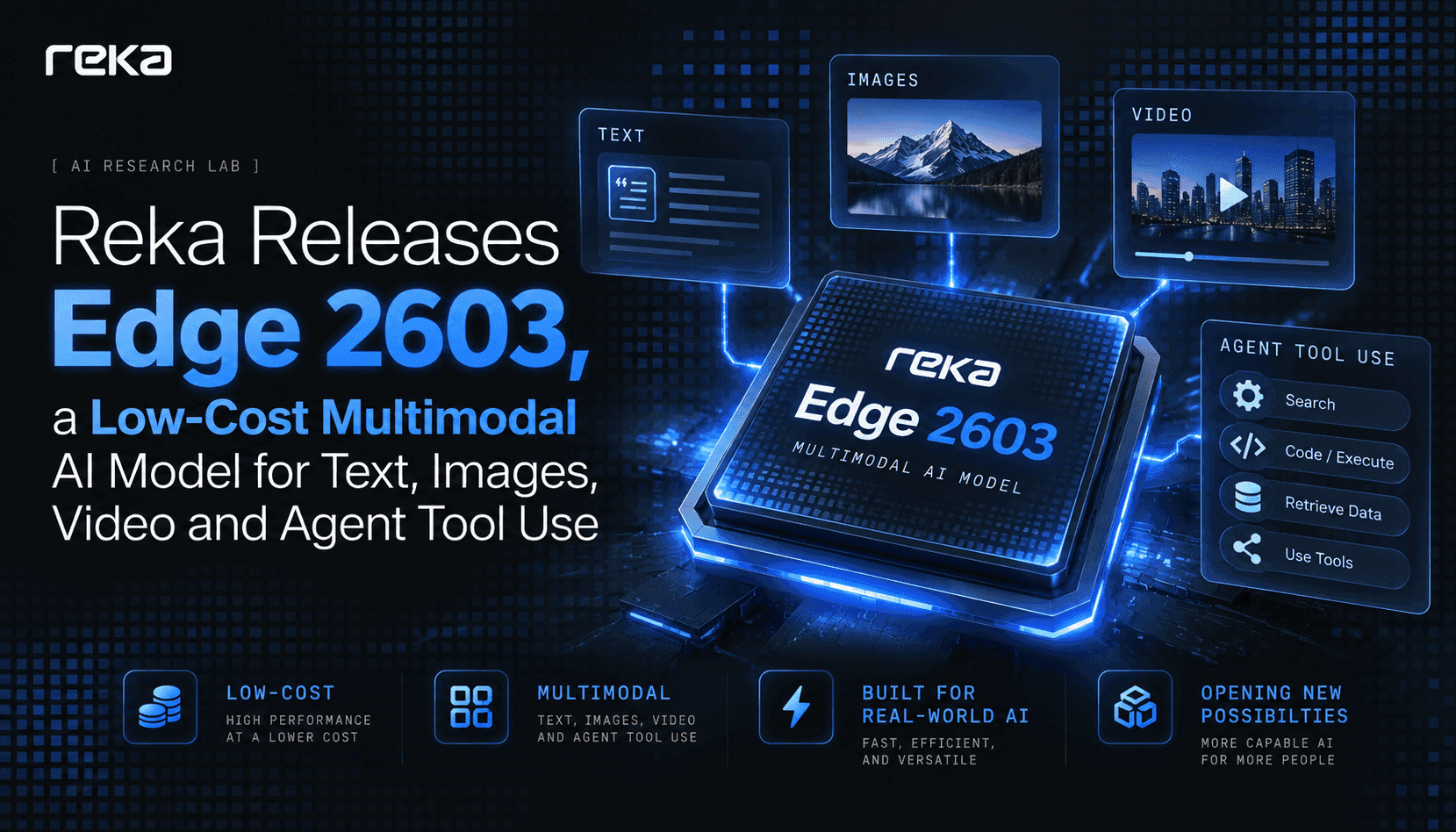
Reka’s Edge 2603 ships as a compact multimodal model for text, image and video inputs with tool calling, structured outputs and streaming. Its micro-priced token rates make it a pragmatic choice for cost-sensitive production — especially teams that need multimodal understanding and agent integration without frontier-scale expense.

NexusAI Editorial DeskOct 11, 20262.9K views6 min read
Reka Releases Edge 2603: A Low-Cost Multimodal Model Built for Edge and Agent Workloads
AI Brief

Reka Edge 2603 is presented as a 16k-context multimodal model tuned for low-cost production: text, image, and video inputs, tool calling, structured outputs, and streaming are supported at token prices intended to be negligible per request. This release targets operators who want agent capabilities and multimedia understanding without routing every call to a frontier model. Read on for an evaluation of model features, the cost-performance calculus, integration patterns for agents and structured outputs, and practical trade-offs — who should adopt Edge 2603, and where it’s best paired with larger models.

Reka’s Edge 2603 positions itself as a pragmatic bridge between capability and cost. Rather than competing purely on raw scale, the model bundles multimodal input support — text, images and video — with agent-oriented features such as tool calling, structured outputs, and streaming. The central sales point is economic: token pricing is intentionally tiny, signaling that Reka expects this model to be used for high-volume or persistent production workloads where each inference needs to be affordable.

From an operational standpoint, Edge 2603’s 16k context window and structured-output features matter. A 16k context supports longer conversations, video transcripts and extended multimodal contexts without frequent prompt chopping, while structured outputs cut integration friction for downstream systems. For teams deploying agents, the model’s tools capability and streaming support make it feasible to implement interactive tool orchestration without expensive orchestration costs — a notable shift from the older pattern of reserving agents for larger, costlier models.

That said, Edge 2603 is not framed as a frontier performer for the hardest reasoning or highest-fidelity generation tasks. Reka’s own catalog differentiates models with varying strengths — flash, larger parameter variants, and models optimized for deep reasoning remain in the lineup. Practically, Edge 2603 is best viewed as a default production model: excellent for retrieval-augmented workflows, vision-assisted classification, lightweight summarization of video, and as an agent coordinator that keeps per-request spend minimal.

For builders and procurement teams, the question becomes how to architect a cost-conscious stack: use Edge 2603 as the high-throughput, low-cost primary model and route a smaller proportion of requests to a larger model for complex reasoning or sensitive outputs. Doing so preserves user experience while dramatically lowering average cost per interaction. The remainder of this piece drills into capability details, integration patterns, cost trade-offs, and practical limitations to guide adoption decisions.

Key Takeaways

Use Edge 2603 as the high-throughput default

Deploy it for routine multimodal ingestion, agent orchestration, and streaming tasks to lower average inference costs while preserving responsiveness.

Combine with escalations to preserve quality

Route complex reasoning, safety-critical outputs, or creative generation to larger models; implement deterministic checks and automated escalation triggers.

Design agent stacks around structured outputs

Leverage structured responses and streaming to simplify downstream integrations, reduce parsing errors, and enable progressive tool execution.

What Edge 2603 Changes

Edge 2603’s combination of multimodal inputs, structured outputs and tool support in a low-price tier changes how teams can budget agent pipelines. Previously, teams bifurcated workloads: cheap unimodal models for trivial tasks and expensive frontier models for anything multimodal or agentic. Reka offers a compact alternative that absorbs most routine multimodal interactions (image labels, short video context, basic tool orchestration) while keeping per-request cost near-zero, which materially alters ROI calculations for scale-oriented applications.

Core Capabilities and Developer UX

Technically, Edge 2603 supports text, image, and video input modalities, a 16k context window, streaming responses, and structured outputs. It honors sampling parameters developers expect (temperature, top_p, max_tokens, etc.) and supports tools. For engineers this means fewer middleware transformations: images and video can be supplied as inputs, structured JSON-like outputs can be requested, and streaming reduces latency for interactive agents. The model’s huggingface ID and readiness flags simplify deployment and testing in existing CI.

Cost and When to Use It

Reka lists essentially negligible per-token pricing for prompt and completion, plus zero-cost image and request tiers in the public catalog sample. That math makes Edge 2603 attractive for call-heavy features: content tagging across large image collections, continuous video indexing, customer-support agents handling media attachments, or background retrieval pipelines. Use it as the primary model for high-throughput paths; allocate a fallback to a higher-capability model for edge cases that require deeper reasoning or higher-fidelity synthesis.

Integration Patterns for Agents and Tooling

Because Edge 2603 supports tools and structured outputs, architects can build agents that coordinate APIs, databases and search without hitting expensive model costs on every step. A recommended pattern: use Edge 2603 for orchestration, extraction, and pre-filtering, and escalate to a stronger model for the final decision or sensitive content generation. Streamed structured outputs simplify progressive execution — the agent can parse interim structured results and call downstream services without waiting for full completion.

Limitations and Risk Considerations

Edge 2603 is not a universal replacement for larger models. Expect limits on complex multi-hop reasoning, the highest-quality creative generation, and nuanced safety filtering without additional guardrails. Teams must invest in validation, monitoring, and fallback routing to detect when outputs need escalation. For regulated domains or tasks with strict accuracy requirements, combine Edge 2603’s throughput economics with policy layers, deterministic post-processing, or human-in-the-loop review.

Frequently Asked Questions

Is Edge 2603 suitable as a single model for production agents?

Edge 2603 is ideal as the primary coordinator in a production agent stack because of its tool support and low cost. However, for edge cases requiring deep reasoning or highly polished generation, you should route to a stronger model. Implement monitoring and automatic escalation rules so the stack can choose the right model per request.

How does the 16k context window affect multimodal workflows?

A 16k context allows longer conversations, richer transcripts and extended multimodal contexts without truncation, which reduces prompt engineering overhead for video and multi-image scenarios. For very long documents or multi-hour video transcripts, chunking and retrieval augmentation will still be necessary, but the larger context reduces round trips and preserves more context locally.

What practical guardrails should teams add when deploying Edge 2603?

Add deterministic content filters, output schema validation for structured responses, fallback escalation to a higher-capability model for low-confidence outputs, and analytics that track quality by use case. For regulated or safety-sensitive applications, include human review or automated checks before finalizing decisions.

#low-cost-models#API Token Pricing#Multimodal Video#Multimodal Reasoning#Tool Calling#Structured Outputs#Multimodal Agents#Streaming Tokens#Developer Cost Optimization#Cost per Million Tokens#inference cost management#Model Hosting APIs#reka-edge#multimodal-edge-model#edge-ai-costing#Agent Orchestration#structured-output-workflows

AI Insight Newsletter

Get the latest AI updates, tool news, and insights delivered to your inbox.

No spam. Unsubscribe anytime.
On This Page
1.What Edge 2603 Changes2.Core Capabilities and Developer UX3.Cost and When to Use It4.Integration Patterns for Agents and Tooling5.Limitations and Risk Considerations
Share this article

Related Articles

ServiceNow’s AI Passport: A Runtime Authority Layer for Enterprise Agents
AI Product News

ServiceNow’s AI Passport: A Runtime Authority Layer for Enterprise Agents

Oct 17, 2026

Google’s Verifiably Private FL for Gboard: How TEEs, Transparency Logs and DP Fit Together
AI Model & Platform Updates

Google’s Verifiably Private FL for Gboard: How TEEs, Transparency Logs and DP Fit Together

Oct 5, 2026

MorningAI’s Multi-Model Agents Add GPT-6 Sol, GPT-6 Luna, Claude Opus 5.5, and Grok 4.7—with Sanity CMS Publishing Built In
AI Product News

MorningAI’s Multi-Model Agents Add GPT-6 Sol, GPT-6 Luna, Claude Opus 5.5, and Grok 4.7—with Sanity CMS Publishing Built In

Sep 28, 2026

Alibaba’s AgentCore Unifies Multi-Model Agents with MCP Tools and Enterprise Governance
AI Product News

Alibaba’s AgentCore Unifies Multi-Model Agents with MCP Tools and Enterprise Governance

Sep 27, 2026

Genesis AI’s Eno Picks Wheels Over Legs for a General‑Purpose Physical Agent
AI Product News

Genesis AI’s Eno Picks Wheels Over Legs for a General‑Purpose Physical Agent

Sep 25, 2026

Related AI Tools

View All
Reka Omni Models and Real Time Cloud for Physical AI

Reka Omni Models and Real Time Cloud for Physical AI

Robotics & Physical AI