

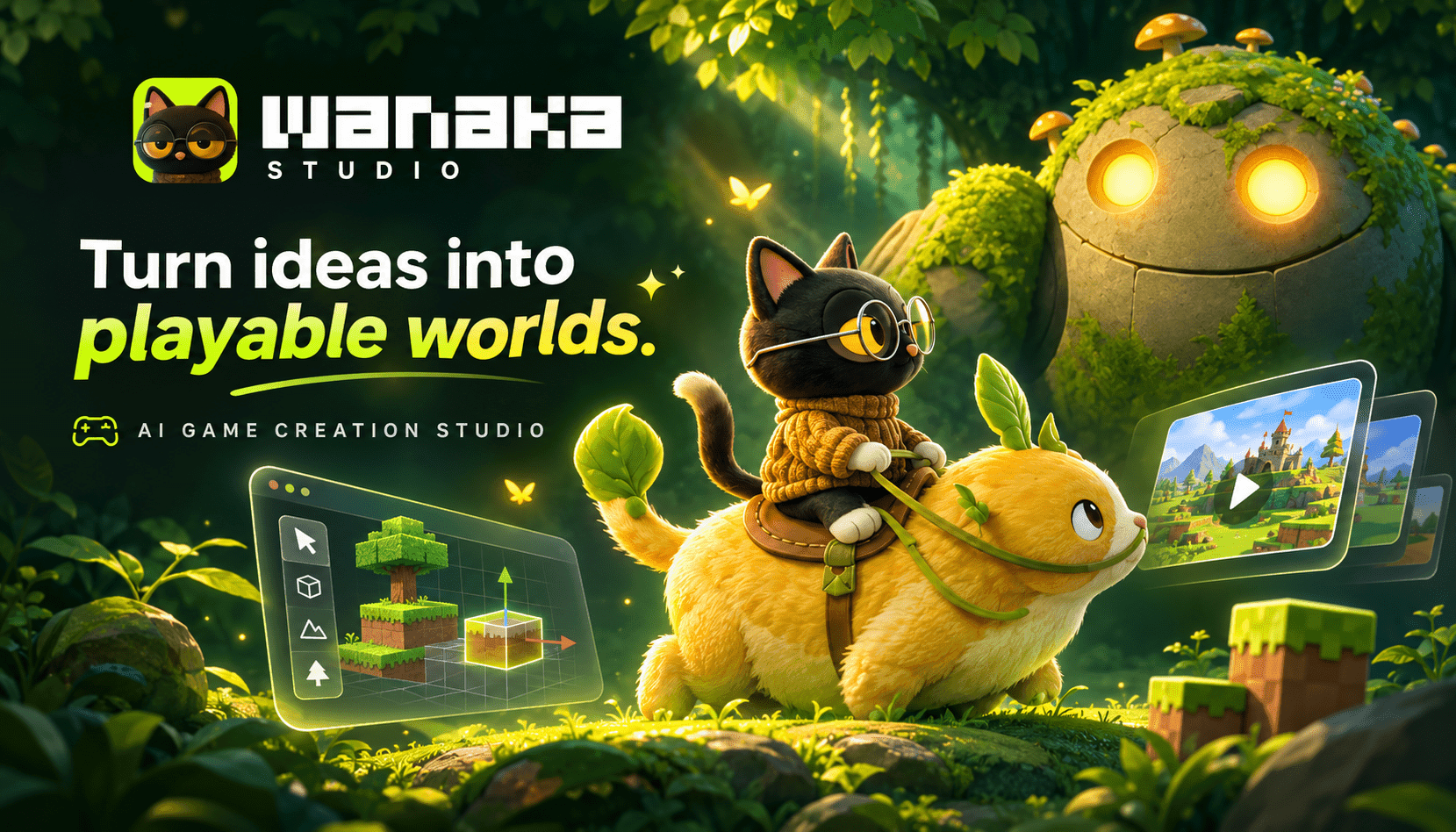
Wanaka Studio positions itself as an AI-native game engine: you describe a game in plain language and the platform scaffolds environments, characters, animations, gameplay rules and a browser-playable build. That promise matters because it reframes where intelligence sits. Instead of a traditional engine that expects humans to assemble assets and write logic, Wanaka treats AI as the primary author of both content and orchestration, leaving the human to steer, edit and refine the output.
This is not merely a copilot bolted onto Unity or Unreal. Copilots augment human workflows inside an existing asset-and-code-first architecture; they suggest code, textures, or procedural rules while assuming the developer manages scenes, dependencies and build pipelines. An AI-native engine reconceives core abstractions — scene templates, behavior primitives and publishing targets — so natural language drives the canonical representation. That difference changes failure modes, governance needs and where product value accrues.
For creators, benefits are real but bounded. Solo designers, hobbyists, educators and small studios gain the fastest lift: they can prototype concepts, iterate without deep technical debt, and ship browser links for playtests quickly. Professional studios will still rely on targeted pipelines for performance, IP control and complex multiplayer systems. The practical question is how reliably generative systems coordinate collision logic, state persistence, multiplayer sync, and platform packaging without producing brittle, unmaintainable projects.
Adopting Wanaka or similar platforms requires new evaluation criteria: fidelity and determinism of generated gameplay, editability of AI-produced assets, debugging tools that map natural-language intents to executable logic, and the legal clarity of generated assets. For decision-makers, the key is assessing whether the platform’s abstractions align with product requirements — whether the engine can export standards-friendly artifacts or lock teams into an opaque, single-vendor representation.