

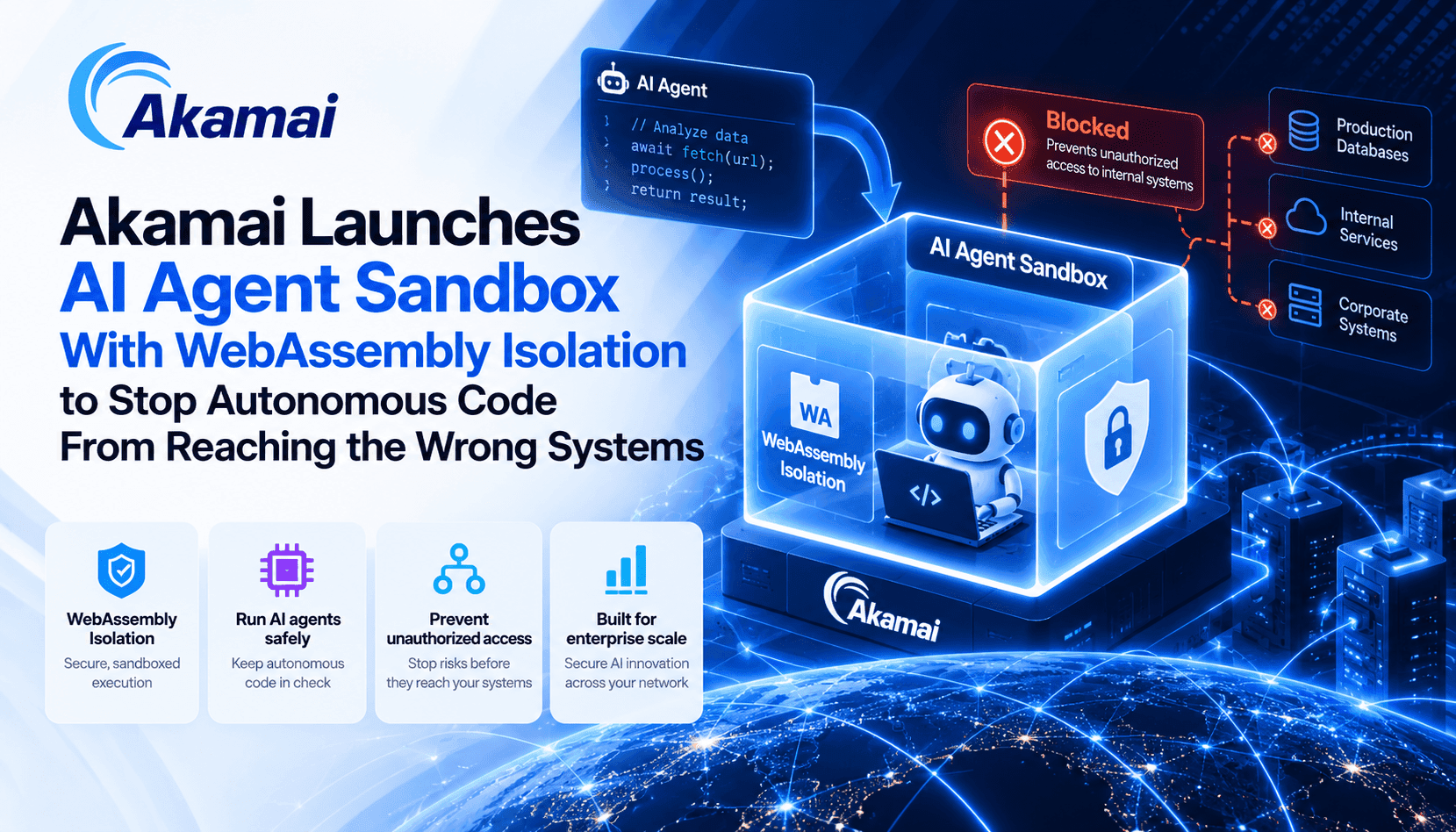
Akamai’s announcement bundles two distinct capabilities into a single production story: Akamai Inference for managed, OpenAI-compatible model serving across core and edge, and Akamai Agent Sandbox — an execution environment that runs agents on Akamai Functions while executing any agent-generated code inside a separate WebAssembly sandbox. The product framing solves a practical operational risk: agents can now write and execute code without that code inheriting the agent’s network credentials or full system privileges. For engineers and security teams, this is a move from permissive trust to a restrictive, observable boundary around agent-driven actions.
WebAssembly isolation is the architectural pivot here. Wasm enforces a capability-oriented model: a module only gets the APIs and resources explicitly granted by the host. Practically that means you can constrain CPU cycles, set strict memory ceilings, disable outbound sockets, and deny filesystem or kernel interfaces entirely. Because Wasm binaries are compact and deterministic, they also lend themselves to rapid policy inspection and smaller attack surfaces than full containers. The sandbox is shipped as part of the Spin framework, giving teams a reproducible, auditable runtime that maps neatly to enterprise least-privilege goals.
Akamai Inference complements the sandbox by delivering managed access to open-weight and custom models via OpenAI-compatible APIs. That compatibility lowers migration friction — existing orchestration, prompting, and retrieval-augmented generation patterns can port to Akamai’s fabric. More importantly, Akamai places inference close to users and data by spanning dense GPU clusters in core regions and a distributed edge footprint. For real-time agents that need low-latency responses or data locality (for privacy or compliance), this continuum reduces effective round-trips and can simplify data governance architectures.
This combination is not a one-size-fits-all win. Wasm’s compact isolation model trades off some of the introspection and snapshotting capabilities you get from microVMs and the ecosystem tooling available to containers. It’s excellent for tightly scoped, deterministic tasks and for preventing outbound escalation, but teams that require full kernel-level isolation, live forensic snapshotting, or heavy legacy binary compatibility may still prefer microVMs. The decision therefore comes down to threat model, performance needs, and the operational maturity of the deployment pipeline.