The 10 Best AI Automation Business Tools in 2026: Zapier, Make, n8n, Copilot Studio, Agentforce and More
Choosing an AI automation platform is about the business you want to build: rapid client delivery, deep custom logic, enterprise governance, RPA-heavy ops, CRM-first automation, agent interfaces, or open/private agents. This guide maps leading tools to those outcomes—and shows how to buy, govern, and scale them.
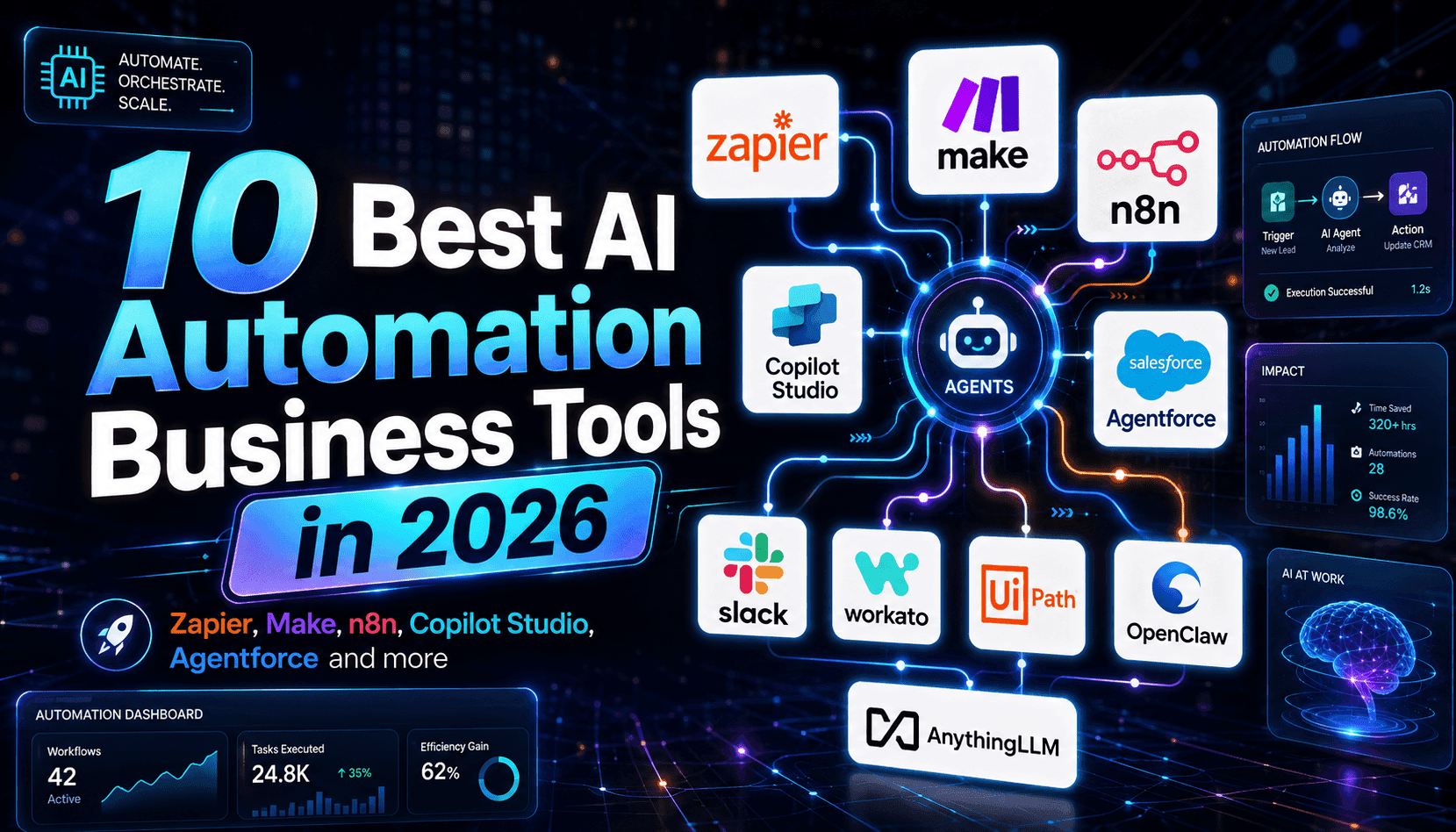
AI BriefIn 2026, the best AI automation stack depends on your operating model. Zapier and Make win for fast client delivery; n8n and Pipedream for code-level control; Microsoft Copilot Studio and Workato for governed enterprise rollouts; UiPath for RPA-heavy processes; Salesforce (Flow/Agentforce) for CRM-first automation; Slack for agent interaction; and OpenClaw/AnythingLLM for open or private agents. Pricing has also shifted to blended ops/credits/activity meters that change where costs land. The practical move is to pick by outcome, not brand: define governance needs, data boundaries, and who will build/maintain agents. Then model costs under realistic usage and design human-in-the-loop controls from day one.
Most teams still evaluate automation by connector counts and templates. That’s a mistake in the agent era. The decisive question is whether you need an AI step inside a fixed workflow, or an agent that decides what to do next. The first favors familiar no‑code canvases; the second demands reasoning, tool use, memory, and governance. Your tool should reflect your operating model and risk posture more than its logo or marketplace size.
If you sell implementation packages or run an agency, speed to deployment and predictable costs dominate—Zapier and Make fit. If you’re engineering-led or need data residency and custom logic, n8n or Pipedream will outlast trend cycles. Enterprises prioritizing audit trails, SSO, DLP, and approval gates lean toward Microsoft Copilot Studio/Power Automate or Workato, while RPA-heavy back offices benefit from UiPath’s desktop and legacy system reach. CRM‑centric teams maximize Salesforce with Flow and Agentforce.
Agent interfaces now matter as much as back-end orchestration. Slack remains the most natural hub for human‑agent collaboration and approvals. For privacy-sensitive or sovereign setups, open or self-hosted agent systems like OpenClaw, AnythingLLM, or n8n let you control models, memory, and telemetry. Whatever you choose, model spend under real workloads—ops, tasks, credits, or activities—and design a human-in-the-loop checkpoint where the business risk is highest.
Key Takeaways
Pick by Operating Model, Not Brand
Match tools to outcomes: speed (Zapier, Make), code control (n8n, Pipedream), enterprise governance (Copilot Studio, Workato), RPA depth (UiPath), CRM‑first (Salesforce), agent UX (Slack), and private agents (OpenClaw/AnythingLLM).
Governance Is Architecture
Design approvals, scopes, and audit trails up front. Constrain agent tools to least privilege, route risky steps through Slack, and maintain environment separation with a clear kill switch.
Model Realistic Costs
Budget with peak‑week workloads across ops, credits, and activities. Separate agent spend from baseline automations and factor in debugging, observability, and review time.
Start With the Business You’re Building
Define the job before the tool. If you deliver client automations on tight timelines, you need breadth of connectors, natural‑language building, and a fast review loop—Zapier or Make. If your differentiator is custom logic and data control, prioritize code, testing, and self‑hosting—n8n or Pipedream. If your risk committee cares about data boundaries and traceability, governance-first suites—Microsoft Copilot Studio/Power Automate or Workato—shorten approvals and audits.
Map to operating zones: RPA‑heavy back office (UiPath), CRM‑first lifecycle (Salesforce Flow and Agentforce), team chat orchestration (Slack), or open/private agents (OpenClaw, AnythingLLM, n8n self‑hosted). Decide who builds and maintains agents—ops generalists vs. engineers—because that single choice often settles the platform debate more than features do.
Tool Picks by Outcome and Team Type
Fast client delivery: Zapier and Make provide huge app coverage and visual building; add AI steps or bundled agents to accelerate handoffs. Technical/custom workflows: n8n (self‑hosted or cloud) and Pipedream give JavaScript/Node control, LangChain-style primitives, and versioning discipline. Enterprise deployments: Microsoft Copilot Studio/Power Automate and Workato bring audit trails, environment separation, SSO, DLP, and centralized governance for agent actions.
RPA‑heavy processes: UiPath and Power Automate Desktop bridge legacy UIs, Citrix, and mainframes. CRM automation: Salesforce Flow plus Agentforce centralize lead, case, and revenue ops with native records and permissions. Agent interaction: Slack is where humans approve, escalate, and correct agents in real time. Open/private agents: OpenClaw and AnythingLLM, or n8n with your own models and vector stores, keep data in your tenancy and reduce vendor lock‑in.
Governance, Risk, and Data Boundaries
Agent autonomy changes your threat model: an AI can click the wrong button faster than any human. Treat approvals, scopes, and audit logs as architecture, not add‑ons. Enterprise suites (Copilot Studio, Workato) provide native approval gates, environment separation, and action-level logging. No‑code tools can be made safer by routing high‑risk steps through Slack approvals and constraining agent tools to least privilege.
For regulated or privacy‑sensitive teams, minimize external data egress. Prefer self‑hosted or private‑network execution where feasible (n8n, open agents), and isolate model memory by business domain. Maintain a kill switch per agent, per environment, and implement run budgets to cap blast radius. Document what an agent may do, with which credentials, and who reviews outcomes.
Cost Models and Hidden Friction
Vendors now blend task/ops, credit, and activity meters. Ops-based pricing scales well for high‑volume, simple automations; activity or credit meters spike under autonomous browsing, long tool chains, or retrieval runs. Separate agent costs from baseline automation so a single heavy agent does not distort your entire bill. Model peak weeks, not just averages, and include observability, retries, and human‑review time.
Hidden costs appear in debugging and governance. Engineering time to stabilize brittle web automations can dwarf license fees. Over‑permissive scopes create downstream remediation work. Counter with: standardized agent templates, tool whitelists, explicit input/output schemas, and a weekly triage ritual to prune failing paths. Buy the observability you’ll actually use; silent failures are the most expensive failures.
Implementation Playbook: 30/60/90 Days
Day 0–30: Inventory processes by risk and ROI; pick one low‑risk, measurable workflow per department. Establish data boundaries, tool scopes, and Slack approvals. Stand up telemetry: run IDs, tool calls, latency, and human‑approval timestamps. Define success metrics: hours saved, response latency, error rate, and business conversion impact where applicable.
Day 31–60: Harden agents with guardrails (schemas, validators, test suites). Expand to adjacent workflows. Introduce change management: versioned agents, release notes, and rollback. Day 61–90: Scale what works; move higher‑risk steps behind approvals; negotiate enterprise features (SSO, SCIM, audit exports). Revisit pricing under observed usage, and lock in a cost ceiling with action budgets.
Frequently Asked Questions
When should a team choose n8n over Zapier or Make?
Choose n8n when you need code‑level control, self‑hosting, or custom logic that outgrows no‑code patterns: nonstandard APIs, complex branching, custom parsers, or data residency. If your builders are engineers and you expect to version, test, and self‑monitor agents, n8n’s flexibility outlasts template speed.
How do Copilot Studio and Workato differ for enterprise governance?
Both centralize governance, but Copilot Studio fits Microsoft‑standardized orgs with native M365 data and identity, while Workato offers broad iPaaS reach with fine‑grained audit, approvals, and recipe governance across mixed SaaS estates. Pick the stack that matches your identity, data, and audit export needs.
What’s a sensible first agent use case in CRM or support?
Start with low‑risk, high‑volume triage: classify inbound leads or support tickets, enrich records, draft next actions, and route for human approval in Slack. This delivers measurable latency and quality gains without letting an agent take irreversible actions on day one.