
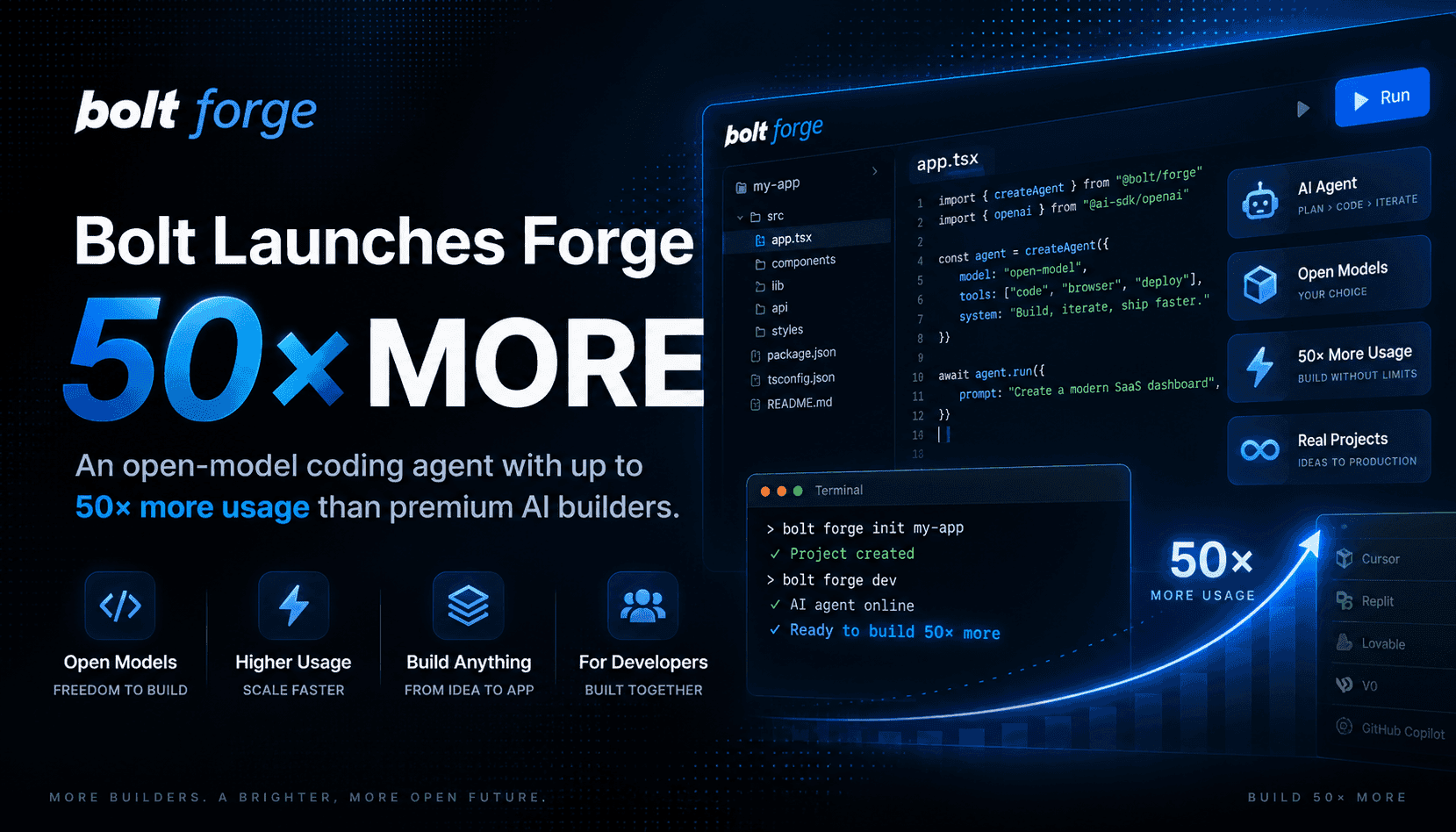
Forge reframes the app-building calculus inside Bolt: it is an agent that runs only open models—GLM 5.3 Flash by default, GLM 5.3 alongside it, plus experimental Kimi K3 and DeepSeek v4 Pro—delivering up to 50× more usage for individual Pro plans during launch. In Bolt’s Build Index, these models collectively score 92.2 versus 101 for a leading paid model, a roughly nine‑point performance trade. The bet is that the drafting phase is starved by token economics, not talent. With Forge, you brainstorm, scaffold, and fix more without daily caps, then switch back to Standard or Max for production polish when every output must land on the first try.
The economics behind Forge are as important as the models. AI inference costs have fallen dramatically, and Bolt pairs reserved capacity with WebContainers to remove per-request markups and server sprawl. That structure supports a single monthly usage bar with a hard stop at 100%—no daily throttle, no surprise overage. For small businesses and solo builders, this creates room to explore architectures, test integrations, and iterate UI flows that previously consumed premium credits. It’s a practical separation of concerns: spend open-model allocation on divergent thinking and code churn; save paid-model credits for convergent tasks, quality gating, and latency-critical user flows.
Forge is intentionally positioned as experimental. Projects should be duplicated before switching, and complex production workloads should remain on Standard or Max. Model choice matters: Kimi K3 and DeepSeek v4 Pro can burn allocation faster than the GLM pair, so start on defaults and escalate selectively for reasoning or code repair bursts. Current constraints include no PDF uploads and the usual open-model variability under heavy refactor loops. Even with those limits, the value is compelling for scaffolding dashboards, wiring CRUD endpoints, or running fast fix–test cycles where the dominant cost is iteration time, not single-shot answer quality.
Governance is explicit. Training occurs only when you opt in on entry to Forge; secrets and personal identifiers are stripped before data exits Bolt’s infrastructure, and Teams/Enterprise workspaces are excluded. Shared sessions fuel open-weight training via Arcee AI, with weights published. That creates a flywheel: builders get generous drafting capacity today, and the models they help improve remain inspectable and portable tomorrow. For technical buyers, the evaluation lens is two-fold—unit economics that reward experimentation, and a data policy that is visible at the moment of choice rather than buried in a one-time terms acceptance.