

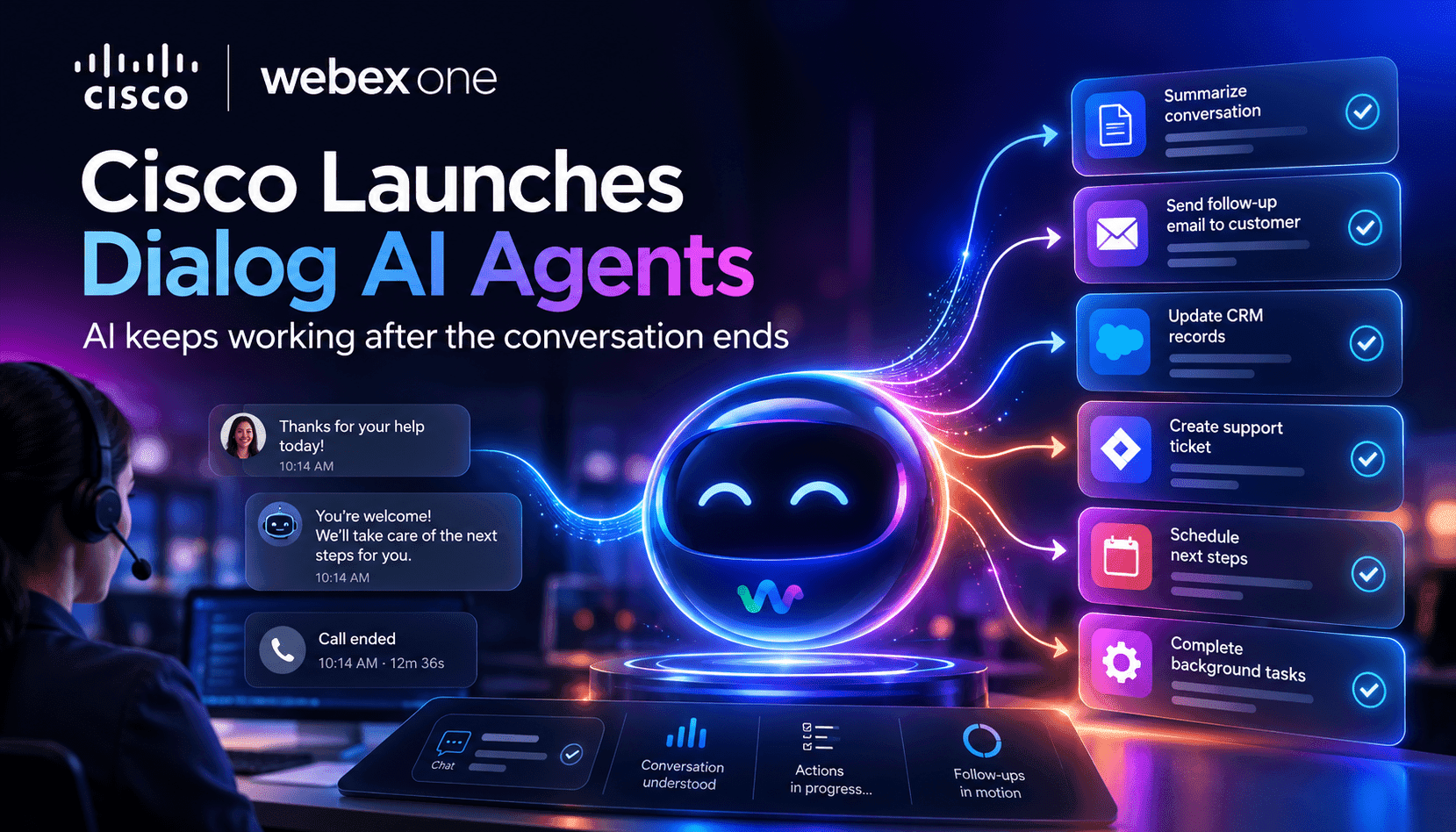
Cisco’s Webex Dialog reframes customer interactions: instead of treating each session as a single, throwaway exchange, Dialog agents are designed to continue working after a conversation ends. They can hold relationship-level context, trigger follow-up actions, and coordinate across people, backend systems, and other agents until an outcome is reached. That shift matters because resolution and customer satisfaction increasingly depend on multi-step work — scheduling technicians, processing refunds, or reconciling system states — which conventional chatbots struggle to complete autonomously.
Technically, Dialog blends persistent context stores, orchestrated agent behaviors, and enterprise connectors. Context is unified from prior history, CRM records and the live conversation, then surfaced to managed agents that can take sequenced actions. Cisco emphasizes long-horizon execution — agents keep working after a user leaves — plus telemetry and policy controls via Cisco AI Defense and Splunk observability. For developers and platform teams this means integrating identity, consent, and system APIs so agents can safely act across ticketing, scheduling, billing, and knowledge systems.
Operationally, Dialog’s promise is threefold: fewer dropped tasks, faster mean time to resolution, and less human context-switching. Human agents are freed from manual handoffs; digital agents can queue work, solicit approvals, and notify customers when actions complete. That changes staffing models — shifting supervisors from triage to exception handling — and creates new metrics: agent handoff frequency, task completion latency, and relationship-level health over time. For product leaders, the imperative is to redesign workflows for continuous agents rather than retrofitting ephemeral chatbots.
Adopting Dialog requires pragmatic ops planning. Start with narrow, high-value use cases (billing corrections, appointment orchestration, replacement logistics) where the agent can safely execute repeatable steps. Establish explicit policies for escalation, approval gates, and data access. Instrument every agented step with telemetry so teams can audit actions, replay decisions, and retrain behaviors. Importantly, build clear customer-visible signals so users know an agent is working on their behalf and what to expect next.
The wider implication is strategic: Dialog nudges enterprises from interaction engineering to relationship engineering. Companies that pair persistent agent capabilities with governance and observability can reduce friction and scale complex service experiences. But success depends on operational discipline — controlled onboarding, robust connector hygiene, and meaningful human-in-the-loop practices — otherwise persistent agents risk creating automation debt or customer confusion.