

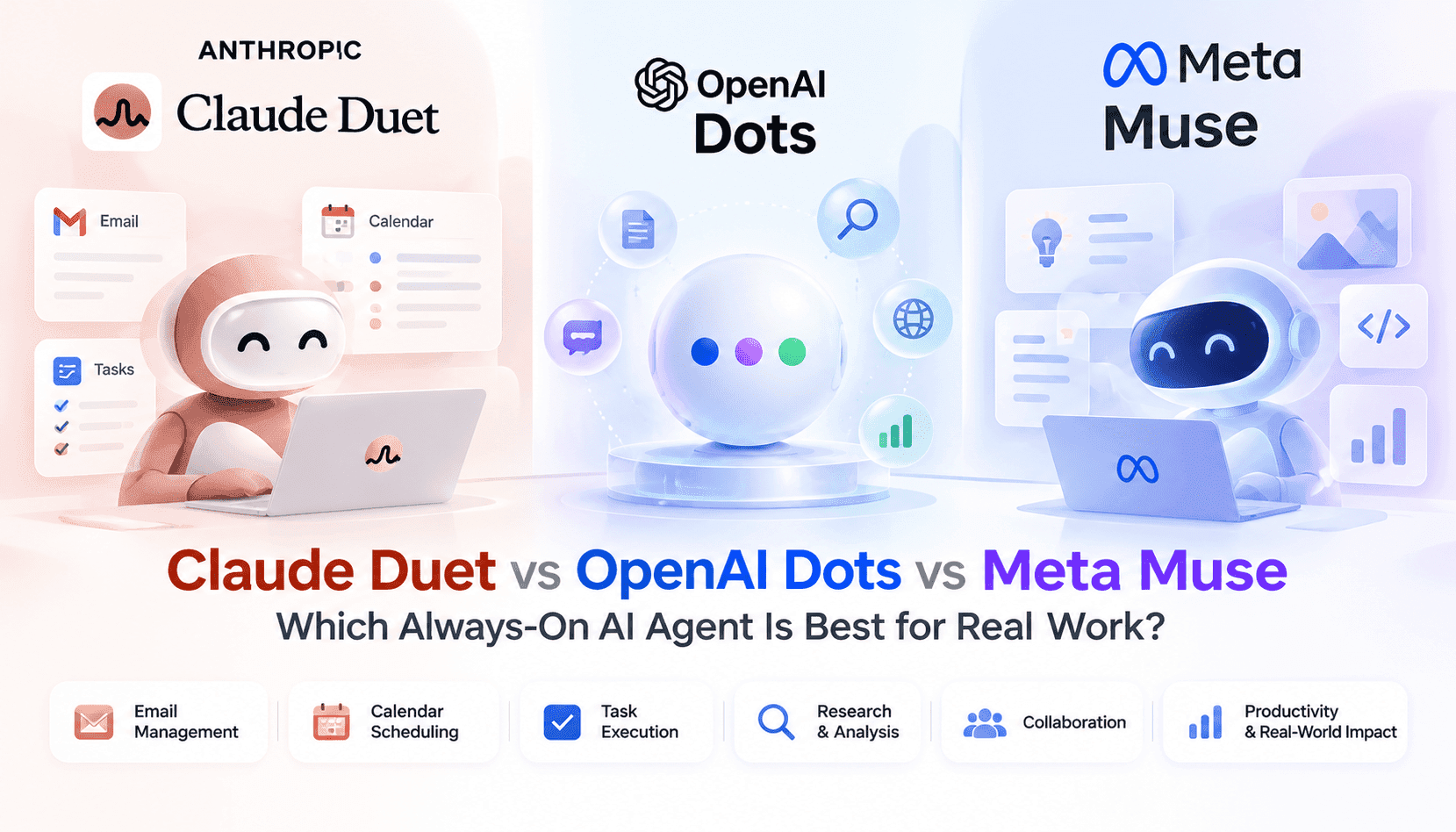
Always‑on agents mark a step change from ephemeral prompt assistants: they maintain ongoing context, act in the background, and surface work without a fresh command each time. For founders and small teams that means less triage time and more continuous execution — inbox triage that learns your priorities, meeting prep that pulls the latest documents, and follow‑ups triggered automatically after calls. But the details matter: the degree of autonomy, how memory is stored, app-level access, and the approval UX determine whether these agents save time or create new operational risks.
Claude Duet, OpenAI Dots and Meta Muse take divergent design paths. Anthropic emphasizes conservative autonomy with granular approvals and scoped memory, OpenAI leans toward proactive task execution tied to deep platform integrations, and Meta positions Muse as an ambient collaborator strongly integrated with its utility stack. For practical work—managing an inbox, preparing investor decks, running research tasks—these differences change who can benefit today: power users who tolerate fine‑grained settings, teams that prioritize speed and integration, or privacy‑sensitive businesses that need on‑device or limited retention.
This article evaluates each agent across seven applied axes: persistent context and memory model, background work and scheduling, email/calendar awareness, application connectors and cloud compute access, proactive recommendations, approval and escalation flows, and privacy and auditability. For each axis it highlights concrete implications for founders, operators and small businesses. The goal is to move beyond marketing claims and show where these agents can actually reduce friction today, and where waiting remains prudent.
The guidance is practical: adopt an always‑on agent for routine, repetitive workflows you trust to automation—like flagged inbox triage, templated follow‑ups and meeting summarization—if the agent offers clear audit trails and reversible actions. Defer widescale deployment for high‑risk tasks that require confidential judgement, broad external access, or regulatory recordkeeping until richer admin controls, per‑action approvals and transparent memory controls are standard across vendors.